
Best Google Ads Agency for SaaS: CAC, LTV & Revenue Growth
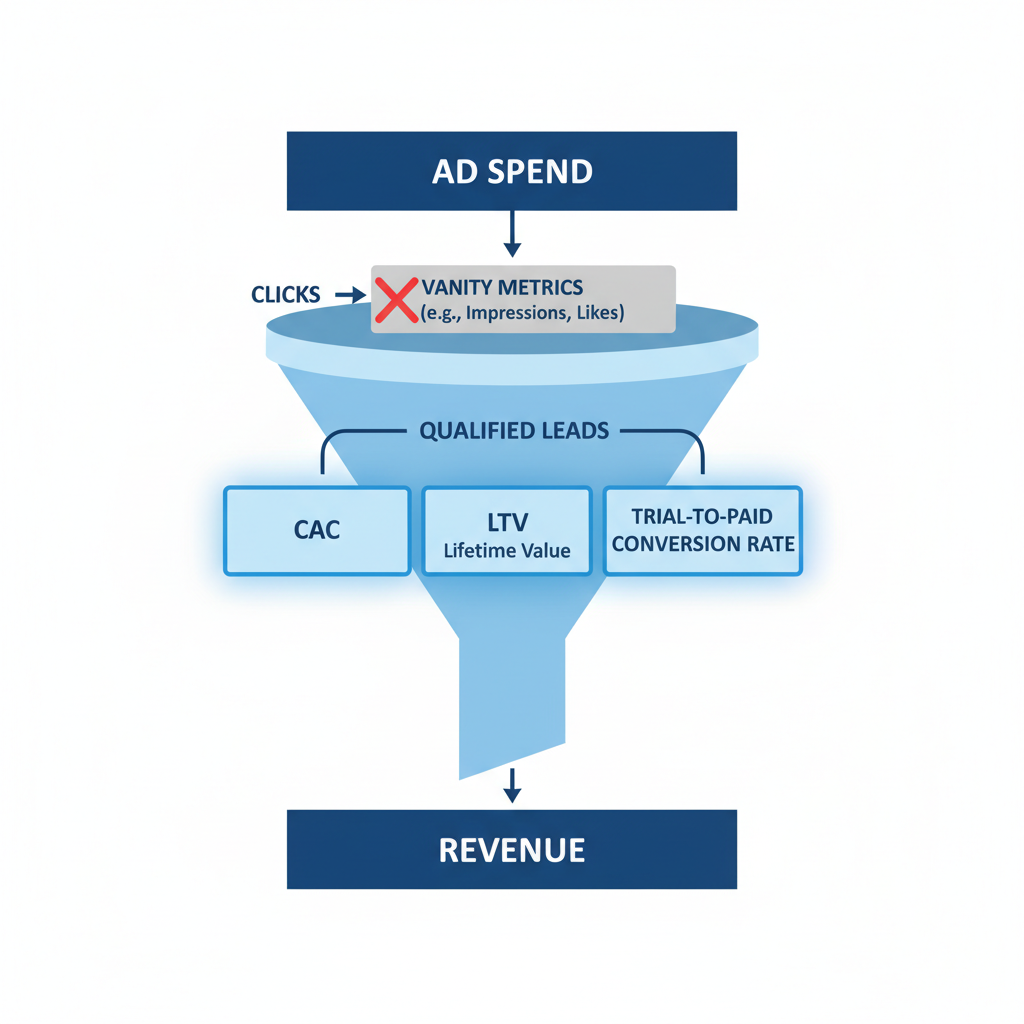
The best Google Ads agency for your SaaS is the one that optimizes for revenue metrics like Customer Acquisition Cost (CAC), Lifetime Value (LTV), and trial-to-paid conversion rates, not clicks or impression volume. If your agency focuses on vanity metrics, you are paying for traffic that may never become a paying subscriber.
Key takeaways
- Define the best agency by CAC payback, LTV to CAC, trial-to-paid conversion, and MRR impact.
- Look for SaaS funnel expertise, reliable attribution, CRO support, and transparent reporting.
- Choose a pricing model that aligns the agency with profitable growth, not bigger ad spend.
- Run a paid audit or pilot before signing a long-term contract.
- Connect paid acquisition with follow-up, content, and community outreach so more leads become customers.
Direct Answer: The Best Google Ads Agency for SaaS Focuses on Revenue, Not Clicks
The best Google Ads agency for a SaaS business is a specialist partner that can connect ad spend to profitable subscription growth. It should optimize for CAC, LTV, CAC payback period, trial-to-paid conversion, qualified pipeline, and MRR.
Clicks and cost per click still matter. They are diagnostic metrics, not the finish line. A campaign with a low CPC can still produce expensive customers if the landing page, onboarding flow, or sales process fails.
The right agency maps the journey from first click to subscription upgrade. It connects ad creative, search terms, landing pages, CRM data, billing data, and product events. Then it makes decisions based on which campaigns create customers who stay.
Use this simple definition of “best”: the agency that helps you acquire customers at a CAC your business can afford, with an LTV that supports sustainable growth. Ask every candidate how they have reduced CAC, improved trial-to-paid conversion, or shortened CAC payback for SaaS clients. If they can only discuss impressions and leads, keep looking.
Top Google Ads agency types for SaaS
- Full-service performance agency: Manages search, Performance Max, YouTube, display, landing pages, analytics, and reporting. Best when you need broad support.
- Niche SaaS specialist: Focuses on subscription funnels, free trials, demos, product-led growth, and B2B buying cycles. Best when funnel complexity is your main challenge.
- Performance-based agency: Ties part of its fee to qualified leads, demos, or agreed revenue outcomes. Best when attribution is mature and conversion definitions are precise.
- Hybrid growth partner: Combines paid media with CRO, lifecycle marketing, content, or sales enablement. Best when ads are only one part of your growth bottleneck.
5 Non-Negotiables in a High-Performing Google Ads Agency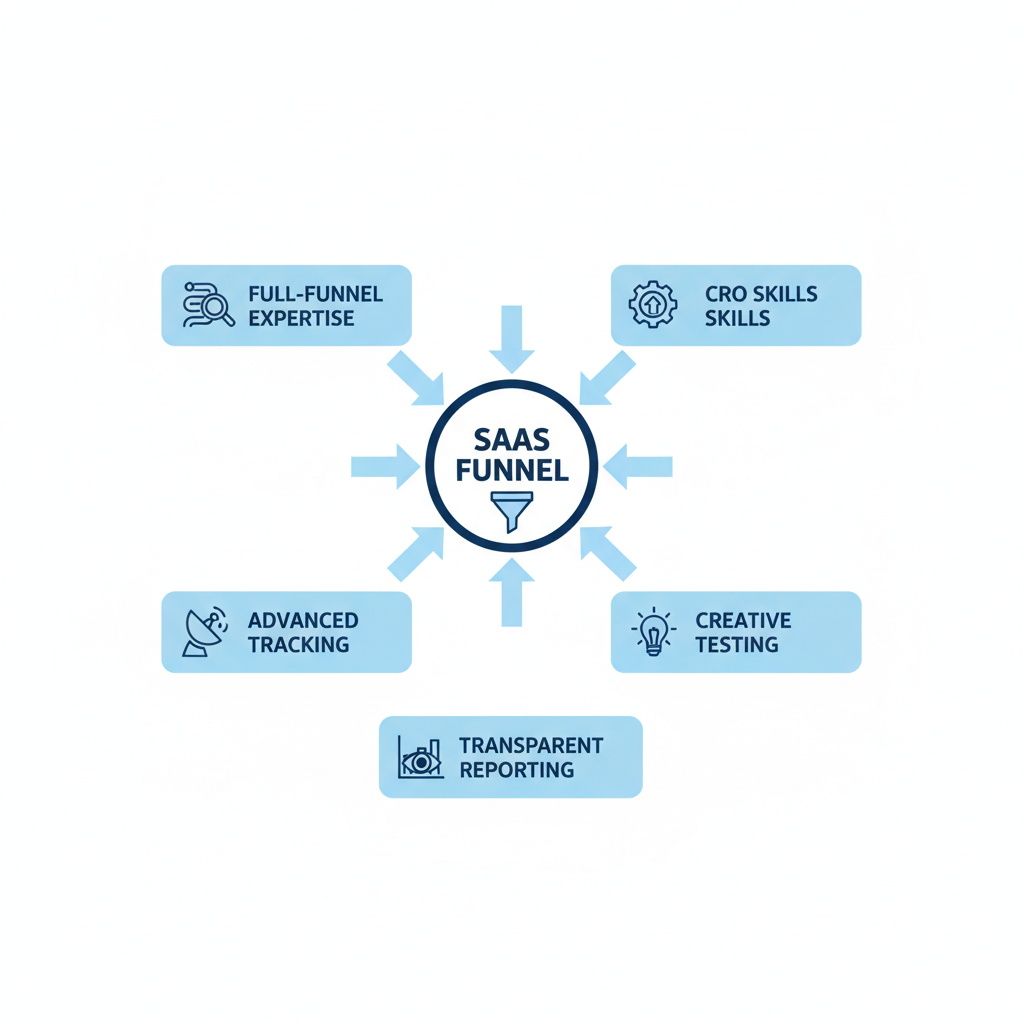
Not every paid media partner can handle the complexity of a SaaS funnel. Verify these five capabilities before signing a contract.
1. Full-funnel expertise across search, display, YouTube, and Performance Max
Your agency should know how to capture demand at every stage. Search can reach people with immediate intent. YouTube and display can build awareness. Remarketing can bring interested visitors back when they are ready to evaluate your product.
Ask: How will you divide budget between high-intent acquisition and assisted conversions? The answer should reflect your sales cycle, audience size, brand demand, and CAC targets. A Performance Max strategy should also use reliable conversion signals, not just automated optimisation toward cheap actions.
This matters because SaaS buyers often need multiple interactions before they start a trial or book a demo. Full-funnel planning helps you measure those interactions without losing sight of the final subscription.
2. Landing page CRO skills that improve conversion rates beyond the click
Driving traffic to a weak landing page wastes ad spend. Your agency should either have conversion rate optimization expertise in-house or work closely with your product and growth teams.
Ask: What would you test first on our landing pages? Strong answers usually cover the headline, product positioning, proof, offer clarity, call to action, form length, and mobile experience. For a SaaS product, the page should also set accurate expectations about the trial, demo, pricing, and onboarding process.
A small improvement in trial signup or demo conversion can lower CAC without increasing your media budget. The agency should model that relationship instead of treating the landing page as someone else’s problem.
3. Advanced tracking and attribution setup
Basic Google Ads conversion tracking is not enough for most SaaS companies. You need a clear event structure for visits, signups, qualified leads, demos, activated users, paid conversions, and revenue.
Ask: Can you implement GA4 events, server-side tagging, consent modes, and offline conversion imports from our CRM or billing system? The agency should explain how it will connect a click to a qualified opportunity or paying customer.
This matters because optimizing for form fills can push the account toward low-quality leads. Importing downstream conversion data gives Google Ads better signals and gives you a more credible view of CAC and LTV.
4. Proactive creative testing and iteration
Ad fatigue is real. Your agency should maintain a testing calendar for headlines, descriptions, calls to action, visuals, offers, and audience-specific messaging.
Ask: What is your process for deciding which creative to test next? Look for a process based on search terms, customer interviews, sales objections, product benefits, and conversion data. Testing should not mean changing everything at once. You need enough structure to learn what influenced performance.
The agency should also explain how it will adapt messaging for self-serve buyers, demo-led buyers, and users comparing alternatives. Generic copy makes it harder to stand out and harder to learn which value propositions create revenue.
5. Transparent reporting that ties spend to MRR growth
Your dashboard should show more than impressions, clicks, CTR, and CPC. It should show spend, trials, qualified leads, demos, paid conversions, CAC, CAC payback, and MRR impact where the data is available.
Ask: Can I trace a campaign from ad spend to a paid account? You should have access to the Google Ads account, search terms, conversion definitions, landing page results, and the assumptions behind any attribution model.
Reporting is not just a monthly presentation. It is the operating system for budget decisions. If the agency cannot explain why spend increased, which campaigns are profitable, and what it will test next, it is not managing growth. It is reporting activity.
How to Choose a Google Ads Agency for SaaS: A Step-by-Step Framework
Use this framework to compare agencies before you hand over your budget. Start with your own numbers. A good agency cannot compensate for undefined goals.
- Define your SaaS metrics: Set benchmarks for CAC, LTV, CAC payback period, trial-to-paid conversion, demo-to-close rate, and qualified pipeline before evaluating agencies.
- Shortlist SaaS-focused candidates: Prioritize agencies that understand SaaS or B2B subscription models, not just general PPC management.
- Review relevant case studies: Look for CAC reduction, LTV improvement, trial-to-paid growth, pipeline quality, and revenue outcomes. Ask for verifiable data and context.
- Evaluate tracking and attribution: Ask whether the agency works with GA4, server-side tagging, consent modes, CRM integrations, and offline conversion imports.
- Assess communication: Confirm who manages your account daily, who owns strategy, and how often you receive performance reports and strategic updates.
- Check pricing alignment: Compare retainers, percentage-of-spend fees, performance fees, and hybrid models. For many SaaS businesses, a hybrid structure balances predictability and incentives.
- Run a pilot or paid audit: Test the agency’s thinking before committing to a long contract. Review the quality of its account analysis, prioritization, and measurement plan.
Agency Pricing Models Compared: Retainer, Percentage, or Performance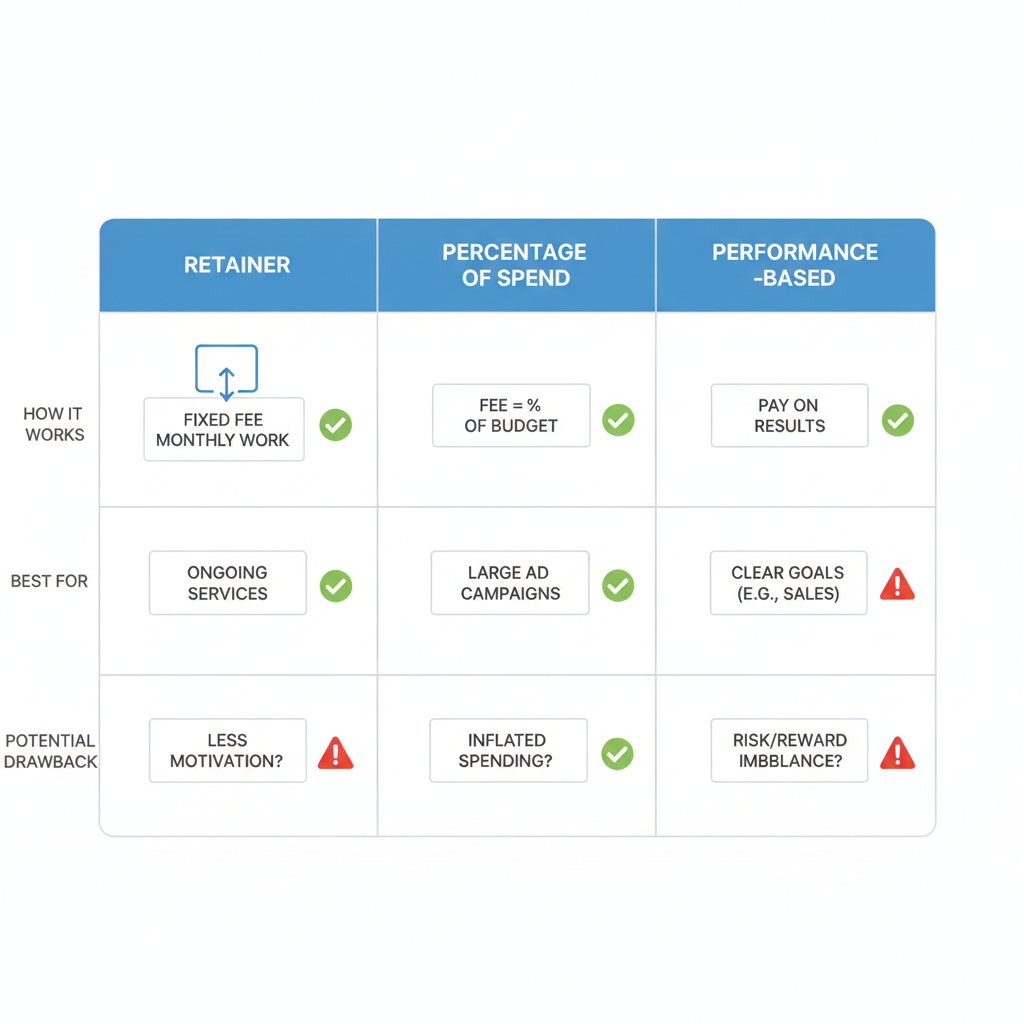
Understanding how a Google Ads agency charges helps you spot incentive problems. The cheapest fee is not always the lowest-cost option if poor management increases CAC.
| Pricing Model | How It Works | Best For | Potential Drawback |
|---|---|---|---|
| Flat Retainer | Fixed monthly fee for management, often $2,000–$8,000+ | Predictable budget; small to mid-size SaaS | No built-in performance incentive; the agency may not feel urgency to scale profitable spend |
| Percentage of Ad Spend | Typically 10–20% of total media budget | Agencies that want upside as you scale; simple to calculate | Can reward higher spend even when returns diminish |
| Performance-Based | Fee tied to outcomes such as a qualified lead or demo booked | Businesses with clear conversion definitions and reliable attribution | Can encourage aggressive tactics or cherry-pick easy conversions |
| Hybrid Retainer and Bonus | Lower base retainer plus bonuses for agreed KPI targets, such as CAC below a defined level | Many SaaS startups because it balances cost control with motivation | Requires careful contract language around attribution and measurement |
For many SaaS companies, the hybrid model offers the best balance. You pay a predictable baseline for account management, while the agency earns more when it delivers agreed business outcomes.
Define the bonus carefully. Specify the data source, attribution window, conversion quality threshold, reporting period, and what happens when you change pricing, budget, targeting, or the sales process.
Google Ads Agency for SaaS: What to Expect in 2026
Google Ads automation is now standard. That does not mean strategy is automatic. In 2026, your agency should know how to use automation while keeping CAC, LTV, and revenue quality in control.
- AI and automation: Agencies should use automation to test, bid, and identify patterns, but optimize toward qualified conversions and customers rather than cheap clicks.
- Privacy-first tracking: Server-side tagging, consent modes, and durable first-party data are increasingly important for attribution and compliance.
- Performance Max: Performance Max should work alongside search and YouTube as part of a full-funnel plan. It should not become a black box that receives your entire budget without clear conversion signals.
- SaaS-specific funnels: Free trials, demos, self-serve onboarding, and sales-assisted conversion paths need different landing pages and event tracking.
- Revenue reporting: A transparent connection between ad spend, qualified pipeline, paid accounts, and MRR is now a baseline expectation.
Ask candidates how they balance automation with human review. The strongest answer will include regular search-term analysis, conversion-quality checks, creative testing, landing page experiments, and budget decisions based on downstream results.
Red Flags That Scream 'Don't Hire This Agency'
Watch for these warning signs during your evaluation.
Guarantees of ROAS or ranking positions. No honest agency can promise a specific return on ad spend for a new paid media account. Results depend on your offer, product-market fit, landing page, audience, sales process, and budget. A guaranteed 4x ROAS upfront is not a credible strategy.
Refusal to show search terms or provide account access. You own the data. An agency that hides search queries or refuses to give you read-only access is not protecting your interests. You need visibility into wasted spend and new demand.
Cookie-cutter strategies. If the proposal could apply to any ecommerce store, it is not SaaS-specific. Your free trial, demo process, onboarding, pricing, and sales cycle should shape the account structure and messaging.
Account management handed to juniors without senior oversight. Ask who will manage the account daily, who approves strategic changes, and how often you will speak with the person who designed the plan.
Long contracts before measurement is proven. A long commitment can make sense after an agency has earned trust. It is a warning sign when you are asked to sign for 12 months before seeing an audit, measurement plan, or pilot.
How to Vet Candidates: 7 Questions to Ask Before Signing
Use these questions to separate capable SaaS agencies from polished sales teams.
Can you share case studies from SaaS clients with real numbers, specifically CAC payback, trial-to-paid rate, and churn impact? Avoid case studies that only show a 300% increase in leads. Ask for metrics that matter to a subscription business.
How do you manage the learning phase and budget volatility for a new account? A good agency should explain how it starts with controlled tests, protects spend, and scales only when conversion quality is clear.
Who will I work with daily, and how often will I receive strategic updates? Confirm your point of contact, reporting cadence, escalation process, and schedule for strategic reviews.
How do you integrate with marketing automation platforms for lead nurturing and lifecycle messaging? Paid ads generate leads, but the work continues after the click. The agency should understand CRM syncing, lead qualification, and follow-up sequences.
What attribution model do you use, and how do you account for offline conversions or self-serve signups? Ask how the agency imports sales and billing outcomes so it can optimize toward customers rather than form fills.
How do you test creative, and how often do you refresh ad copy? Look for a structured process covering headlines, calls to action, visuals, offers, search terms, and customer objections.
What happens if we need to pause or reduce spend? A flexible agency should support seasonality and changing cash-flow conditions. Review minimum-spend commitments and termination terms before signing.
The OneUp Today Advantage: Amplify Your Agency's Paid Campaigns
Even the best Google Ads agency cannot close every sale alone. You also need a follow-up system that captures intent, answers questions, and keeps conversations moving after the click.
OneUp Today is an AI marketing team for SaaS founders, indie hackers, and small teams. Its agents find high-intent conversations on Reddit, draft personalized DMs, emails, and replies in your voice, publish content, and support SEO. You approve every send.
That complements paid acquisition. Your Google Ads agency captures existing demand. OneUp Today helps you find people who are already discussing problems your product solves, then supports authentic outreach and follow-up.
In OneUp Today’s own data from 2,269 real Reddit cold DM conversations sent March to September 2026, 29.7% received at least one human reply. See the Reddit DM benchmarks. Use this as a separate acquisition channel, not as a substitute for accurate paid media attribution.
The goal is a closed loop: ads create awareness, useful conversations build trust, and consistent follow-up turns intent into customers. That is how you give every lead more chances to convert.
Final Recommendation: Your Next Step to Choosing the Best Google Ads Agency
Shortlist three agencies that specialize in SaaS and can explain your buyer journey, sales cycle, product, and marketing stack. Request a paid growth audit from each candidate.
Compare their account structure, targeting plan, conversion events, landing page recommendations, creative testing process, budget allocation, and reporting model. Choose the agency that prioritizes revenue analytics, transparent communication, and collaborative execution.
Start with a pilot when possible. A short, paid engagement gives you evidence of how the agency thinks, communicates, tests, and handles your data before you make a long-term commitment.
Then connect your paid campaigns to a broader follow-up system. Your agency can drive qualified traffic. OneUp Today can help you continue the conversation across Reddit, content, email, and your website. Together, those systems can create a more complete path from intent to revenue.
Frequently asked questions
What is the minimum monthly ad spend required for a Google Ads agency to take on a SaaS client?
Many agencies require at least $5,000–$10,000 per month. This gives the account enough budget for testing and helps cover management fees. Smaller budgets can still work, but the agency should set realistic expectations about testing speed and statistical confidence.
How long does it take to see meaningful results from a Google Ads campaign managed by an agency?
Expect an initial learning and setup period, followed by several rounds of testing. Meaningful results often take 2–3 months, depending on conversion volume, sales-cycle length, budget, tracking quality, and landing page readiness.
Can a Google Ads agency guarantee a specific return on ad spend for a SaaS product?
No reputable agency should guarantee a specific ROAS for a new account. Results depend on product-market fit, pricing, competition, landing page quality, sales execution, and conversion tracking. A credible agency commits to transparent measurement and continuous optimization toward agreed targets.
Should a SaaS company choose a Google Ads agency with B2B or B2C experience?
Choose experience that matches your buyers and funnel. B2B SaaS often requires expertise in demo bookings, longer sales cycles, account qualification, and offline conversion tracking. B2C experience can be useful for self-serve products, but volume-focused tactics may not align with your LTV and CAC goals.
What reporting metrics should a SaaS business expect from its Google Ads agency?
Expect CAC, CAC payback, LTV to CAC ratio, cost per trial signup, trial-to-paid conversion rate, qualified leads, demos, paid conversions, and MRR impact where available. CTR and impressions are useful supporting metrics, but they should not be the headline outcome.
Ready to turn more intent into customers? Shortlist a SaaS-focused Google Ads agency, request a paid audit, and build the follow-up system that keeps every qualified conversation moving.