
SEO Content Marketing for SaaS: Strategy, Tools & Automation
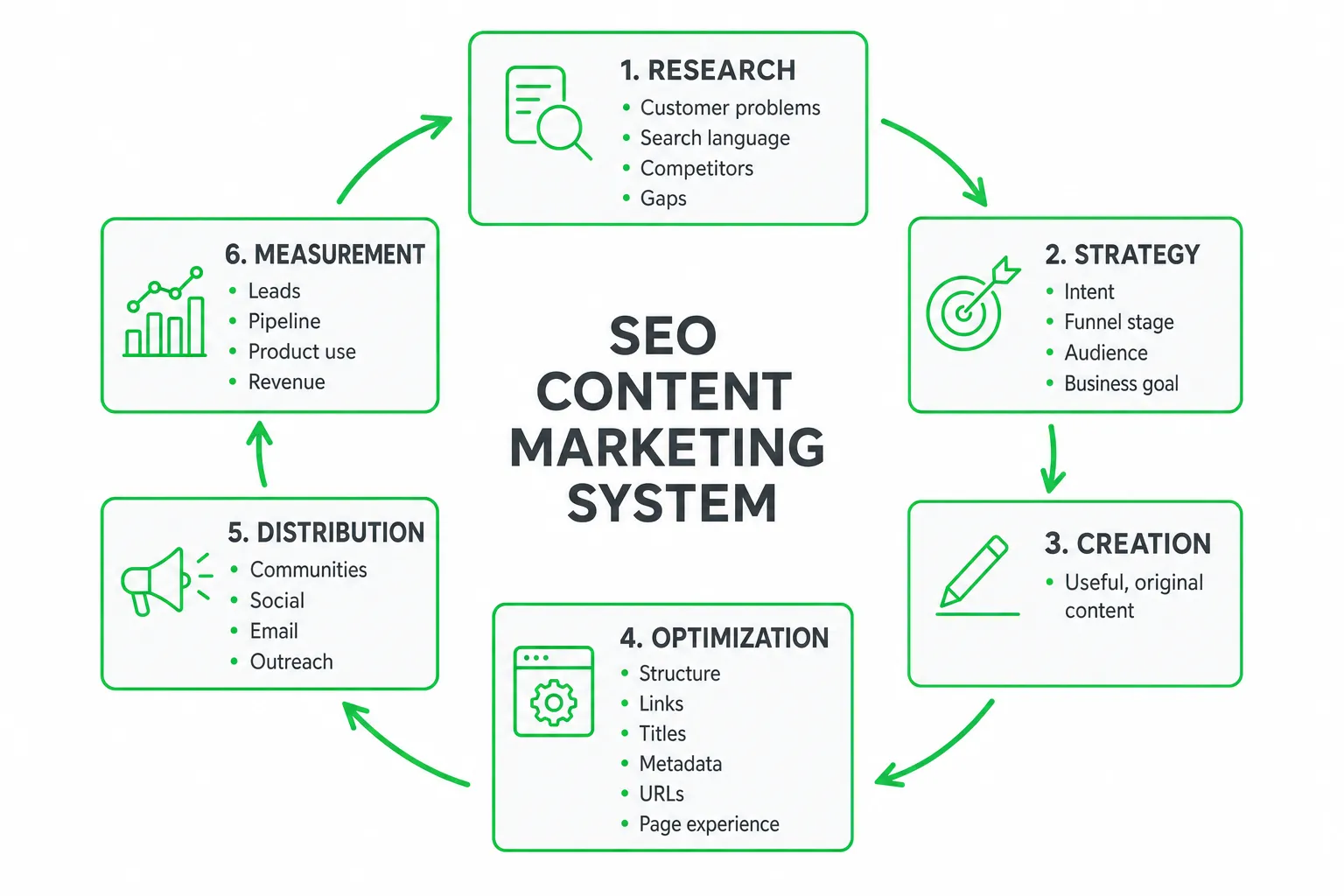
SEO content marketing combines search visibility with useful content that helps the right people choose your SaaS. The goal is not to publish more articles or chase rankings. It is to connect real customer problems with search intent, a clear funnel stage, and a measurable next step.
Key takeaways
- Map every topic to a customer problem, search intent, funnel stage, and business outcome.
- Use customer conversations, Reddit discussions, support questions, and sales objections to validate topics before you write.
- Use AI to speed up research, outlining, editing, distribution, and reporting, but keep positioning and final approval human-controlled.
- Measure qualified leads, trials, demos, activation, and revenue, not just traffic or rankings.
What Is SEO Content Marketing?
SEO content marketing brings together search engine optimization and audience-focused content. You create pages that answer questions people are already asking, help them solve a problem, and guide them toward becoming customers.
For SaaS, the target is not simply a larger audience. You want qualified visitors who have a problem your product solves. A useful article should lead naturally to a demo, trial, signup, email capture, product workflow, or conversation.
A complete system includes:
- Research: Find customer problems, search language, competitors, and content gaps.
- Strategy: Assign each topic an intent, funnel stage, audience, and business goal.
- Creation: Produce useful, original content in the format searchers need.
- Optimization: Improve structure, internal links, titles, metadata, URLs, and page experience.
- Distribution: Share approved content across communities, social channels, email, and outreach.
- Measurement: Connect content activity to leads, pipeline, product use, and revenue.
That last connection separates content marketing from publishing. A ranking is useful only when it brings the right person closer to a valuable action.
What Page-One SEO Content Marketing Guides Miss
Most SEO guides explain keywords, metadata, headings, and broad content formats. Those basics matter, but they do not give a small SaaS team a complete growth system.
The missing layer is operational. You need to connect search demand with customer evidence, product positioning, distribution, and revenue. Otherwise, you can publish technically optimized pages that attract visitors who never become users.
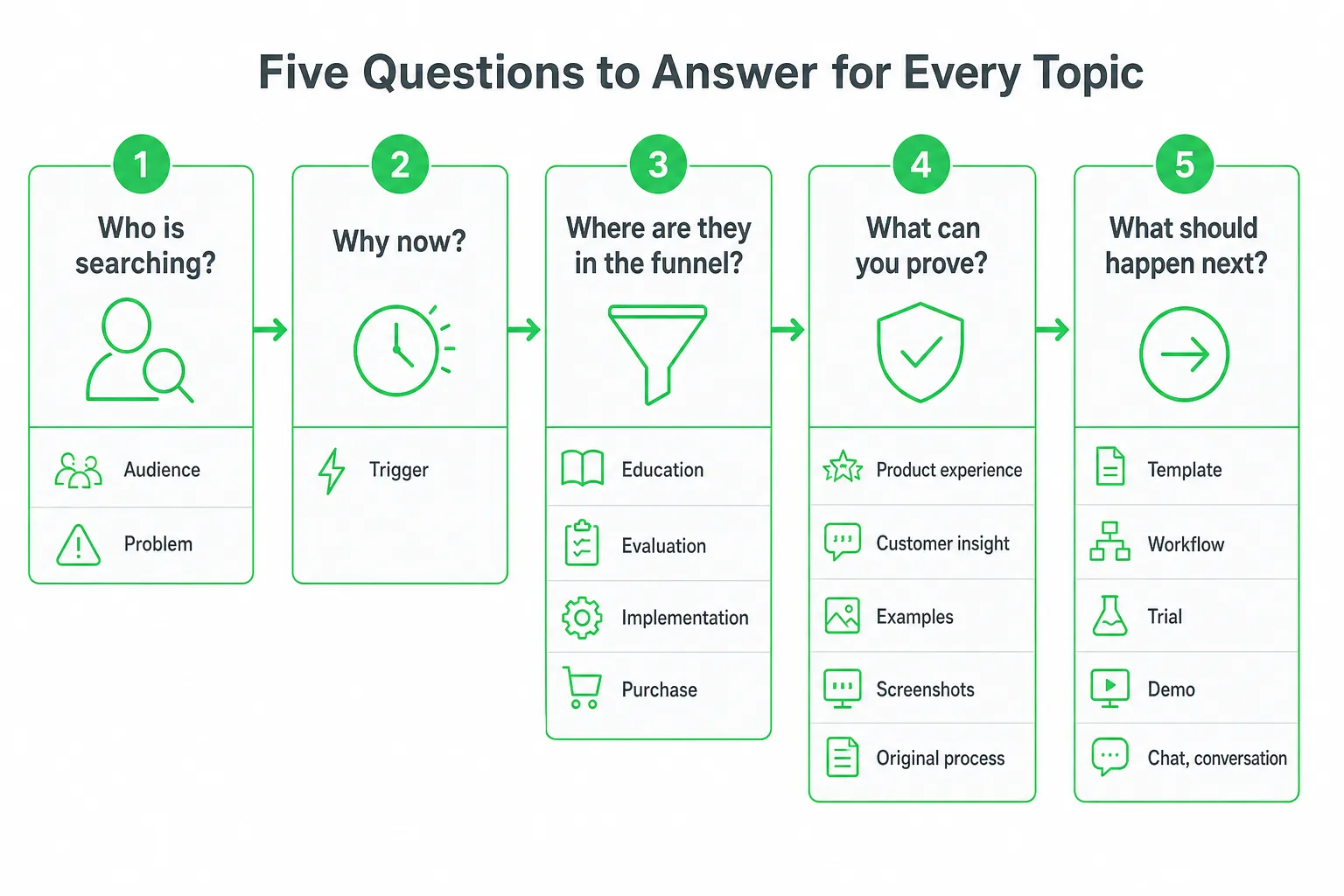
A stronger system answers five questions for every topic:
- Who is searching? Identify the audience and the problem behind the query.
- Why now? Understand the trigger that makes the problem urgent.
- Where are they in the funnel? Separate education from evaluation, implementation, and purchase intent.
- What can you prove? Add product experience, customer insight, examples, screenshots, or an original process.
- What should happen next? Offer a relevant template, workflow, trial, demo, chat, or conversation.
This approach gives you a defensible advantage over generic search-first content. It also makes every article easier to distribute because the topic came from a real problem, not just a keyword list.
Build a SaaS SEO Content Strategy Around Intent
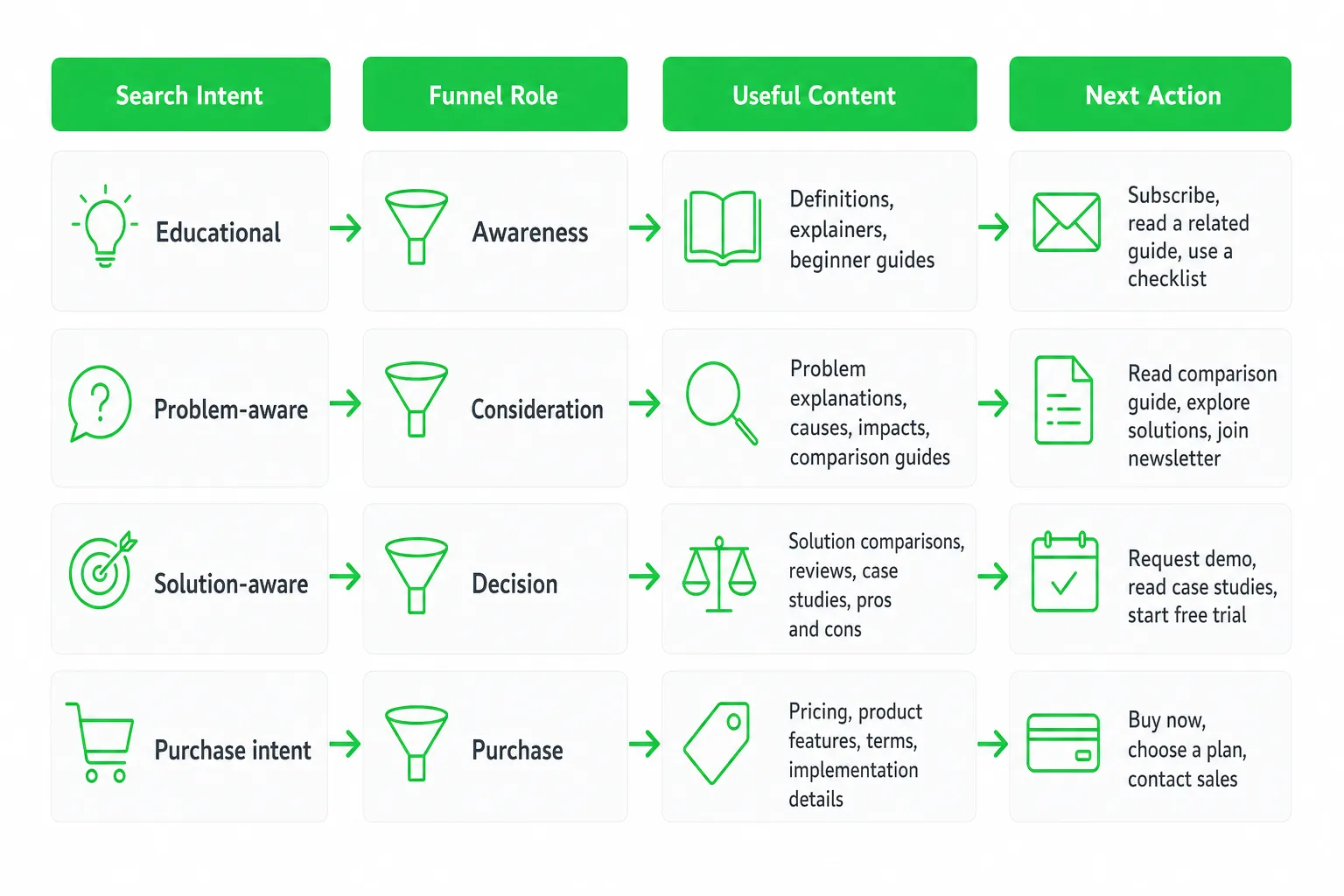
Start by mapping search intent to the SaaS funnel. The same audience may use different language as they move from learning about a problem to selecting a solution.
| Search intent | Funnel role | Useful content | Next action |
|---|---|---|---|
| Educational | Awareness | Definitions, explainers, beginner guides | Subscribe, read a related guide, use a checklist |
| Problem-aware | Consideration | How-to guides, workflows, troubleshooting content | Download a template or explore a method |
| Solution and comparison | Evaluation | Alternatives, comparisons, tool roundups, use cases | Start a trial, book a demo, compare workflows |
| Branded and implementation | Conversion or retention | Product education, setup guides, integration pages | Activate a feature or contact support |
Build topic clusters around customer problems rather than disconnected keywords. Strong SaaS clusters often include use cases, integrations, alternatives, comparisons, workflows, implementation guides, and product education.
Use keyword research to understand demand and language. Then validate each idea against sales calls, support tickets, product feedback, customer reviews, Reddit discussions, and objections you hear repeatedly.
Prioritize topics using five filters:
- Business relevance: Does the problem connect to your product’s core value?
- Customer pain: Is the problem costly, frustrating, urgent, or recurring?
- Ranking opportunity: Can your site contribute something better or more specific?
- Evidence: Can you add firsthand experience, examples, or original analysis?
- Next action: Do you have a useful step for the reader after the article?
Create Content That Searchers and Customers Trust
Match the format to the query. A how-to search needs a practical guide. An evaluation search needs a comparison or alternatives page. An implementation search may need a checklist, template, calculator, or step-by-step tutorial.
Give every page a direct answer near the beginning. Then make the page easy to scan with descriptive headings, short paragraphs, examples, internal links, relevant calls to action, a clear title tag, a useful meta description, and a readable URL.
Trust comes from details generic content cannot reproduce. Add:
- Product screenshots and real workflows.
- Transparent trade-offs and limitations.
- Examples based on your experience.
- Original templates, checklists, or frameworks.
- Clear explanations of who should and should not use a solution.
- Internal links that help readers complete the next step.
Use Google Search Central’s helpful content guidance as a quality check. Its five practical evaluation questions include whether your content demonstrates firsthand expertise, serves a defined audience, and leaves readers satisfied.
AI can help you produce a first draft. It cannot replace your product knowledge, customer evidence, positioning, or judgment. Review every claim, remove filler, and add details only your team could provide.
The Small-Team SaaS SEO Content Marketing System
A small team needs a repeatable workflow, not another collection of disconnected tools. Build the process around real customer problems.
- Collect conversations: Gather questions from sales calls, support tickets, communities, reviews, and product feedback.
- Score opportunities: Rate each problem by customer pain, business fit, search opportunity, evidence, and conversion potential.
- Assign intent: Define the query, audience, funnel stage, desired outcome, and likely next action.
- Write the brief: Specify the direct answer, outline, examples, internal links, proof points, and call to action.
- Create the draft: Use AI for research assistance, clustering, outlining, repurposing, and editing where it improves speed.
- Add human value: Insert product experience, customer language, original examples, trade-offs, and verified claims.
- Publish and distribute: Release the approved page, then share it with relevant communities and channels.
- Review results: Study qualified visits, conversations, leads, trials, activation, and assisted conversions.
AI adoption can improve production without guaranteeing quality. In an Ahrefs survey, 87% of marketers said they use AI to create or help create content. The most common uses were brainstorming topic ideas at 76%, creating content outlines at 73%, and improving content at 67%.
Use those strengths carefully. Let AI organize information and accelerate repetitive work. Keep customer insight, product claims, positioning, examples, and final approval under human control.
Your system should connect SEO research with community listening, personalized outreach, social publishing, website chat, and one shared editorial calendar. That creates a loop: customer problem, useful content, distribution, conversation, product feedback, and a better next page.
SEO Content Marketing Tools and Automation Options
Choose tools by workflow coverage rather than feature count. You need a process that moves an idea from discovery to publication and measurement without creating extra manual work.
| Approach | Strength | Limitation | Best fit |
|---|---|---|---|
| Standalone AI writer | Fast drafts and rewrites | Can produce repetitive, search-first content | Teams with strong editorial review |
| Manual workflow | High control and deep context | Consumes founder and team time | Small content volume with complex expertise |
| Specialized SEO stack | Detailed research and optimization | Often requires several disconnected tools | Teams with dedicated SEO ownership |
| Integrated AI marketing system | Connects research, creation, distribution, and outreach | Still needs approval and strategic direction | Small SaaS teams managing the full growth loop |
A focused stack usually includes search and analytics tools for demand and performance, a CMS for publishing, customer research sources for validation, and automation for moving approved content across channels.
For SaaS founders and small teams, OneUp Today fits when you need Reddit lead generation, lead scoring, AI content creation, SEO and blog autopilot, multi-platform publishing, website chat, and approval before anything is sent. Use it to connect content production with the conversations where potential buyers are already describing their problems.
How to Measure SEO Content Marketing Performance
Measure the full journey from search impression to revenue. Traffic and rankings show visibility, but they do not tell you whether the page attracts the right audience.
- Visibility: Search impressions, clicks, rankings, and landing pages.
- Engagement: Scroll depth, return visits, internal-link clicks, and meaningful page interactions.
- Lead quality: Email captures, chat conversations, qualified leads, and sales acceptance.
- Product outcomes: Trials, demos, activation, feature use, and conversion to paid plans.
- Revenue influence: First-touch, last-touch, and assisted conversions connected to content.
Use page-level reporting to identify which topics attract qualified visitors and which calls to action create pipeline. A guide may assist a conversion without being the final page someone visits, so review assisted conversions alongside last-touch reports.
Measure quality with more than publishing volume. Ask whether the content is relevant to the target customer, adds original insight, supports sales, creates useful conversations, and still reflects the product after updates.
Attribution will always have gaps. Combine analytics with CRM data, customer interviews, lead-source notes, and sales feedback. Your goal is not perfect tracking. It is better investment decisions.
A Practical SEO Content Marketing Workflow
Use this workflow for your next SaaS content project:
- Build a problem inventory: Review calls, tickets, community posts, product reviews, and competitor gaps.
- Group the findings: Create themes tied to your audience, use cases, integrations, and positioning.
- Select one focused topic: Define its search intent, funnel role, audience, and desired outcome.
- Write a useful brief: Include the direct answer, structure, examples, proof, internal links, and next step.
- Draft with assistance: Use AI for speed, then add original insight and verify every important claim.
- Optimize the page: Improve headings, title, description, URL, links, readability, and conversion path.
- Publish and distribute: Share the approved version in relevant communities, social channels, email, and outreach.
- Review and refresh: Update pages when your product, customer needs, or search landscape changes.
SEO content marketing works best as a connected operating system. Start with one customer problem, publish one genuinely useful page, distribute it where that audience already asks questions, and track what happens next.
Next step: Choose one recurring customer question today. Map its intent and funnel stage, create a brief with a relevant next action, and schedule a review of leads and conversions after publication. If you want to automate the research, content, distribution, and approval loop, OneUp Today can help you manage that process in one place.
Frequently asked questions
How does SEO content marketing differ from regular content marketing?
SEO content marketing focuses on attracting organic search traffic by targeting specific keywords and search intent, while regular content marketing prioritizes audience engagement across channels. For SaaS, SEO content marketing adds a measurable funnel layer, each piece maps to a query, stage, and conversion goal, whereas general content may lack that search-driven, revenue-linked structure.
What is the best way to measure SEO content marketing success?
The best way is to track qualified leads, trials, demos, activation, and revenue, not just traffic or rankings. A single metric like organic sessions can mislead; instead, connect each article to a next action, such as signup or demo booking. Use UTM parameters and CRM data to attribute pipeline value to specific content pieces.
Can AI replace human writers in SEO content marketing?
No, AI cannot fully replace human writers. It excels at research, outlining, editing, and distribution, but positioning, brand voice, and final approval require human judgment. AI-generated drafts often lack customer nuance and product insight, so keep humans in control of strategy and quality checks to avoid generic, low-trust content.
How do you find SEO content topics that actually convert?
You find converting topics by mining customer conversations, Reddit discussions, support tickets, and sales objections, not just keyword tools. Validate each topic against search intent and funnel stage, then ask if it leads to a natural next step like a trial or demo. Topics from real problems outperform keyword-stuffed ideas.
What is the ideal length for SEO content marketing articles?
There is no fixed ideal length; it depends on search intent and topic depth. For SaaS, educational guides often need 1,500–2,500 words, while comparison pages can be shorter. Focus on fully answering the query with original insights, examples, and a clear CTA, length alone doesn't drive rankings or conversions.