
SEO Content Strategy: A Step-by-Step Guide for SaaS
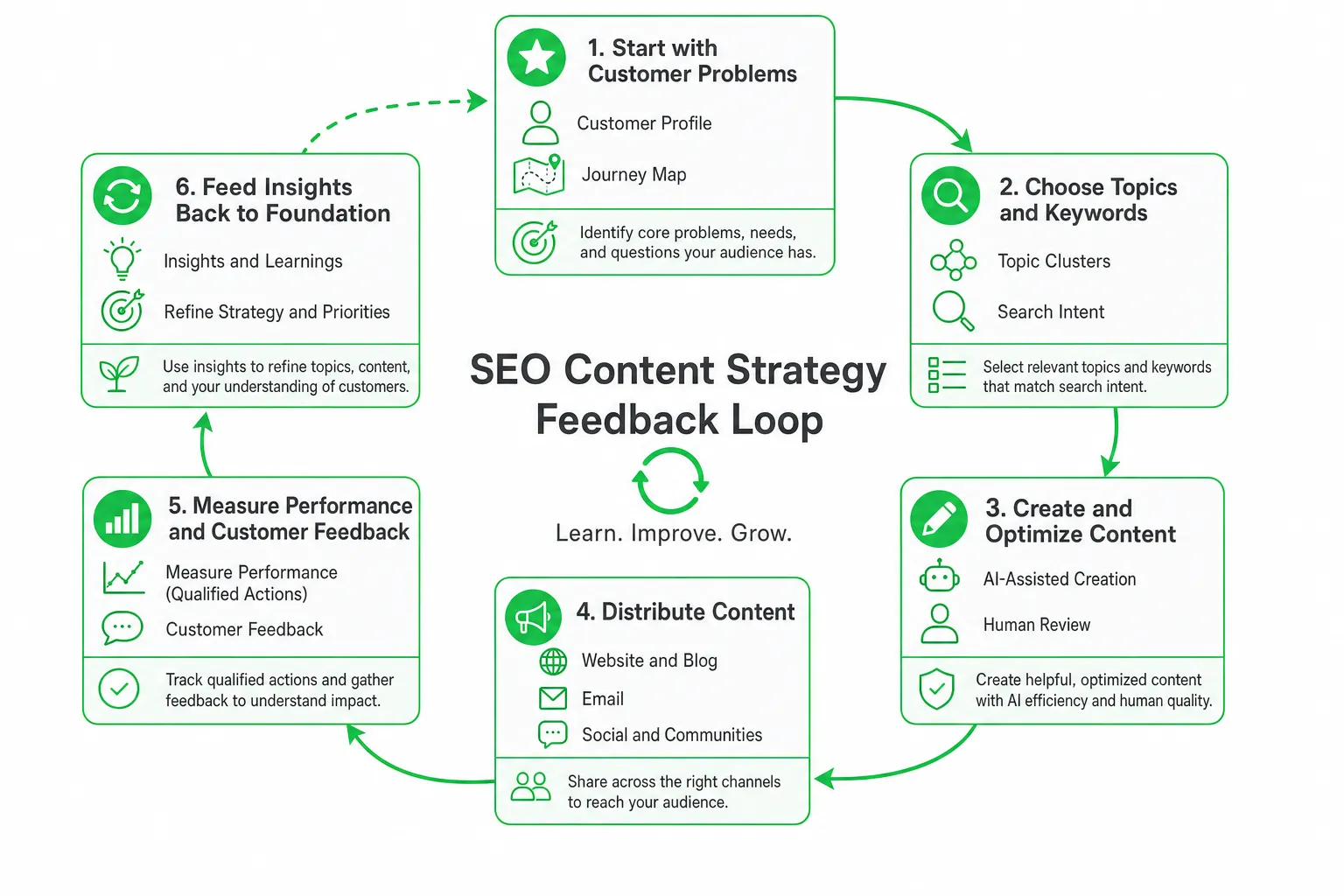
An SEO content strategy is a repeatable plan for turning customer problems into useful pages that attract searchers, build trust, and create business results. For SaaS, that means connecting every topic to a real use case, a stage of the buying journey, a distribution channel, and a measurable next action.
The strongest strategy is not “publish more blog posts.” It is a system for choosing the right problems, creating genuinely useful content, reviewing AI-assisted work carefully, distributing each asset, and improving pages using search and customer feedback.
Key takeaways
- Map every topic to customer intent, product relevance, and a business outcome.
- Build connected topic clusters instead of isolated posts.
- Use AI for speed, but keep human ownership of facts, positioning, and final approval.
- Distribute content where your buyers ask questions, then feed those conversations back into your plan.
- Measure qualified actions and content effort, not rankings alone.
What Is an SEO Content Strategy?
An SEO content strategy covers the research, planning, creation, optimization, distribution, and improvement of content designed to earn organic visibility. It combines keyword research with customer understanding, technical SEO, editorial judgment, conversion planning, and performance analysis.
For a SaaS company, the strategy must go beyond traffic. A page should connect a customer problem to your product’s capabilities and to an appropriate next step, such as reading a related guide, starting a trial, requesting a demo, or asking a question in chat.
A complete strategy includes:
- Audience and customer research.
- Topic clusters and keyword selection.
- Search intent and funnel-stage mapping.
- Content briefs, production, and editorial review.
- Internal linking and conversion paths.
- Distribution across relevant communities and channels.
- Performance measurement and content refreshes.
Think of SEO as a feedback system. Search queries reveal what people want. Sales calls reveal what stops them from buying. Support conversations reveal where customers get stuck. Your strategy should bring all three signals together.
Build the Strategic Foundation
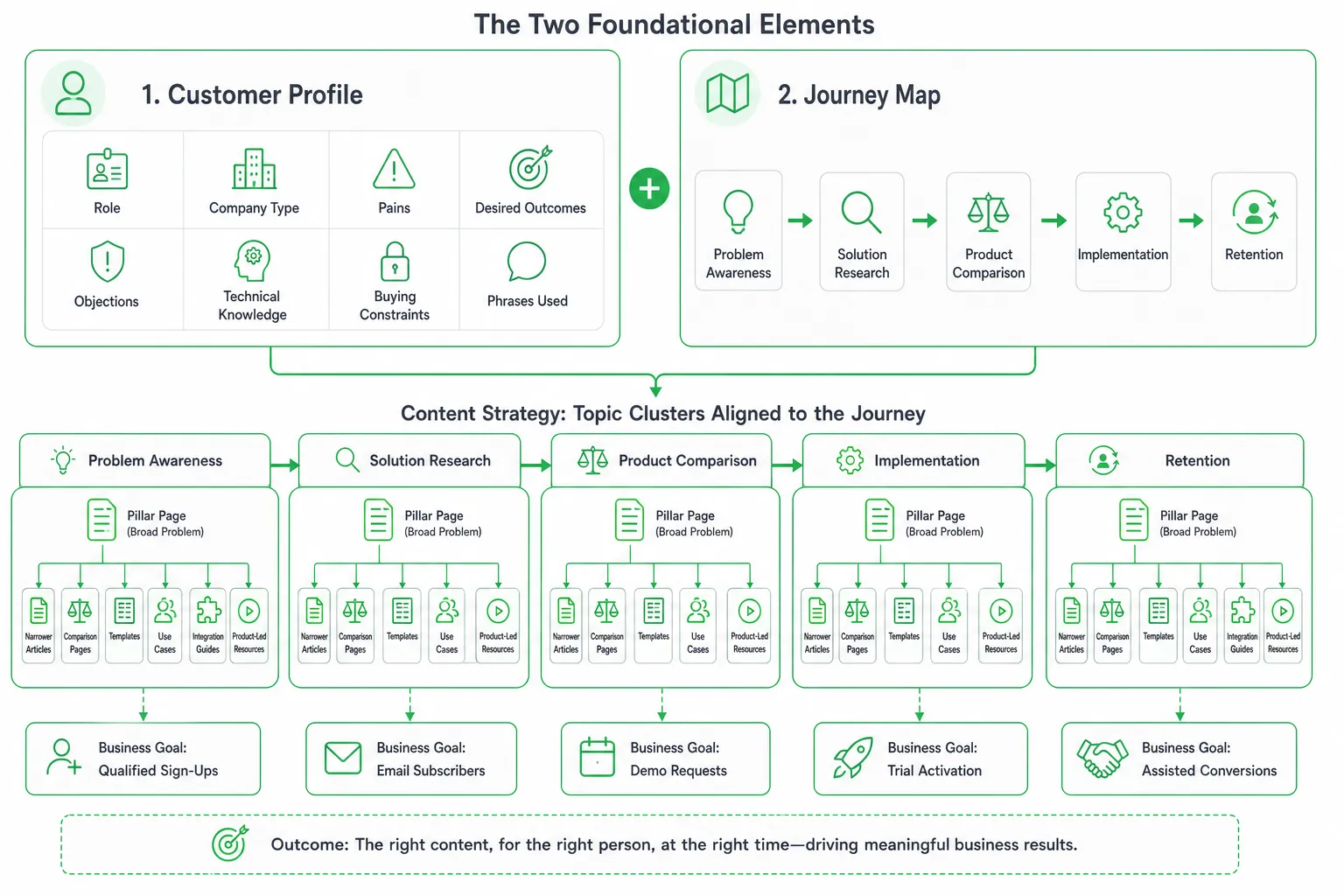
Start with the customer, not a keyword tool. Define who you serve, what they are trying to accomplish, and how they describe the problem in their own words.
Customer profile: Document the ideal customer’s role, company type, pains, desired outcomes, objections, technical knowledge, and buying constraints. Record the phrases they use. Internal terminology may not match search language.
Journey map: Organize opportunities by buying stage:
- Problem awareness: The reader understands a symptom but not the solution.
- Solution research: The reader compares approaches, methods, or categories.
- Product comparison: The reader evaluates tools, vendors, pricing, and fit.
- Implementation: The reader wants setup instructions, templates, or integration help.
- Retention: The customer needs advanced workflows, troubleshooting, or better results.
Next, create topic clusters around core SaaS problems. Build a substantial pillar page for the broad problem, then support it with narrower articles, comparison pages, templates, use cases, integration guides, and product-led resources.
Give each cluster a business goal. One cluster may support qualified sign-ups. Another may support demo requests, email subscribers, trial activation, or assisted conversions. This prevents your editorial calendar from becoming a list of disconnected topics.
Choose Topics, Keywords, and Search Intent
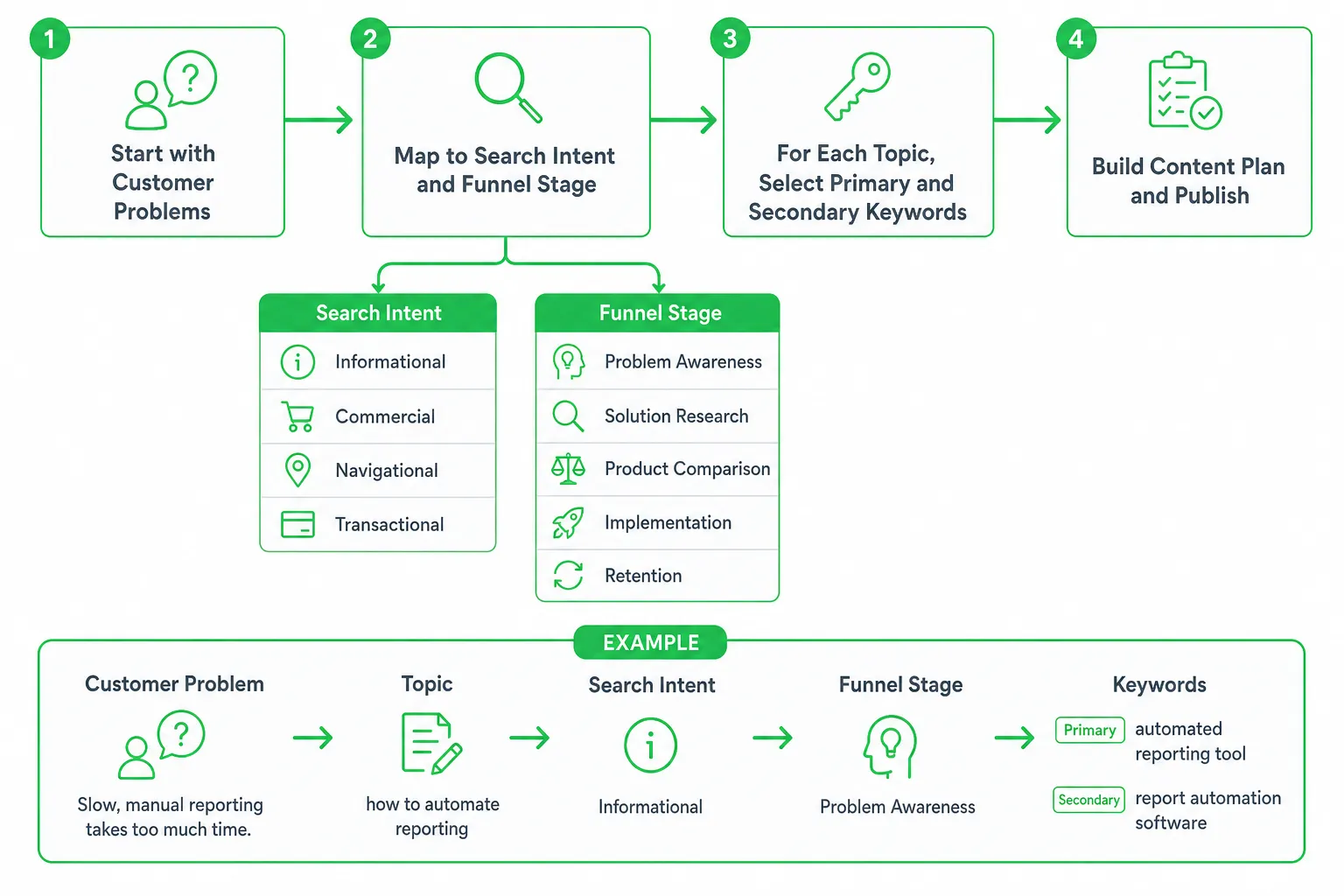
Use keyword research as one input, not the entire discovery process. Combine it with questions from sales calls, support tickets, customer interviews, Reddit discussions, competitor gaps, product reviews, and autocomplete suggestions.
These sources reveal different types of demand. A keyword tool may show the phrase people search. A community discussion may show why they search it, what they have already tried, and which objections your content must address.
Classify each topic by intent:
- Informational: The reader wants an explanation, definition, process, or answer.
- Commercial investigation: The reader compares solutions, categories, vendors, or features.
- Transactional: The reader is ready to take an action, such as signing up or requesting a demo.
- Navigational: The reader is looking for a specific brand, product, page, or resource.
Match the page and call to action to the intent. An informational guide should not push an aggressive sales message before answering the question. A comparison page can introduce stronger product proof. An implementation guide can point to a relevant feature, template, or support resource.
Prioritize topics using five questions:
- Does the topic connect to a painful customer problem?
- Can your product or expertise provide a meaningful solution?
- Can you create something more useful than the current results?
- Can you support the page with evidence, examples, or firsthand experience?
- What business action should the reader take next?
Then create a brief. Include the primary topic, related questions, target reader, intent, unique angle, evidence requirements, internal links, conversion path, and editorial standards.
Create and Optimize Content That Can Rank
Answer the main query quickly. Then make the page more useful with original examples, clear explanations, screenshots, workflows, templates, decision criteria, and transparent limitations.
Use a practical structure:
- Write a descriptive title that reflects the page’s promise.
- Open with a direct answer or useful definition.
- Use headings that mirror the reader’s questions.
- Keep paragraphs short and examples concrete.
- Use natural variations of the main topic.
- Link to related pages that help the reader continue.
- Use descriptive URLs and image text.
- Add relevant structured data where it genuinely fits.
Show why the reader should trust the page. Identify the author or reviewer. Cite credible sources. Explain your method when you provide recommendations. Check product details, screenshots, pricing references, and claims before publication.
Optimize for people before search engines. Avoid keyword stuffing, generic filler, copied competitor structures, unsupported promises, and pages created only to capture impressions.
The Modern SaaS Workflow: AI, Human Review, and Distribution
This is where many SEO content strategies remain incomplete. They explain people-first content, but not how a small team should operate when AI changes production speed and review requirements.
AI can help with research organization, topic ideation, outlines, first drafts, metadata, repurposing, and channel-specific variations. Keep positioning, firsthand insight, factual judgment, and final accountability with a human.
AI-assisted production is now common. Ahrefs’ 2026 survey reports that 93% of surveyed marketers use AI to create or help create content. However, only 2.7% trusted AI-generated content without review, while 66% trusted it only after a person reviewed it.
Build a review workflow before you increase output. Ask a subject-matter reviewer to verify:
- Facts, figures, dates, and citations.
- Product capabilities and current workflows.
- Customer examples and firsthand claims.
- Legal, privacy, security, or compliance language.
- Originality and similarity to competing pages.
- Tone, clarity, and usefulness for the intended reader.
- Whether the page actually solves the searcher’s problem.
Publishing is the midpoint, not the finish line. Adapt a useful article into a thoughtful Reddit contribution, a social post, an email, a sales enablement asset, a website chat answer, or a community response. Change the format and context. Do not paste the same promotion everywhere.
This workflow also creates a production trade-off. More automation can increase volume, but careless volume increases review pressure and the risk of publishing weak or inaccurate material. The goal is not maximum output. The goal is more useful output per unit of team effort.
Measure the Feedback Loop, Not Just Rankings
Rankings show visibility. They do not tell you whether the right people arrived, trusted the page, or took a valuable action.
Track a practical operating dashboard with:
- Indexed pages and search impressions.
- Organic clicks and qualified organic sessions.
- Conversions and assisted conversions.
- Engagement with important calls to action.
- Internal-link clicks between cluster pages.
- Content production and review effort.
- Distribution activity and meaningful responses.
Review performance by intent and funnel stage. An informational guide may help a later conversion without producing an immediate sign-up. A comparison page should usually have a clearer commercial path. Judge each asset against its assigned job.
Use feedback from several sources:
- Search queries: Find language and questions your page does not answer.
- Sales objections: Identify missing proof or unclear positioning.
- Support tickets: Find implementation gaps and recurring confusion.
- Reddit conversations: Discover urgent problems and buyer vocabulary.
- Chat transcripts: Spot unanswered questions before they become friction.
- Conversion paths: See which pages assist the actions you care about.
Run a recurring review cycle. Improve pages with promising visibility but weak clicks. Strengthen pages with traffic but weak conversion. Consolidate overlapping articles. Refresh content when the product, market, or source material changes. Stop or rethink work that has little audience or business value.
Choose a Production Model and Start Your SaaS Plan
Choose the model that matches your available expertise, time, and review capacity.
| Production model | Strength | Trade-off | Best practice |
|---|---|---|---|
| In-house | Deep product knowledge and voice control | Requires sustained SEO, editorial, and distribution capacity | Assign clear ownership for research, review, and measurement |
| Agency | External leverage and specialized execution | Needs careful briefing and quality control | Provide customer evidence, product access, and approval criteria |
| AI-assisted | Faster research, drafting, repurposing, and production support | Requires source checking and human subject-matter review | Document approval steps and assign an owner to every claim |
For a small SaaS team, start narrow. Choose one valuable customer problem. Build a connected cluster. Publish a genuinely useful core resource. Distribute it where buyers already ask questions. Connect every page to a relevant next action.
Lead Agent: Finds your buyers. OneUp Today supports this operating model by combining SEO and blog automation with content creation, multi-platform publishing, Reddit lead generation, lead scoring, website chat, and approval-based outreach. You retain control over what gets sent or published.
- Interview customers and collect recurring questions from sales, support, chat, and communities.
- Choose one problem with clear product relevance and map its search intents.
- Create a pillar brief plus supporting articles, comparisons, templates, or use cases.
- Produce the content with AI assistance where useful, then complete human fact and quality review.
- Publish, distribute thoughtfully, measure qualified actions, and feed the results into the next brief.
Next step: Write down the highest-value customer problem your SaaS solves, then create a brief that connects that problem to search intent, proof, distribution, and one measurable business action.
Frequently asked questions
How often should I update my SEO content strategy?
You should review your SEO content strategy quarterly. This frequency allows you to adapt to search algorithm changes, customer feedback, and performance data without overreacting to short-term fluctuations, ensuring your content remains relevant and effective.
What is the difference between an SEO content strategy and a content marketing strategy?
An SEO content strategy specifically focuses on earning organic search visibility through keyword research and technical optimization, while a content marketing strategy encompasses broader distribution and promotion across channels. Both align with business goals, but SEO prioritizes search engine rankings as a primary channel.
Can I use AI to write my entire SEO content strategy plan?
No, you should not rely on AI to write your entire SEO content strategy plan. AI is useful for speed and generating drafts, but human ownership is critical for facts, positioning, and final approval to ensure accuracy, brand voice, and alignment with customer needs.
How do I measure the success of my SEO content strategy beyond rankings?
Measure qualified actions like sign-ups, demo requests, and content effort instead of rankings alone. Track metrics such as conversion rates, time on page, and customer feedback to determine if your content solves problems and drives business results, not just traffic.