
Is AI Replacing SEO? What SaaS Teams Should Do
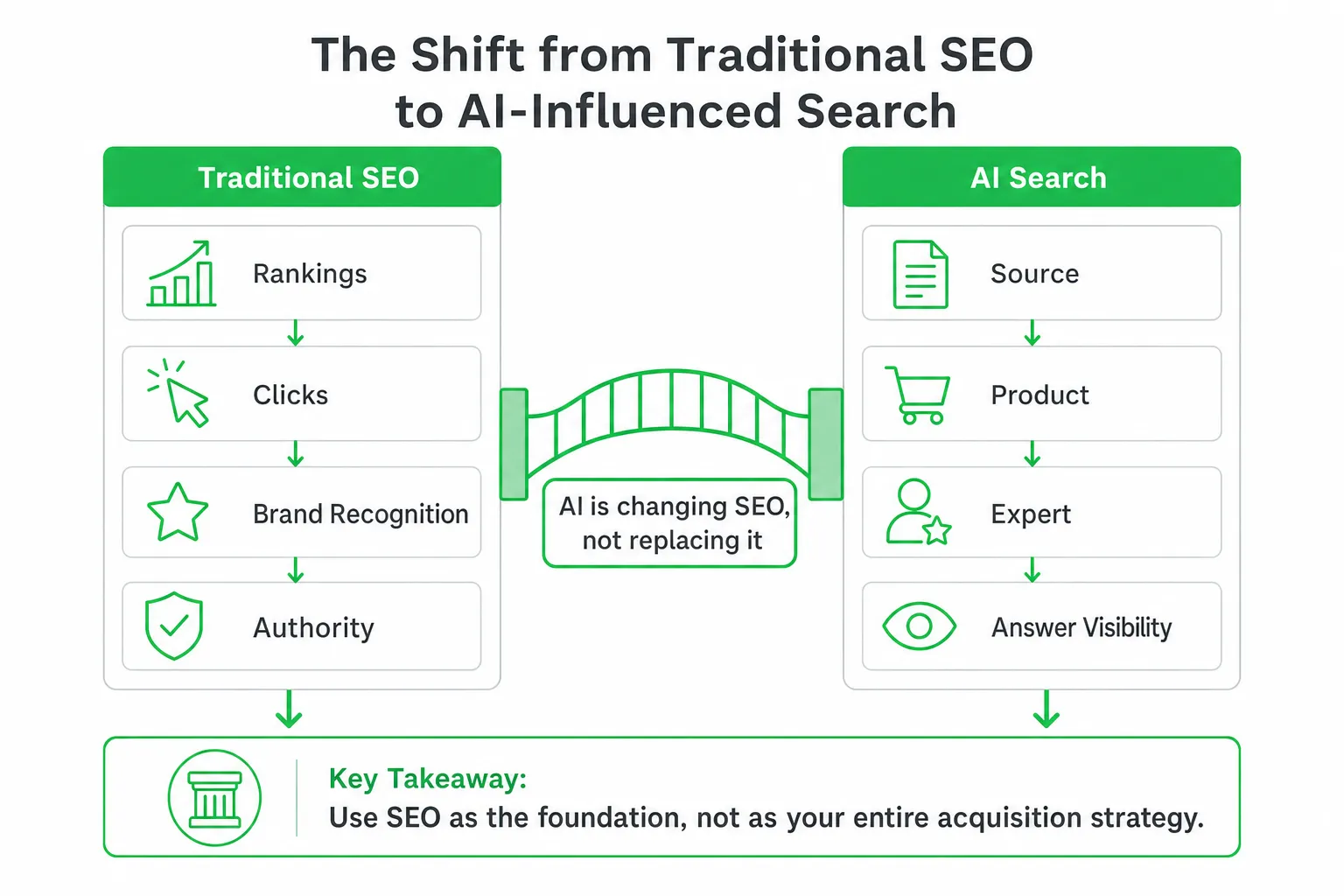
No. AI is not replacing SEO. It is changing what SEO must achieve. Traditional SEO still helps SaaS companies earn visibility, qualified clicks, brand recognition, and authority, while AI search adds a new goal: becoming the source, product, or expert that appears inside generated answers.
That shift matters because a page can rank well and still receive fewer clicks when an AI summary answers the query first. You need a broader system that combines search visibility, answer visibility, owned content, and direct distribution.
Key takeaways
- Use SEO as the foundation, not as your entire acquisition strategy.
- Measure traditional rankings separately from mentions and citations in AI-generated answers.
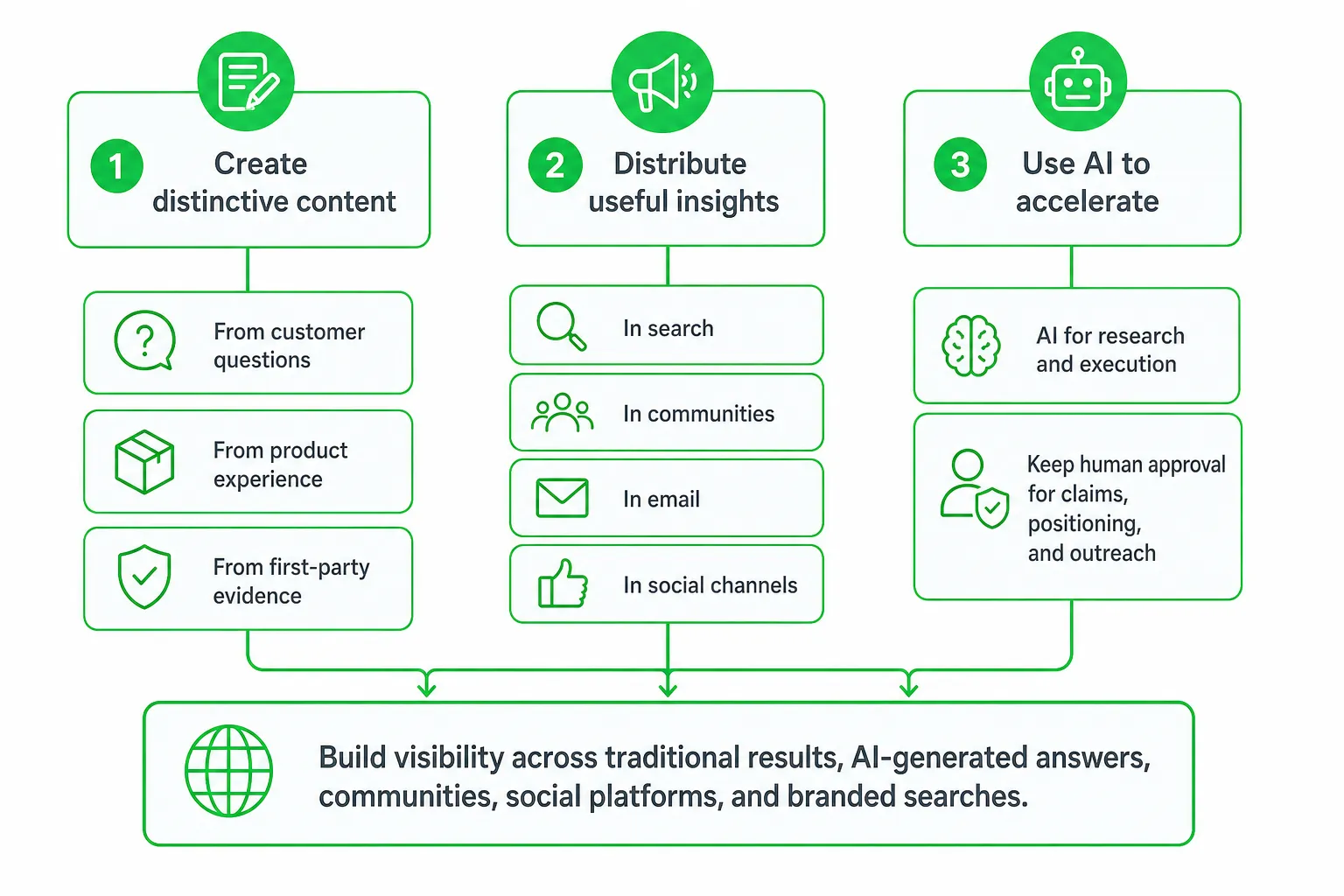
- Create distinctive content from customer questions, product experience, and first-party evidence.
- Distribute useful insights in search, communities, email, and social channels.
- Use AI to accelerate research and execution, but keep human approval for claims, positioning, and outreach.
No, AI Is Changing SEO, Not Replacing It
Traditional SEO still gives you a durable way to appear when prospects search for problems, compare products, learn implementation details, or look for documentation. It also creates assets that can earn links, citations, branded searches, and qualified visits over time.
AI is automating parts of the work. It can help with keyword research, content briefs, optimization suggestions, internal-link recommendations, repurposing, and reporting. It does not remove the need for sound positioning, technical accessibility, original expertise, or distribution.
The real shift: stop optimizing only for blue-link rankings. Build visibility across traditional results, AI-generated answers, communities, social platforms, and branded searches.
For a SaaS team, that means your best content should do more than target a phrase. It should answer a real question, explain the tradeoffs, show what happens in practice, and give the reader a sensible next action.
What AI Is Changing in Search
Search engines increasingly summarize information, answer questions directly, and combine evidence from multiple sources. Instead of choosing one result from a list, a prospect may first read a synthesized explanation and then decide whether to investigate a company.
That makes certain qualities more valuable:
- Clear entities: explain what your company, product, category, and use cases are.
- First-hand experience: share workflows, lessons, experiments, and product details that generic content cannot copy easily.
- Useful structure: define the problem, answer it directly, and organize supporting details under descriptive headings.
- Credible evidence: support important claims with documentation, customer insight, research, or transparent examples.
- Distinctive perspective: explain where common advice fails and what you recommend instead.
The reach of AI search is also expanding. AI Overviews had reached more than 200 countries and territories and more than 40 languages by May 2025. Google also said usage increased by more than 10% for the types of queries that trigger AI Overviews in the United States and India, according to Google.
AI makes content production cheaper. That creates a problem for every SaaS team: more pages can look polished while saying almost nothing new. Repetitive summaries become easier to ignore. Original customer evidence and a recognizable point of view become harder to replace.
The Missing Distinction: Rankings Versus AI Visibility
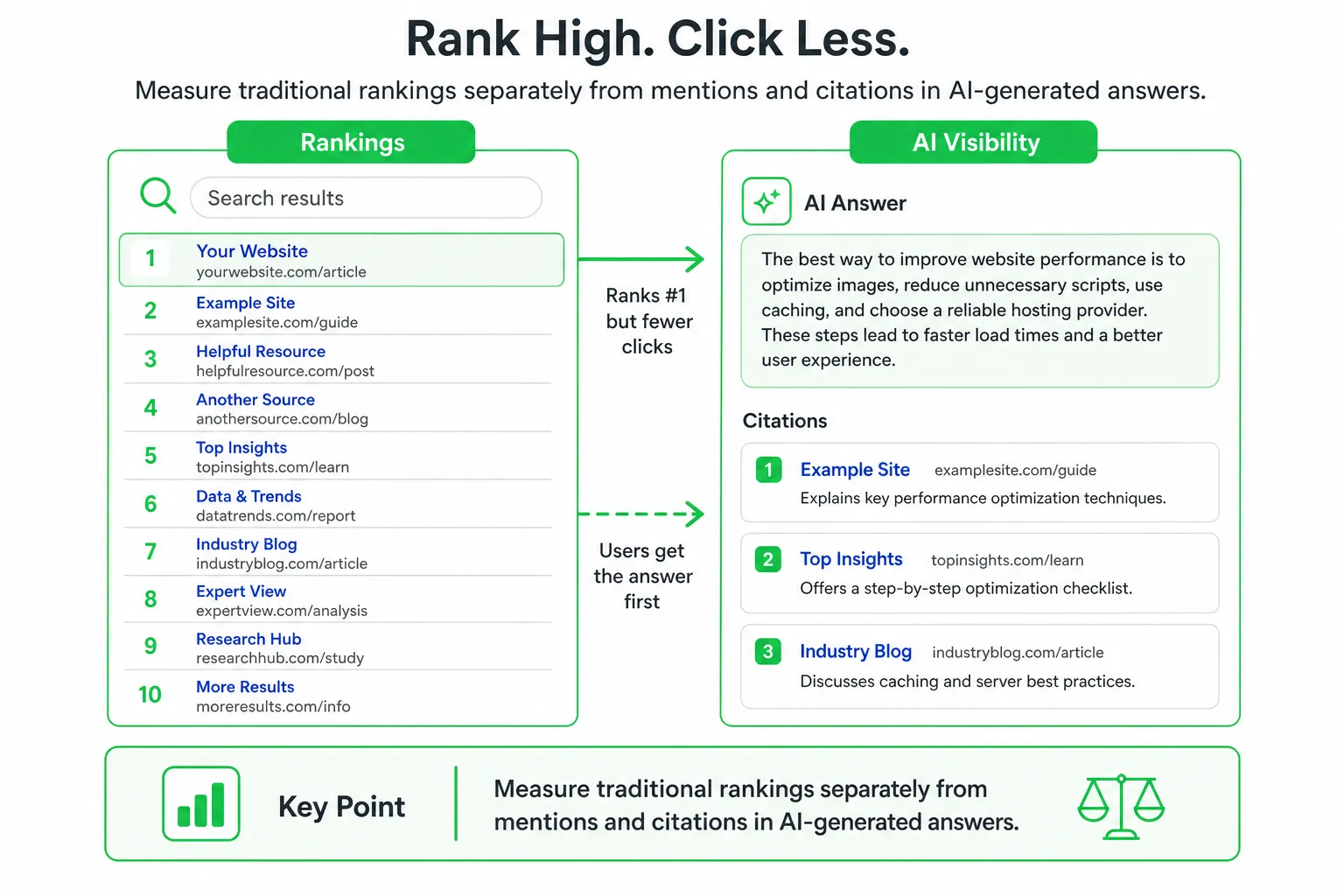
A traditional ranking measures where your page appears in a search-result list. AI visibility measures whether your company, product, or source is mentioned, cited, or used in an AI-generated answer, even when the user does not visit your website.
These outcomes overlap, but they are not interchangeable. A page can rank well without being cited in an answer. A company can earn awareness from an AI response without receiving a conventional click.
Behavior makes the difference concrete. In an analysis of Google searches collected by Pew Research Center, users clicked a traditional result on 8% of visits when an AI summary appeared, compared with 15% when one did not. Users clicked a link inside the AI summary on only 1% of visits where a summary appeared, according to Pew Research Center.
That creates competing effects for SaaS:
- Less immediate traffic: an informational query may be answered before the searcher reaches your page.
- More opportunities for recognition: your company may become the named solution, cited source, or recommended product.
- More complicated journeys: a prospect may discover your brand in an answer, return later through a branded query, and convert through a product page or demo.
Do not collapse these outcomes into one SEO score. Track where you rank, whether you appear in generated answers, what sources are cited, and whether the resulting audience is qualified.
What the Search Data Means for SaaS Growth
A drop in clicks for an informational query does not automatically mean demand disappeared. The user may have received enough information in the search interface, changed the wording of a follow-up query, or returned later through a branded or product-specific search.
AI-search exposure now belongs in your reporting model. Pew Research Center found that 58% of U.S. adults in its March 2025 browsing-data sample conducted at least one Google search that produced an AI-generated summary, while 65% encountered an AI reference somewhere on a results page, as reported by Pew Research Center.
Measure outcomes in separate layers:
- Traditional search: rankings, impressions, organic clicks, landing pages, and click-through rate.
- AI visibility: brand mentions, product mentions, citations, recommendation context, and the accuracy of the generated description.
- Demand quality: branded searches, qualified visits, sign-ups, demos, assisted conversions, and pipeline.
- Distribution: referral traffic, community conversations, email responses, social engagement, and direct visits.
Do not assume every click has equal value. Google said total organic click volume from Google Search to websites was relatively stable year over year in August 2025, while average click quality had increased and Google was sending slightly more quality clicks than a year earlier, according to Google Search.
Your goal is not to defend a single traffic number. It is to understand which discovery paths create qualified conversations and revenue.
Which AI-SEO Approach Should a SaaS Team Choose?
You do not need to choose between traditional SEO and AI search. Each approach solves a different part of the discovery problem.
| Approach | Best for | What to protect |
|---|---|---|
| Traditional SEO | Durable discovery, comparison traffic, documentation, and product education | Technical quality, search intent, internal links, and useful pages |
| AI-assisted SEO | Faster research, briefs, updates, repurposing, and testing | Human review of positioning, claims, examples, and publication |
| AI-search visibility | Conversational questions, recommendations, comparisons, and early research | Clear entities, first-hand evidence, citations, and brand accuracy |
| Community distribution | Real objections, warm conversations, and problem-aware prospects | Relevance, timing, community rules, and a non-promotional voice |
Recommended approach: combine technically sound SEO, genuinely useful expert content, first-party customer insight, and distribution in communities such as Reddit.
Use AI to speed up the work. Do not outsource judgment. A machine can suggest a topic cluster. You still need to decide whether the topic fits your market, whether the advice is correct, and whether the page gives prospects a reason to trust you.
A Practical AI-Ready SEO and Distribution Workflow
Build a repeatable workflow that connects research, content, distribution, and measurement.
- Map high-intent questions. Organize questions by funnel stage. Separate direct-answer queries from questions that require evaluation, proof, implementation guidance, or a product experience.
- Create answer-friendly pages. Lead with a concise conclusion. Use descriptive headings, clear definitions, comparison criteria, original examples, transparent authorship, supporting evidence, and a specific next step.
- Add source material competitors cannot copy. Publish customer workflows, anonymized lessons, product documentation, expert commentary, experiments, and opinions grounded in your experience.
- Distribute every useful insight. Share the idea on your website, in relevant Reddit conversations, through email, in social posts, and with partners. Adapt the format, not the underlying point.
- Review outcomes by query and channel. Look at qualified conversions, assisted journeys, citations, mentions, recurring customer questions, and conversation quality. Treat rankings as one input, not the final verdict.
Lead Agent: Finds your buyers. For community distribution, timing and audience fit matter. In OneUp Today’s own data across 2,269 real Reddit cold DM conversations sent from March to September 2026, 29.7% received at least one human reply. DMs sent within 12 hours of a post replied about 43% of the time, against about 21% for DMs sent a week or more later, according to OneUp Today’s Reddit DM benchmarks.
The lesson applies beyond Reddit: publish and respond while the problem is active. A perfect article delivered after the buying moment has passed is less useful than a timely, relevant answer.
What SaaS Teams Should Do Next
Start with the pages closest to revenue. Audit them for thin summaries, duplicated AI copy, unclear expertise, missing product context, weak internal links, and claims without evidence. Improve the pages that help prospects choose, implement, or justify your product before expanding into broad informational topics.
Then build a dashboard that separates:
- Traditional rankings and organic clicks.
- AI mentions and citation presence.
- Branded search activity and direct visits.
- Referral sources and community engagement.
- Qualified pipeline, assisted conversions, and conversion quality.
Next, create a content-and-distribution loop:
- Identify a real customer question.
- Publish the clearest and most useful answer.
- Share it where the question was asked.
- Collect objections and follow-up questions.
- Feed those insights back into your site, product, and messaging.
OneUp Today can support this loop by finding high-intent Reddit conversations, drafting personalized outreach and replies, repurposing approved content across platforms, and supporting SEO or blog workflows. You approve every send, so automation increases execution speed without removing control.
The Bottom Line on AI Replacing SEO
AI is not replacing SEO. It is replacing a narrow definition of SEO that ends with ranking for a keyword.
Build pages that answer real problems. Add evidence only your team can provide. Track both clicks and answer visibility. Distribute useful insights where your prospects already ask for help.
Practical next step: choose one revenue-adjacent search topic, audit its current page, create a more useful answer from real customer insight, and distribute it in one relevant community. Measure qualified outcomes alongside rankings.
Frequently asked questions
Will AI search engines completely eliminate the need for SEO specialists?
No, AI will not eliminate SEO specialists, but it will shift their focus from link-building to optimizing for AI visibility. Specialists must now track mentions in AI answers, create original content, and adapt to changing algorithms. The role evolves rather than disappears, requiring new skills like prompt optimization and data analysis.
How can I measure AI visibility separately from traditional search rankings?
Track AI visibility by monitoring AI-generated answers for your brand or product mentions, using tools like ChatGPT, Perplexity, and Google AI Overviews. Set up alerts for your key terms and log citation frequency. Compare this data against your traditional ranking reports to identify gaps and opportunities in your strategy.
What types of content are most likely to be cited in AI-generated answers?
Content with clear entities, first-hand experience, and credible evidence is most likely to be cited. AI systems favor pages that directly answer questions with structured headings, include unique data or case studies, and demonstrate authoritative expertise. Avoid generic summaries; instead, provide specific examples, tradeoffs, and actionable insights that AI can extract confidently.
Does AI replacing SEO mean I should stop investing in traditional search optimization?
No, you should not stop investing in traditional SEO; it remains the foundation for visibility and authority. AI search still relies on indexed web content, and traditional rankings drive qualified clicks and brand recognition. Instead, expand your strategy to include AI visibility, but maintain your core SEO efforts to sustain long-term growth.
How often should I update my content to stay relevant for AI search engines?
Update your content at least quarterly, but prioritize freshness for pages covering fast-changing topics or product features. AI systems favor current, accurate information, so review your top pages monthly for outdated claims. Add new first-hand evidence, customer insights, or product updates to maintain citation worthiness and ranking strength.