
Lead Generation SEO: Strategies for B2B SaaS Growth
Key takeaways
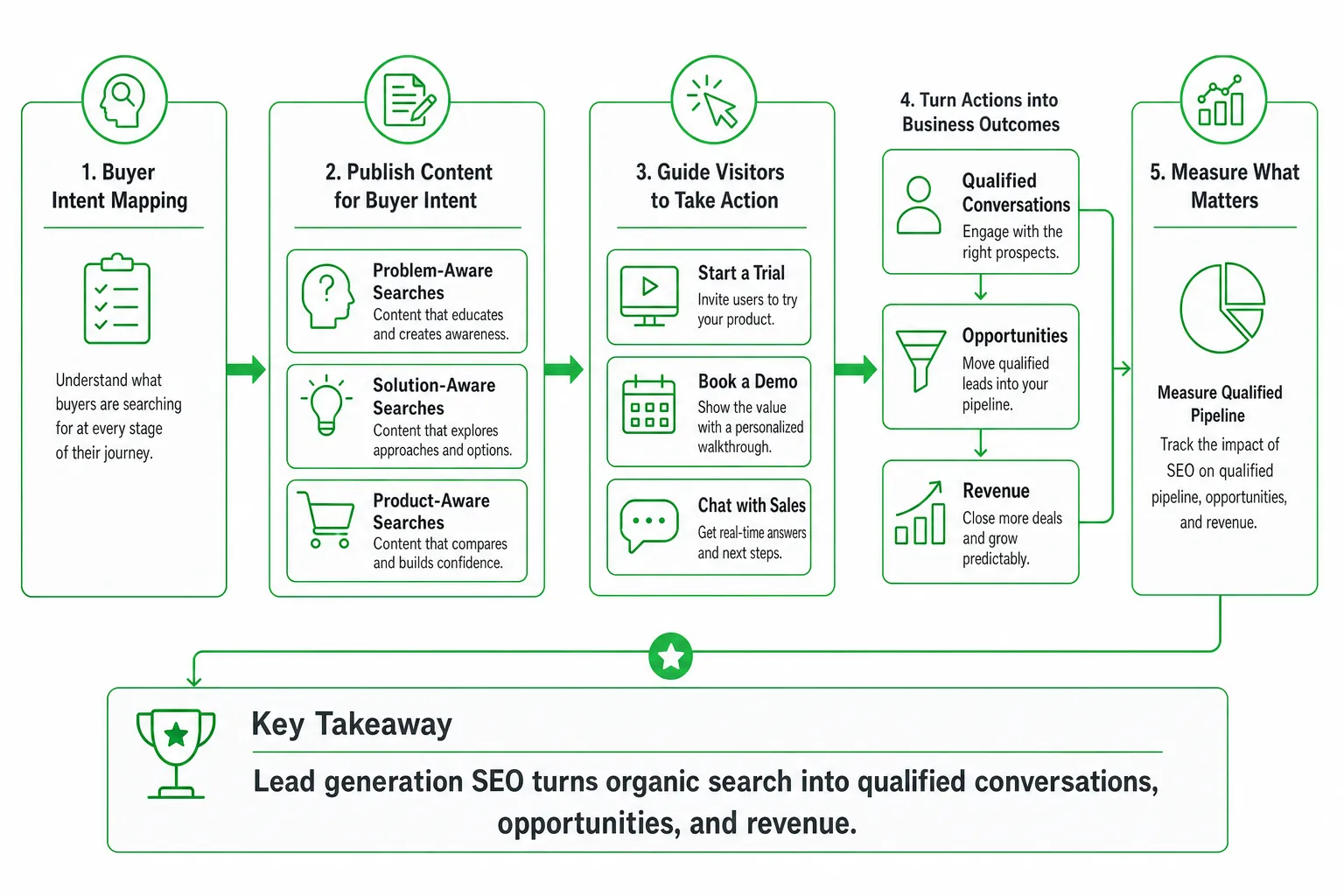
- Lead generation SEO turns organic search into qualified conversations, opportunities, and revenue.
- Map every keyword to buyer intent, a useful page, and a clear next step.
- Combine SEO with AI search visibility and high-intent Reddit conversations.
- Measure qualified pipeline, not traffic and rankings alone.
Lead generation SEO attracts people who are actively researching a problem, converts them into identifiable prospects, and moves the right prospects toward sales. For B2B SaaS, that means building search visibility around real buying questions, creating low-friction conversion paths, and connecting every lead to a follow-up process.
The shift matters because software buyers increasingly research without a sales representative. Your content needs to answer their questions before they book a call, while your broader marketing system needs to find the buyers already asking for help elsewhere.
What Is Lead Generation SEO?
Lead generation SEO is the practice of using organic search to create commercial demand. You target searches connected to a painful problem, publish content that helps people make a decision, and guide qualified visitors toward an action.
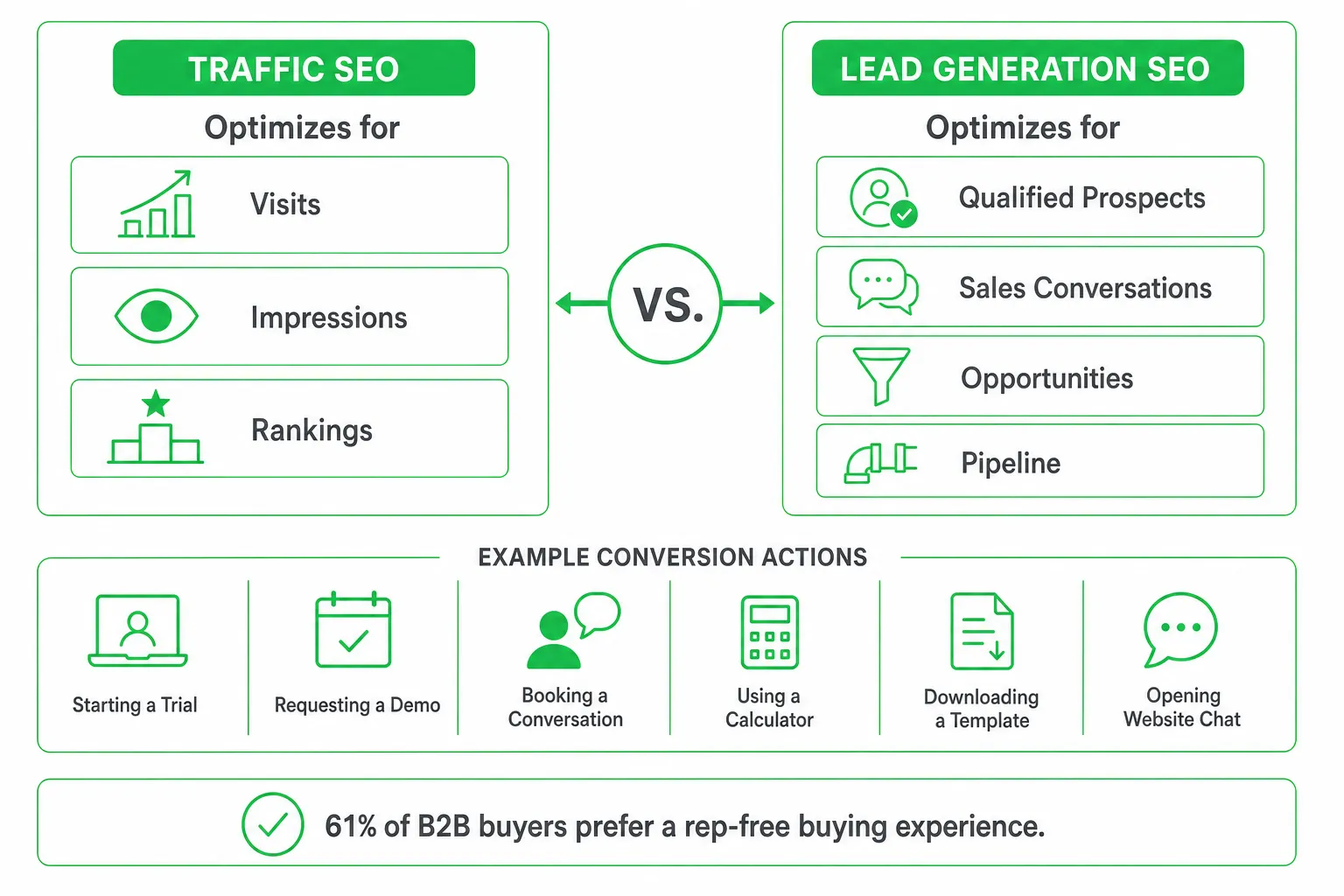
That action might be starting a trial, requesting a demo, booking a conversation, using a calculator, downloading a template, or opening website chat. The right action depends on the visitor's intent and readiness.
Traffic SEO: Optimizes for visits, impressions, and rankings.
Lead generation SEO: Optimizes for qualified prospects, sales conversations, opportunities, and pipeline.
This distinction is especially valuable in B2B SaaS. Gartner reports that 61% of B2B buyers prefer a rep-free buying experience. Your website must therefore explain the problem, show how your product works, address objections, and make the next step obvious without forcing a buyer to contact sales too early.
Content already contributes to demand. In its 2025 B2B content marketing benchmark, the Content Marketing Institute found that 74% of B2B marketers said content marketing helped generate demand or leads, while 49% said it helped generate sales or revenue.
How to Build an SEO Lead Generation Strategy
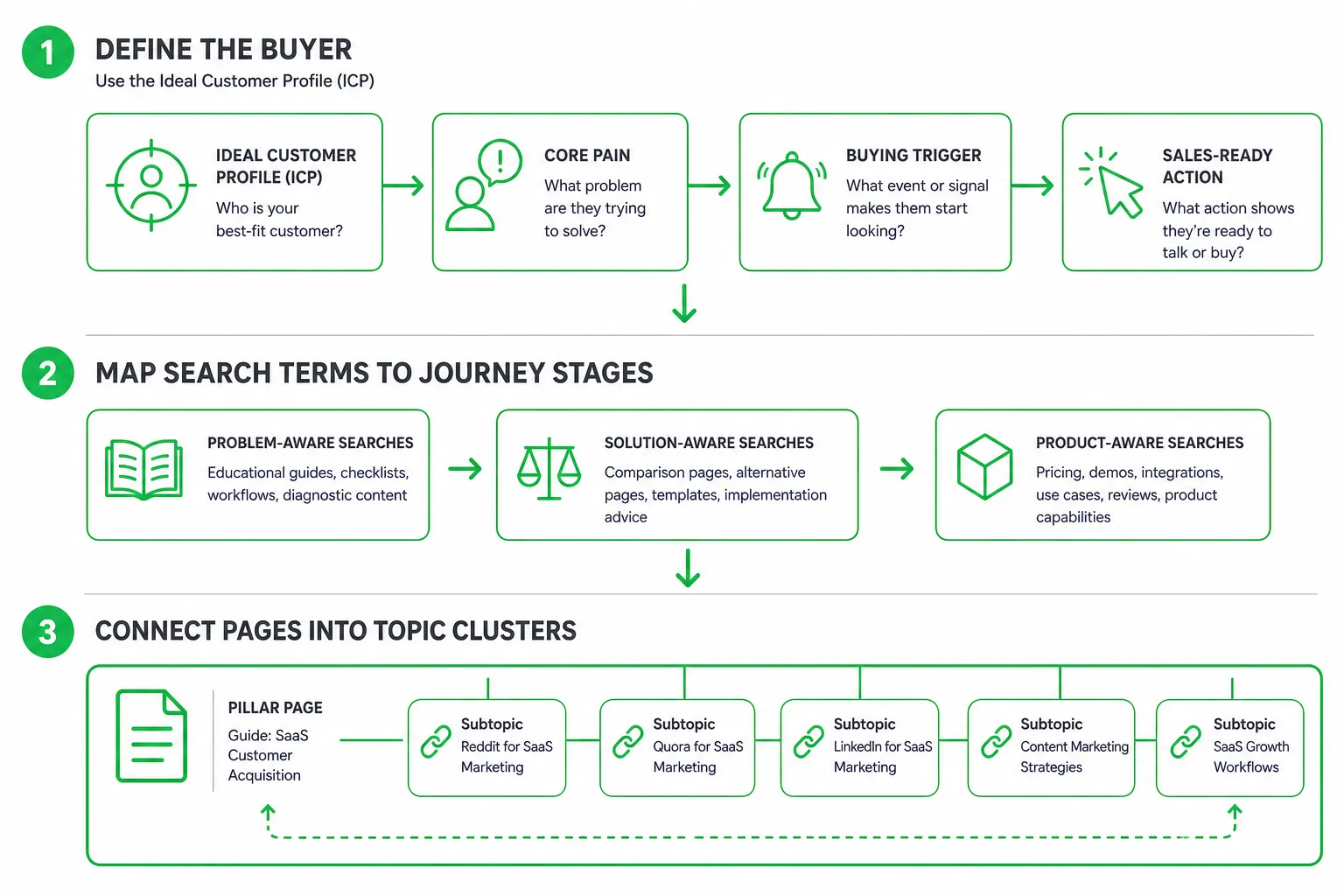
Start with the buyer, not a keyword tool. Define who you want to attract and what makes a prospect commercially valuable.
- Ideal customer profile: Identify company type, team size, use case, industry, and buying authority.
- Core pain: Describe the problem in the words your prospects use, not in internal product language.
- Buying trigger: Look for events that create urgency, such as a new growth target, failed process, team expansion, or expensive manual work.
- Sales-ready action: Decide which behaviors indicate genuine interest, such as viewing pricing, comparing alternatives, starting a trial, or requesting implementation guidance.
Then map search terms to the buyer journey.
- Problem-aware searches: Publish educational guides, checklists, workflows, and diagnostic content.
- Solution-aware searches: Create comparison pages, alternative pages, templates, and implementation advice.
- Product-aware searches: Build pages for pricing, demos, integrations, use cases, reviews, and product capabilities.
Connect these pages into topic clusters. A broad guide should link to more specific use cases. A use case should link to a product page. A product page should offer a relevant next step.
Topic Cluster: Problem guide to product page
For example, a guide about SaaS customer acquisition can link to a page about Reddit lead generation, which can link to a product workflow, a relevant integration, and a conversation option. Each link helps the reader continue researching while giving you a clearer signal of intent.
The SEO Foundations That Turn Visits Into Leads
Strong content cannot generate leads if search engines cannot access it or visitors cannot understand what to do next. Build the foundation before scaling publication.
- Use crawlable page architecture and descriptive URLs.
- Write distinct page titles and headings that match search intent.
- Keep important pages indexable and connect them with useful internal links.
- Make the mobile experience fast, readable, and easy to navigate.
- Place the value proposition and next step near the start of each commercial page.
Make conversion paths specific. A visitor reading an integration page may want setup documentation or a product tour. Someone comparing tools may want pricing, feature differences, or a demo. Someone reading an educational article may need a template before they are ready to speak with sales.
Reduce form friction. Ask only for information you can use. Add privacy reassurance, calendar booking, relevant follow-up emails, and website chat where they help the buyer continue independently.
Use structured data that accurately describes your pages, including software applications, products, articles, FAQs, reviews, and breadcrumbs. Validate the markup and monitor how those pages appear in search. Structured data cannot replace useful content, but it can help search engines interpret the page and qualify it for enhanced search features.
Google says its systems prioritize helpful, reliable, people-first content. It also warns against producing large amounts of automated content across many topics without adding value. Use automation to accelerate research and production, but add product knowledge, original examples, clear trade-offs, and expert review.
The Missed Opportunity: AI Search, Reddit, and Pipeline
Traditional SEO advice often stops at keywords, content, backlinks, forms, and rankings. That is no longer enough for software companies. Buyers now discover products through AI-generated answers and high-intent communities, then move between those channels before they ever visit your website.
In the 2025 Buyer Behavior Report, G2 Research found that 79% of software buyers said AI search had changed how they conduct research. Approximately 30% said they were more productive with AI search than with traditional search and started research with AI search more often than Google.
That changes how you create content. Write pages that answer the question directly. Define terms clearly. Explain trade-offs. Show where your advice applies and where it does not. Cite reliable sources. Cover the follow-up questions a buyer asks before choosing software.
Answer Engine Content: Clear claims, useful evidence, obvious context
AI systems need understandable information, but people still decide whether your advice feels credible. Include first-hand product knowledge, implementation detail, transparent limitations, and examples that help a buyer judge fit.
Then connect search with communities such as Reddit. Search for conversations where people describe the problem your product solves. Read the entire thread. Contribute a genuinely useful answer before mentioning your product. If the person wants more detail, invite them to continue the conversation without pushing an automated pitch.
Reddit can reveal demand that keyword data misses. A prospect may describe a workflow failure, ask for tool recommendations, or compare approaches without using the category term you target in SEO. Those conversations can inform new content, product pages, FAQs, and outreach.
Measure the combined system by qualified conversations, sales-accepted leads, opportunities, pipeline, and revenue influence. Rankings and sessions remain useful diagnostic signals, but they are not the commercial result.
SEO Lead Generation Options for B2B SaaS
You can build this program internally, use an agency, or adopt an AI-assisted workflow. The right choice depends on your available expertise, speed requirements, and need for control.
| Option | Best for | Strength | Watch for |
|---|---|---|---|
| In-house team | Companies with product and marketing capacity | Deep product knowledge and brand control | Requires sustained research, writing, technical SEO, distribution, and reporting |
| SEO agency | Teams needing specialist execution | External expertise and production capacity | Generic content, weak SaaS context, or reporting focused only on traffic |
| AI-assisted platform | Founders and small teams that need leverage | Faster research, content, publishing, outreach, and lead scoring | Outputs still need review for accuracy, relevance, and authentic voice |
In-house Agent: Owns the customer context
An internal program gives you the strongest connection to product knowledge and customer language. It also requires someone to manage keyword research, content briefs, technical issues, distribution, conversion optimization, community activity, and reporting.
Agency Agent: Adds specialist capacity
An agency can fill strategic or execution gaps. Ask how it defines a qualified lead, how it understands your sales cycle, and how it proves content contributed to pipeline. Avoid programs that promise volume without explaining relevance.
AI Agent: Accelerates repetitive work
An AI-assisted workflow can surface topics, draft content, identify relevant conversations, prepare personalized outreach, publish across channels, and score leads. Keep a human approval step for every important output and send.
How to Measure SEO Lead Generation
Build measurement around the full funnel. Start with the visitor, but finish with the business outcome.
- Discovery: Track qualified organic visits, target-page impressions, and search queries.
- Engagement: Monitor time spent on useful pages, product-page visits, pricing views, and return visits.
- Conversion: Record form completions, trial starts, calendar bookings, chat conversations, and template downloads.
- Qualification: Separate relevant prospects from students, vendors, job seekers, and poor-fit submissions.
- Pipeline: Track sales acceptance, opportunity creation, sourced pipeline, influenced pipeline, and revenue.
Define your stages before reporting results. Agree on what qualifies as a marketing-qualified lead, sales-qualified lead, opportunity, and disqualified lead. Otherwise, your dashboard can make weak submissions look like growth.
Connect search data, analytics, forms, chat, CRM stages, and campaign information. Record the first-touch source, converting page, assisting content, community interaction, and account progression. This reveals whether a commercial page created the conversion or whether an educational article and Reddit conversation helped the account get there.
Use the feedback loop to refine your program. If a page attracts the right visitors but few conversations, improve its offer and call to action. If it creates many submissions but little sales acceptance, tighten the audience and qualification. If prospects repeatedly ask the same question in chat or Reddit, create a direct answer and link to it from relevant pages.
Start Lead Generation SEO With OneUp Today
OneUp Today combines SEO autopilot, blog autopilot, AI content creation, multi-platform publishing, Reddit lead generation, lead scoring, personalized DMs and emails, website chat, and Google-focused growth in one AI marketing workflow.
Start with your ideal customer and highest-value problem. Then use the workflow to surface relevant search topics and Reddit conversations, draft responses in your voice, prepare content, and organize follow-up for approval.
Keep control over every send. Review the recommendation, personalize the message, publish the most useful answer, and route interested prospects into a tracked conversation. The goal is not automated volume. It is a connected system that earns visibility, reaches buyers already asking for solutions, and turns demand into qualified pipeline.
OneUp Today helps you connect that process across SEO, blog publishing, Reddit discovery, personalized outreach, website chat, and lead scoring, while keeping approval in your hands.
Frequently asked questions
How long does lead generation SEO typically take to produce results?
It usually takes 4 to 6 months to see measurable lead generation from SEO. This timeline depends on your site's authority, competition, and content quality, but consistent optimization for buyer intent accelerates pipeline growth.
What is the most important metric for lead generation SEO?
Qualified pipeline is the most important metric, not traffic or rankings. Track demo requests, trial starts, and sales conversations from organic visitors to measure real revenue impact.
Can lead generation SEO work for small businesses with limited budgets?
Yes, small businesses can succeed by targeting long-tail problem-aware keywords and creating high-value content like checklists or calculators. This approach attracts qualified leads without competing for expensive generic terms.
How does lead generation SEO differ from traditional SEO?
Lead generation SEO optimizes for qualified prospects and sales conversations, while traditional SEO focuses on traffic and rankings. The former maps every keyword to a conversion action, such as a demo request or trial start.
What types of content best support lead generation SEO?
Comparison pages, implementation guides, and diagnostic checklists perform best. These help solution-aware buyers evaluate options and take a low-friction next step, like booking a call or using a template.