
Sprout Social Ticker: Smarter Publishing Options
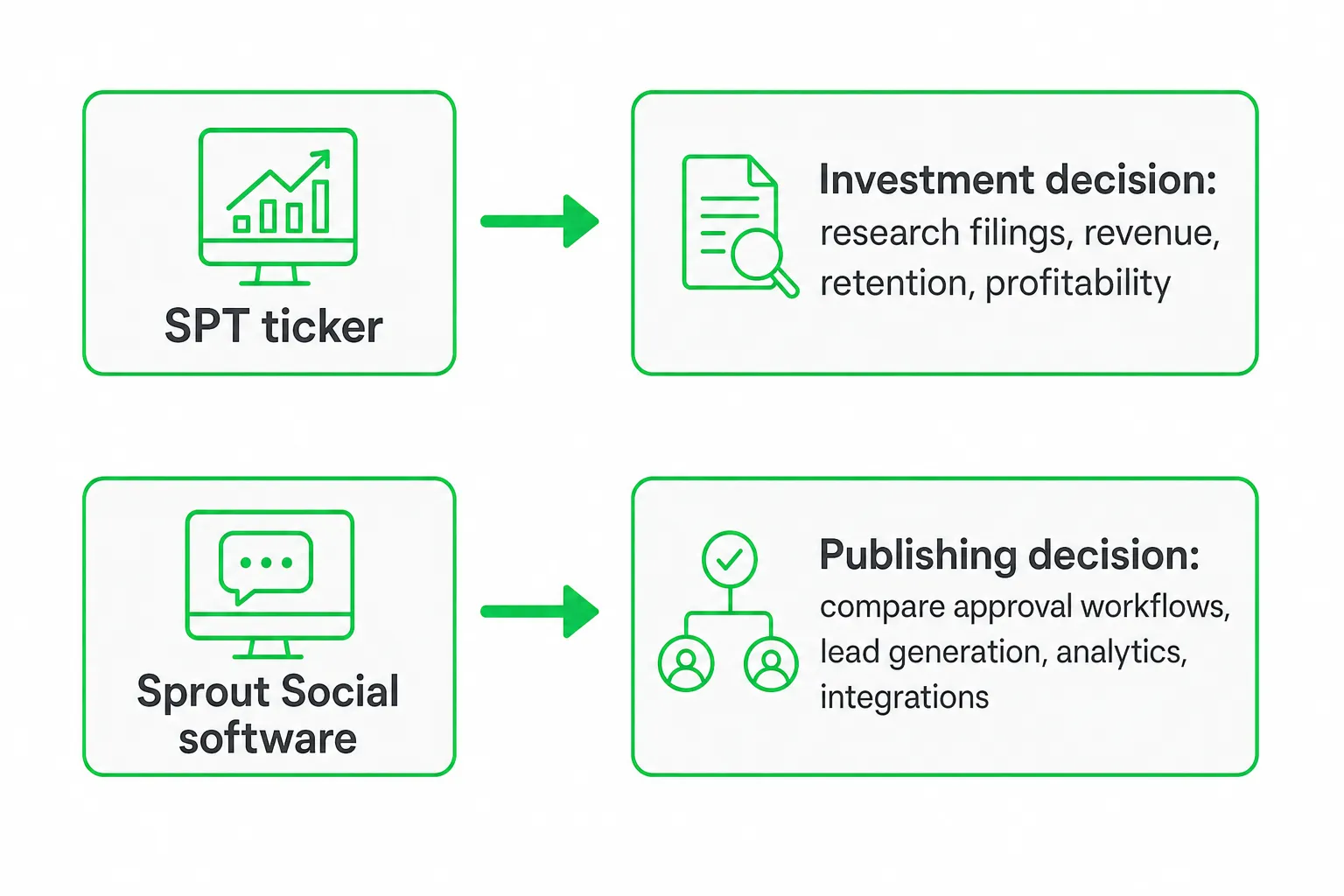
The Sprout Social ticker is SPT, the Nasdaq symbol for Sprout Social, Inc., according to the Sprout Social Investor Relations FAQ. If you are researching SPT, separate the stock from the software: buying shares is an investment decision, while subscribing gives your team access to a social-management platform. That distinction matters because a ticker lookup tells you little about whether the product fits your publishing and growth workflow.
Key takeaways
- Use SPT to research Sprout Social as a public company, not as a shortcut for evaluating its software.
- Review revenue, customer mix, retention, profitability disclosures, and guidance before forming an investment view.
- Sprout Social and broader AI marketing platforms solve different problems, even when both offer publishing.
- Compare approval workflows, lead generation, analytics, integrations, and the manual work left for your team.
What Is the Sprout Social Ticker?
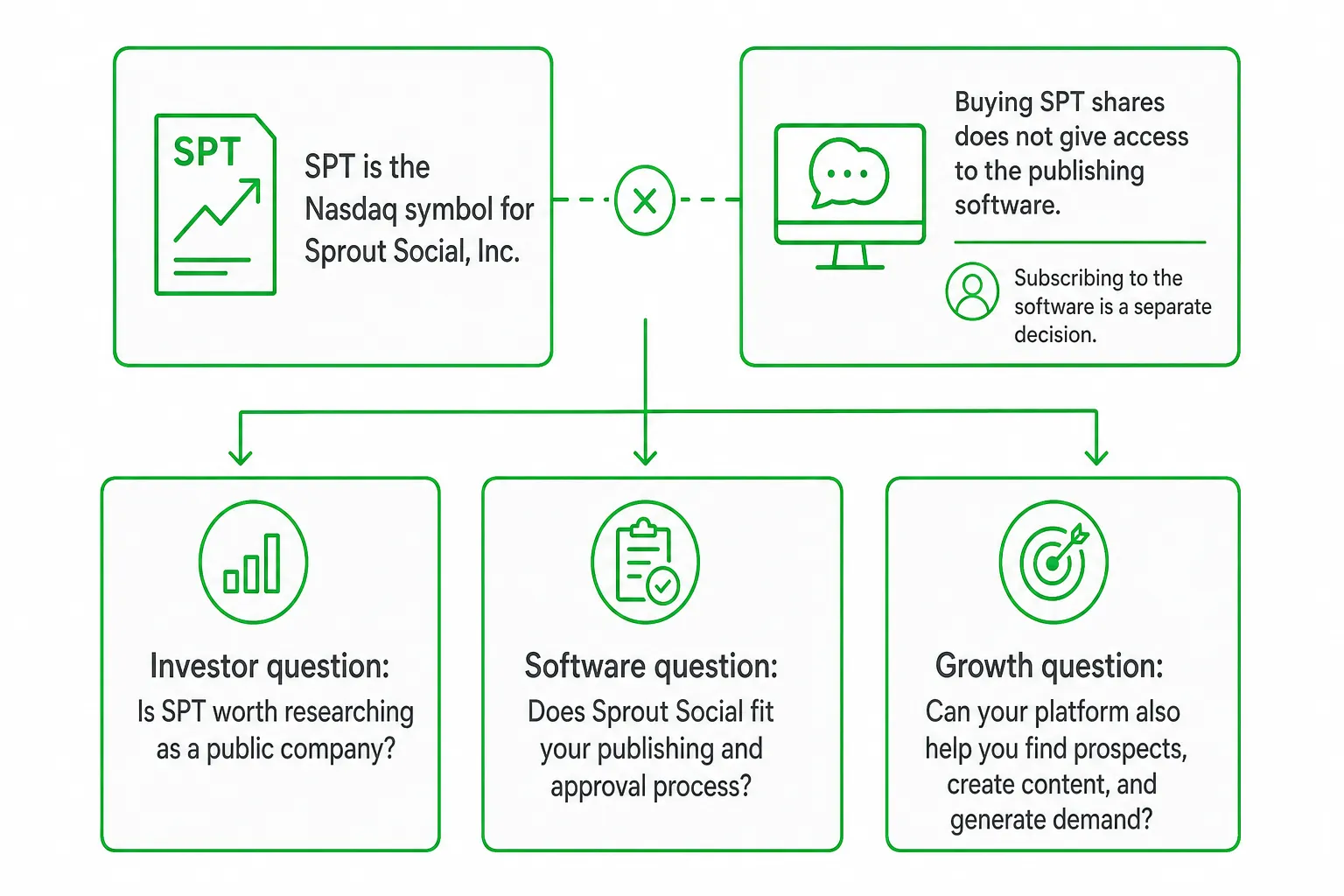
The Sprout Social ticker is SPT. It identifies Sprout Social, Inc. on Nasdaq. Use the company’s Investor Relations FAQ to confirm the symbol, then use the company’s stock-information page for current market data and official updates.
Buying SPT means buying shares in Sprout Social. It does not give you access to the company’s publishing software. Subscribing to Sprout Social is a separate commercial decision for managing social channels, content calendars, analytics, and team workflows.
That sounds obvious. Search results often blur the two. A person looking for “Sprout Social ticker” may actually want a live quote, an investor snapshot, software pricing, or an alternative publishing tool. Start by identifying which decision you are making.
- Investor question: Is SPT worth researching as a public company?
- Software question: Does Sprout Social fit your publishing and approval process?
- Growth question: Can your platform also help you find prospects, create content, and generate demand?
How to Research SPT Before You Buy
Researching SPT requires more than checking the latest share price. A price is a market signal, not a complete business analysis. Review the company’s filings, earnings releases, guidance, customer metrics, retention, and profitability disclosures before deciding what the stock means to you.
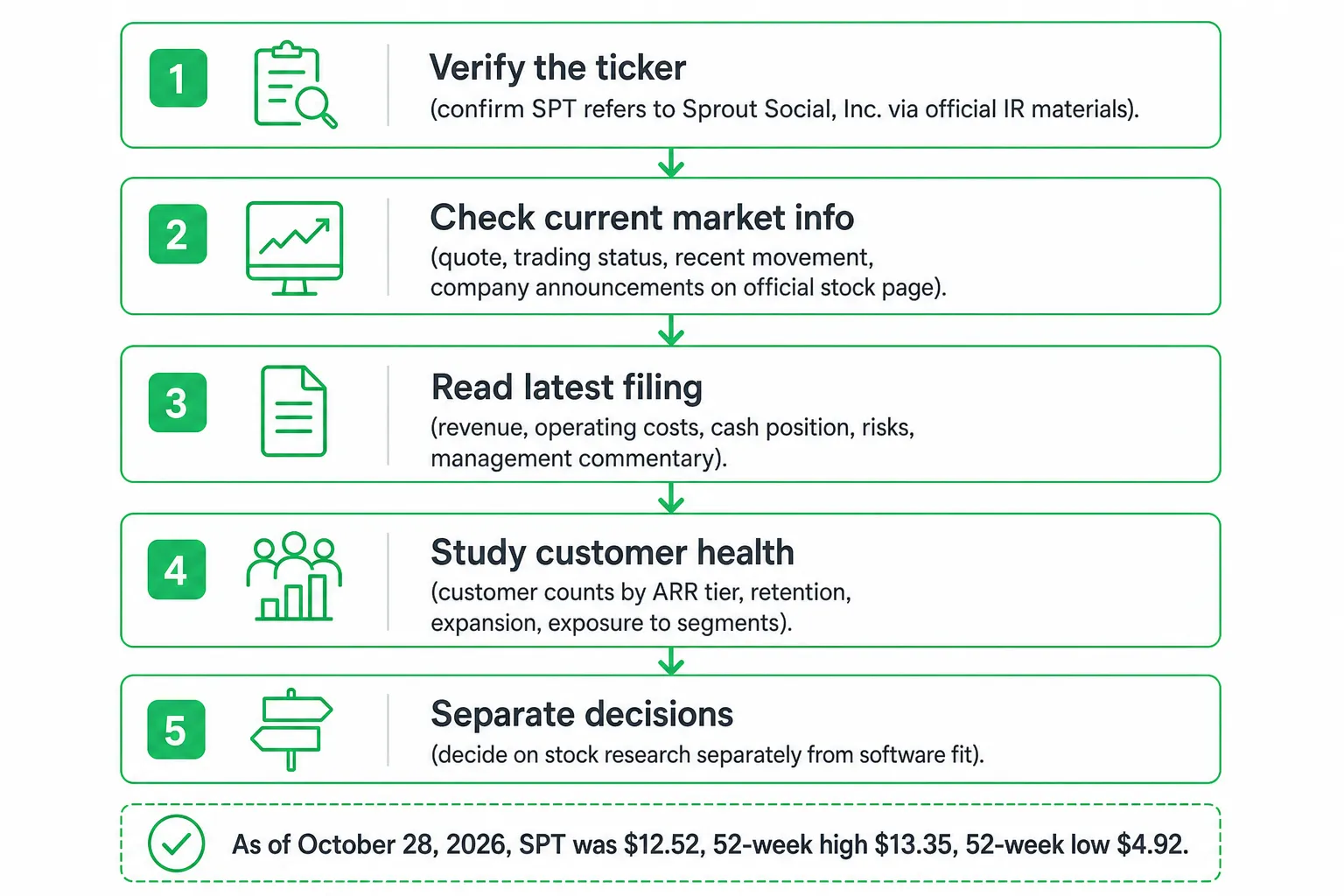
- Verify the ticker: Confirm that SPT still refers to Sprout Social, Inc. through official investor-relations materials.
- Check the current market information: Review the quote, trading status, recent movement, and company announcements on the official stock page.
- Read the latest filing: Look for revenue performance, operating costs, cash position, risks, and management commentary.
- Study customer health: Examine customer counts by ARR tier, retention, expansion, and the company’s exposure to different customer segments.
- Separate the decisions: Decide whether the stock deserves further research, then separately decide whether the software matches your team.
As of October 28, 2026, Sprout Social’s investor-relations stock page listed SPT at $12.52, with a 52-week high of $13.35 and a 52-week low of $4.92. See the company’s Investor Relations stock information for that market snapshot and subsequent updates.
Do not treat that quote as a verdict. A stock can move for reasons that have little to do with the publishing experience you would receive as a customer. Likewise, a useful software product does not automatically make its public company an attractive investment.
The Fundamental Context Page-One Results Miss
Many ticker pages stop at “SPT means Sprout Social.” Pricing pages stop at plan names. Neither gives you enough context to understand the company behind the product.
Sprout Social reported $457.5 million in fiscal-year 2025 revenue, compared with $405.9 million in 2024, representing 13% year-over-year growth, according to its 2025 Form 10-K. That gives you a better starting point than the ticker alone, because it shows the scale and recent growth rate of the business.
The customer mix adds another useful layer. At December 31, 2025, Sprout Social had 3,803 customers contributing at least $30,000 in annual recurring revenue and 2,022 customers contributing at least $50,000, according to the Sprout Social fourth-quarter earnings release.
Retention also matters. Sprout Social’s dollar-based net retention rate was 100% in 2025, or 102% when excluding SMB customers, according to the same Sprout Social fourth-quarter earnings release.
- Revenue: Shows the company’s reported scale and growth.
- ARR tiers: Shows how many customers sit above meaningful recurring-revenue thresholds.
- Net retention: Helps you assess expansion and contraction among existing customers.
- Profitability: Requires reading the filing and disclosures rather than inferring it from revenue alone.
These figures add context that a ticker lookup cannot provide. They still do not represent a complete customer-concentration analysis or a full profitability conclusion. Use them as inputs, not as a substitute for reading the filing.
Buying Sprout Social Software: What to Compare
If your goal is software, evaluate the workflow rather than the ticker. Ask how many seats you need, which channels you publish to, how approvals work, what analytics are included, and how much setup your team must handle.
Sprout Social’s published annual-billing prices list Essentials at $79 per seat per month, Standard at $199, Professional at $299, and Advanced at $399. Enterprise pricing is custom. Confirm current availability and billing terms on the official Sprout Social pricing page.
The same pricing page advertises a 30-day free trial without requiring a credit card. Treat the trial as a workflow test, not just a feature tour.
- Publishing: Can you draft, schedule, review, and modify posts without unnecessary handoffs?
- Approvals: Can the right person approve content before it goes live?
- Analytics: Do the reports answer the questions your team actually asks?
- Integrations: Does the platform connect with the systems you already use?
- Support: What happens when a channel changes or a publishing issue appears?
- Scope: Do you need social management alone, or a broader marketing workflow?
During a trial, recreate a real week of work. Connect the relevant channels, draft representative posts, run the approval process, inspect the reports, and record every manual step. That process tells you more than a polished product tour.
Sprout Social vs. OneUp Today
Sprout Social is worth considering when your priority is a purpose-built social publishing and management environment. It makes sense to compare it with a broader AI marketing workflow when publishing is only one part of how you acquire customers.
OneUp Today is built for SaaS founders, indie hackers, and small teams that want an AI marketing team covering Reddit lead generation, lead scoring, personalized DMs and emails, SEO autopilot, blog autopilot, AI content creation, chatbot use cases, and multi-platform posting. The distinction is simple: Sprout Social centers on social management, while OneUp Today connects publishing with demand generation.
| Compare | Sprout Social | OneUp Today |
|---|---|---|
| Primary fit | Focused social publishing and management | Broader AI marketing and SaaS growth workflows |
| Publishing | Team-oriented scheduling, approvals, and social workflows | Multi-platform posting connected to content and outreach |
| Lead generation | Evaluate based on your required integrations and process | Reddit discovery, lead scoring, and personalized outreach drafts |
| Content scope | Social content and management tasks | Social content, blogs, SEO, replies, DMs, and emails |
| Control | Compare approval and permission features | Review every AI-generated send before it goes out |
Our own Reddit benchmark shows why timing and channel context matter when publishing connects to outreach. Across 2,269 real Reddit cold DM conversations sent from March to September 2026, 29.7% received at least one human reply. DMs sent within 12 hours of the post replied about 43% of the time, against about 21% for DMs sent a week or more later. See the OneUp Today Reddit DM benchmarks.
Use that data as a workflow lesson, not a promise. A publishing tool helps you distribute content. A broader marketing system may help you identify the conversation, draft a relevant response, and route the work for approval before sending.
What to Do Next
If your goal is investing, verify SPT through official investor-relations materials. Read the latest filing and earnings release. Assess revenue, customer mix, retention, profitability disclosures, and guidance instead of reacting to a ticker-page headline.
If your goal is publishing software, write down your required channels, approval process, content volume, analytics needs, integrations, and lead-generation workflows. Then test the product against real work rather than generic demo examples.
- Define the job: Decide whether you need social management, lead discovery, content production, or a combination.
- Build a short comparison: Score each option on publishing control, approvals, reporting, integrations, and manual effort.
- Run a controlled pilot: Connect relevant channels and use representative content and conversations.
- Review every AI send: Confirm that drafts match your voice and that your team approves outreach before delivery.
- Measure the workflow: Track time saved, quality of conversations, publishing consistency, and qualified opportunities.
Short takeaway: SPT is Sprout Social’s stock ticker, not its software plan. Research SPT as an investment, then choose your publishing platform based on how your team actually acquires and converts customers.
Practical next step: Open the official SPT investor page if you are researching the stock. If you are choosing software, list your required workflows first, then start a controlled trial with approval enabled.
Frequently asked questions
Is Sprout Social ticker SPT the same as the software subscription?
No. SPT is the Nasdaq symbol for Sprout Social, Inc. shares, not a software subscription. Buying SPT is an investment decision, while subscribing gives your team access to the social management platform. These are separate actions with different purposes.
What was Sprout Social's stock price on October 28, 2026?
The price was $12.52 on October 28, 2026, according to Sprout Social's investor relations stock page. This was within a 52-week range of $4.92 to $13.35. Remember, stock prices fluctuate and should not be used alone for investment decisions.
How much revenue did Sprout Social report in fiscal year 2025?
Sprout Social reported $457.5 million in fiscal-year 2025 revenue, up from $405.9 million in 2024, a 13% year-over-year growth. This data comes from their 2025 Form 10-K and provides context for evaluating the company's financial health.
Does buying SPT shares give you access to Sprout Social software?
No. Buying SPT shares is an investment in the public company and does not provide access to the publishing software. Subscribing to Sprout Social is a separate commercial decision for managing social channels, content calendars, and analytics.