
HubSpot CRM Alternative for Small Teams
Key takeaways
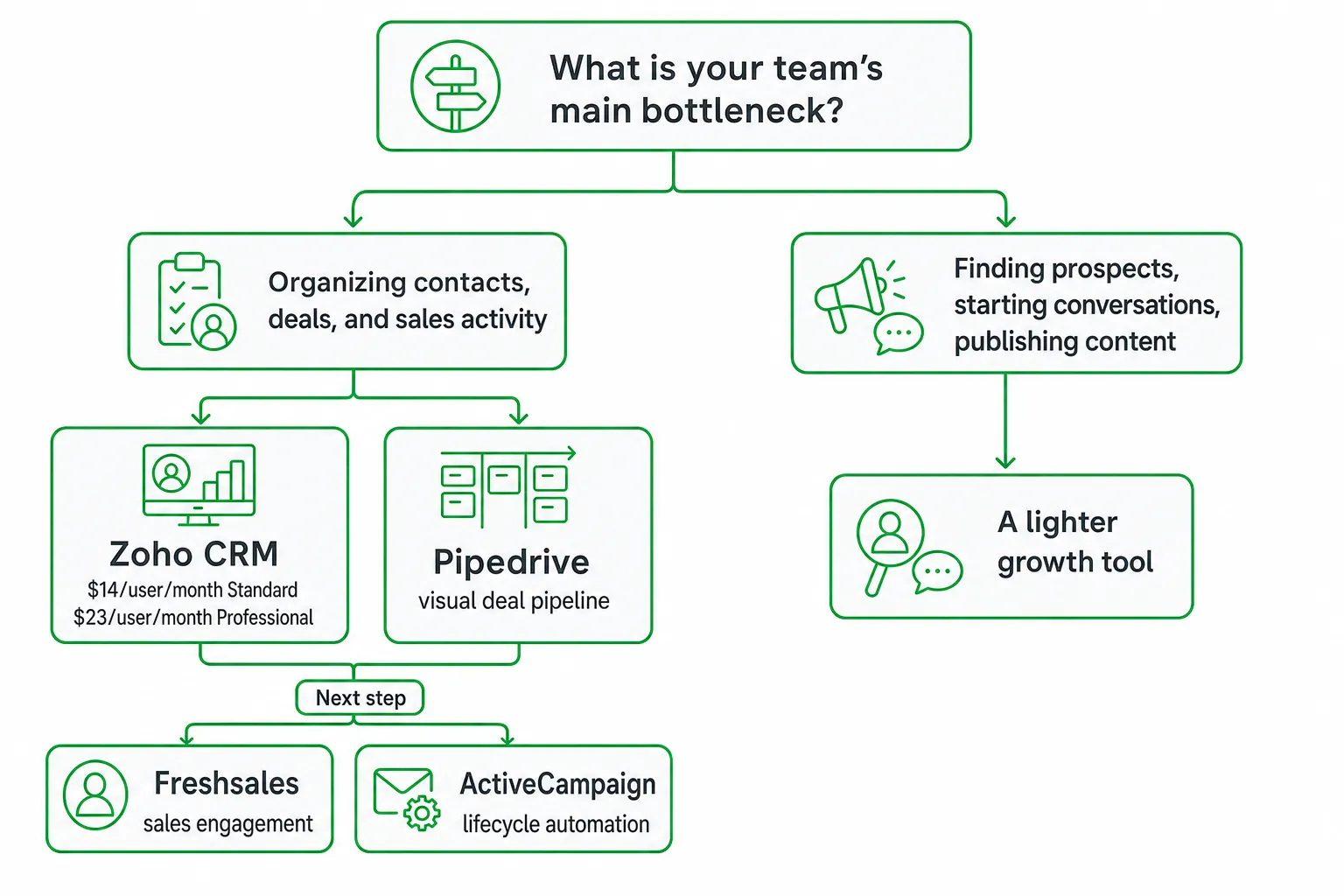
- Choose Zoho CRM or Pipedrive when your main need is organizing contacts, deals, and sales activity.
- Choose Freshsales or ActiveCampaign when sales engagement and lifecycle automation matter more than CRM breadth.
- Choose a lighter growth tool when your bottleneck is finding prospects, starting conversations, and publishing demand-generating content.
- Keep your CRM as the source of truth when needed, but evaluate whether another tool can create qualified conversations faster.
The best HubSpot CRM alternative for a small team depends on the work you need completed. Choose Zoho CRM for broad CRM functionality, Pipedrive for a focused sales pipeline, Freshsales for approachable sales automation, or ActiveCampaign for lifecycle marketing.
If your real problem is finding people who already want a solution, a traditional CRM may not be enough. You may need a lighter growth layer that discovers buying intent, drafts relevant outreach, and turns attention into sales conversations.
The best HubSpot CRM alternative for small teams
Start with the bottleneck, not the brand name.
- Need a system of record? Choose Zoho CRM or another full CRM.
- Need a visual deal pipeline? Choose Pipedrive.
- Need sales engagement and lifecycle automation? Consider Freshsales or ActiveCampaign.
- Need more qualified conversations? Consider a lighter growth tool alongside your CRM.
Zoho CRM is the broadest lower-cost option in this comparison. Its Standard plan costs $14 per user per month, while Professional costs $23 per user per month, according to Zoho CRM.
Pipedrive fits a sales-led team that wants to see every deal, follow-up, and next step in one visual workflow. Freshsales suits teams that want CRM and sales engagement in one approachable product. ActiveCampaign is better viewed as a marketing automation platform than as a direct replacement for every CRM function.
Choose a lighter growth tool when the CRM is not the main constraint. If you already know how to manage contacts but struggle to identify buyers, write relevant messages, or publish consistently, adding more CRM features may not solve the problem.
Why small teams look for a HubSpot replacement
Small teams often leave HubSpot for practical reasons. The platform may be broader than the team needs, the implementation may take too much attention, or the total cost may rise as more sales functionality becomes necessary.
HubSpot Sales Hub Starter starts at $20 per core seat per month. Professional costs $100 per sales seat, and Enterprise costs $150 per sales seat when billed annually, according to the HubSpot Product and Services Catalog.
Look beyond the headline subscription price. Professional requires a $1,500 one-time onboarding fee, while Enterprise requires $3,500, according to the same HubSpot Product and Services Catalog.
That does not make HubSpot a poor choice. A full platform can be useful when you need shared records, structured sales stages, marketing workflows, permissions, reporting, and handoffs between teams.
The better question is different: which work should your software complete? A CRM can organize the leads you already have. It does not automatically create demand, identify every relevant buying conversation, or make your outreach timely and useful.
HubSpot alternatives compared by use case
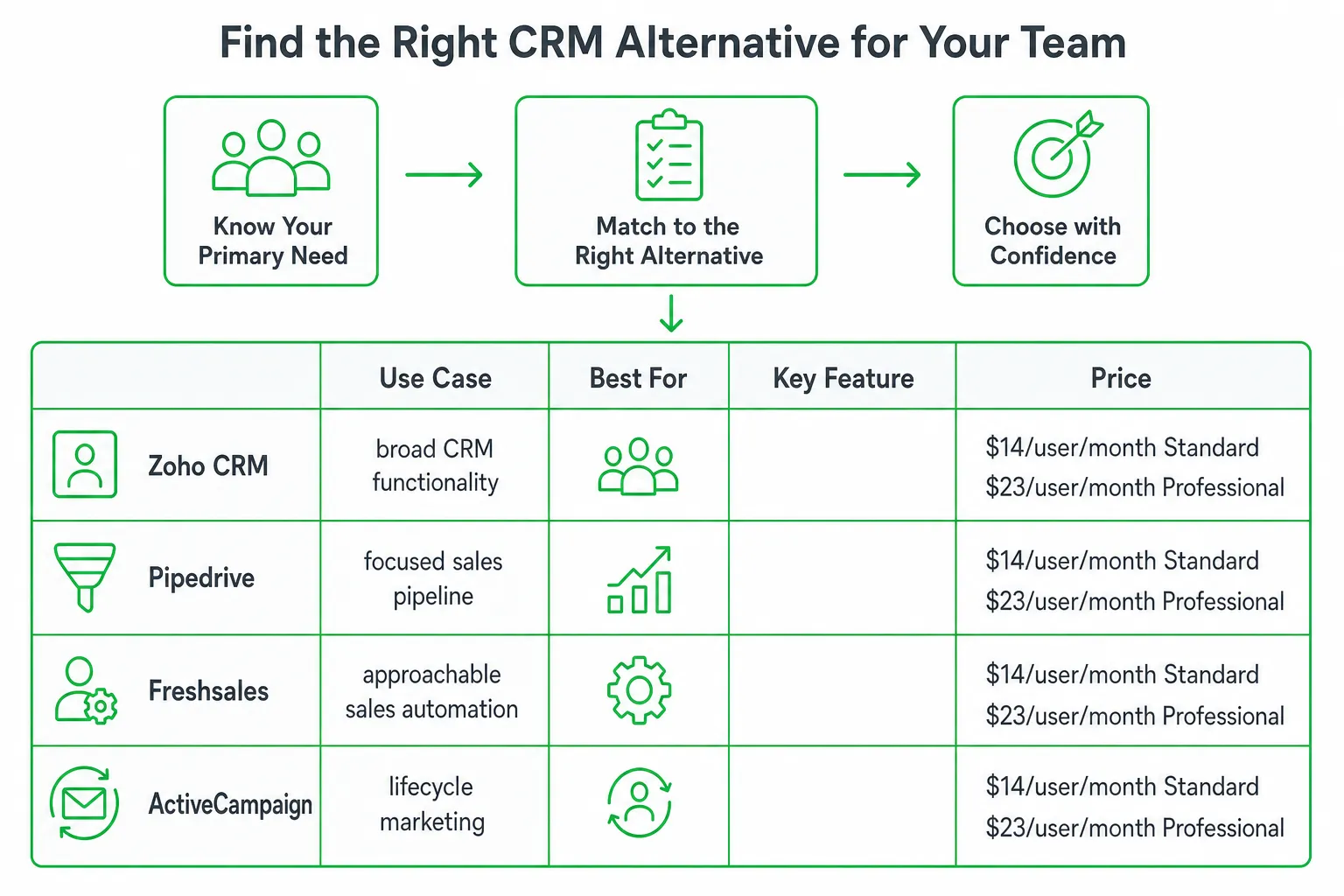
Compare these products by job to be done. A lower price does not help if the platform lacks the workflow your team needs.
| Tool | Best fit | Published pricing or limit | Key distinction |
|---|---|---|---|
| Zoho CRM | Broad, configurable CRM | $14 per user per month Standard; $23 per user per month Professional, according to Zoho CRM | Professional includes AI agents, process management, inventory management, predictive intelligence, unlimited reports, CPQ, and custom portals. |
| Freshsales | CRM and sales engagement | Free for up to three users; $9, $39, and $59 per user per month for Growth, Pro, and Enterprise when billed annually, according to Freshworks Freshsales | Useful when you want CRM, engagement, and intelligence in one product. |
| Pipedrive | Focused sales pipeline | $14 per seat per month for Lite when billed annually, according to Pipedrive CRM pricing | Includes lead, calendar, and pipeline management, plus access to more than 500 integrations. |
| ActiveCampaign | Marketing automation | Starts at $15 for accounts with fewer than 1,000 contacts, according to ActiveCampaign | Better suited to lifecycle communication and automated nurturing than broad CRM administration. |
| Salesforce | Complex or enterprise CRM | Not published | Evaluate it for advanced CRM requirements, governance, and customization rather than simplicity. |
Use Zoho CRM when you need configurable workflows, reporting, custom processes, and room to expand. Use Pipedrive when your team mainly needs clear deal stages and disciplined follow-up.
Freshsales is a practical middle ground for sales teams that want more than a pipeline without adopting a large platform. ActiveCampaign belongs on the shortlist when automated nurture, segmentation, and lifecycle messaging drive your sales motion.
The gap most CRM comparison guides miss
A CRM manages records. A demand-generation system helps you find the right people before they become records.
That difference changes your evaluation. Ask whether a product can:
- Find relevant conversations where people describe a problem.
- Detect buying intent and prioritize the strongest opportunities.
- Draft a message that references the prospect’s actual words.
- Let you approve each outbound message before it sends.
- Support public replies, direct messages, email, and website conversations.
- Connect engagement data to your sales process.
Meet the Lead Agent: A useful growth layer should surface high-intent conversations instead of forcing you to search manually through every channel. That is different from importing a contact after the prospect has already found you.
Meet the Outreach Agent: Human approval matters when messages represent your company. OneUp Today describes a workflow that drafts personalized DMs, email notes, and public replies, keeps them as drafts until approval, and sends through your browser using a Chrome extension, as described by OneUp Today.
Timing also belongs in the evaluation. OneUp Today’s study of 2,269 Reddit cold-DM conversations found that 29.7% received at least one human reply. Messages sent within 12 hours of a post received replies about 43.2% of the time, compared with about 21.3% for messages sent a week or more later, according to OneUp Today’s Reddit DM Benchmarks 2026.
The lesson is not to send more messages. It is to identify the right conversation, respond while the problem is active, and keep a human in control of the final send.
How to choose between a full CRM and a lighter growth tool
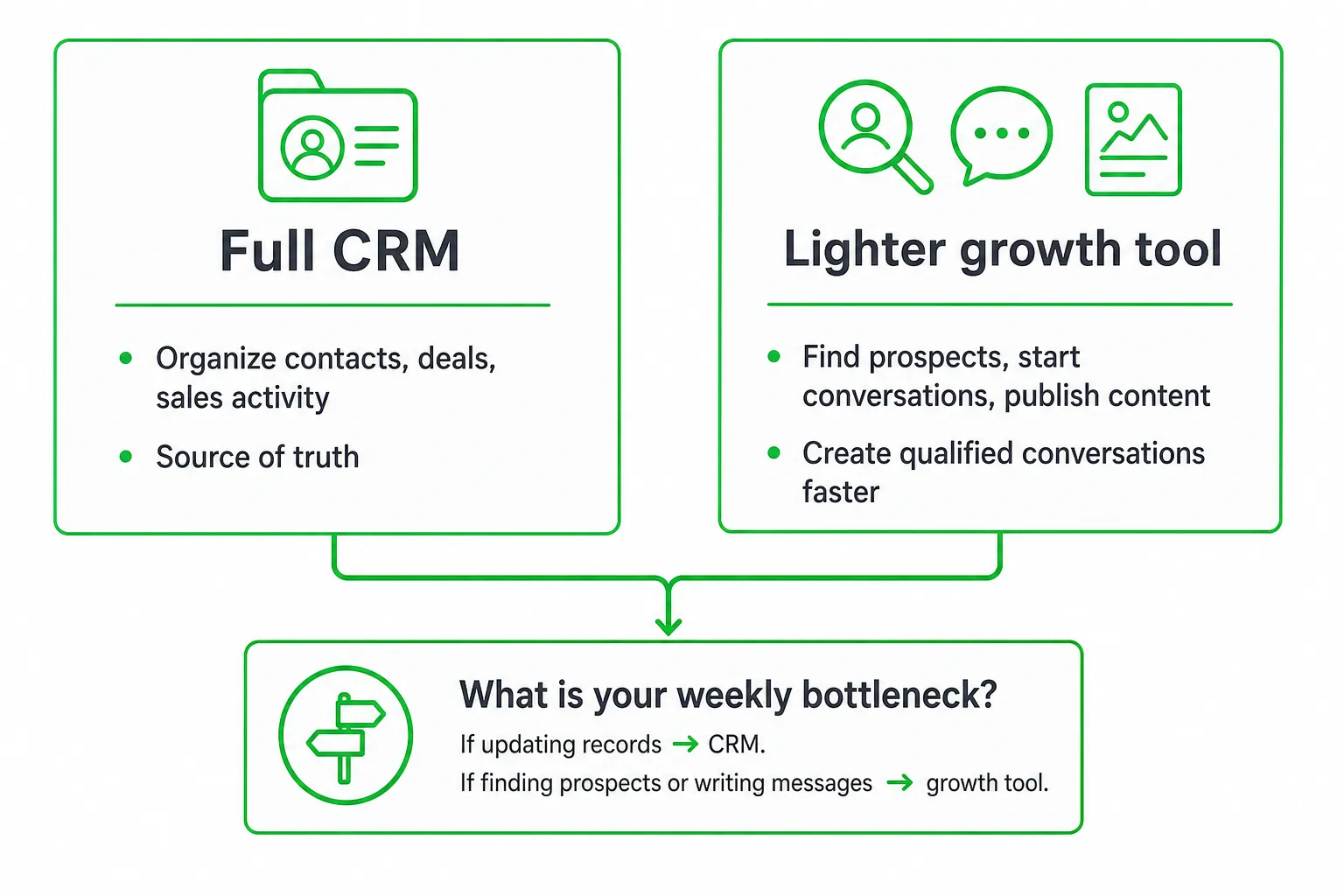
Choose a full CRM when your team needs a dependable shared record of every account and opportunity.
- Shared account records: Keep contacts, companies, activities, and ownership in one place.
- Structured stages: Define qualification, proposal, negotiation, and closed outcomes.
- Forecasting: Review pipeline value and expected revenue using consistent stages.
- Permissions: Control who can view, edit, or export customer information.
- Handoffs: Move work cleanly from marketing to sales or from sales to customer success.
- Reporting: Measure conversion activity, pipeline movement, and follow-up.
Choose a lighter growth tool when the immediate problem happens before CRM administration:
- You do not have enough qualified prospects.
- Your team spends too long researching who to contact.
- Every outreach message starts from a blank page.
- You need public replies across multiple channels.
- Your publishing schedule stops whenever the founder gets busy.
- Your website receives questions that nobody answers promptly.
You can also use both. Keep the CRM as your source of truth, then connect a growth layer for prospect discovery, approved outreach, content distribution, and lead handoff.
Score each option on implementation effort, data ownership, approval controls, integrations, reporting depth, channel coverage, and its direct contribution to qualified conversations. This prevents you from choosing a platform because its feature list looks impressive while ignoring the work your team actually needs done.
A practical migration and evaluation process
Do not migrate because another product has a better homepage. Test it against your real sales motion.
- Document the workflows. List contact capture, qualification, pipeline stages, follow-ups, email sync, reporting, website conversion, and team notifications.
- Separate requirements. Mark each item as a must-have CRM function, a marketing feature, or a growth task. Remove requirements that do not support your current sales motion.
- Run a real-workflow test. Use real prospects and real draft messages. Review relevance, editing time, approval steps, deliverability, and handoff quality.
- Check the data model. Confirm that fields, ownership rules, opt-out handling, account records, and activity history will survive the switch.
- Plan integrations. Identify the tools that need to exchange contacts, conversations, website leads, and status changes.
- Keep an exit path. Maintain a fallback export and document how your team can retrieve its data if the replacement does not fit.
Recommendation: match the tool to the bottleneck
Pick Zoho CRM or Pipedrive when your primary bottleneck is organizing sales work. Pick Freshsales when you want a practical combination of CRM and sales engagement. Pick ActiveCampaign when automated nurturing and lifecycle communication are central.
Pick a lighter growth tool when your primary bottleneck is generating demand. OneUp Today combines lead discovery, personalized outreach, cross-channel reply drafts, SEO publishing, and website chat, while keeping messages in draft form until approval, according to OneUp Today.
That lighter tool does not need to replace your CRM. It can feed qualified conversations into the system you already trust. Approval-based automation also does not mean uncontrolled sending. It means software handles research and drafting while you retain the final decision.
Start with one action: define whether your biggest constraint is record management or demand generation. Shortlist the matching category, run a real-workflow trial, connect it to your CRM where needed, and keep human approval for outbound messages.
Bottom line: The right HubSpot CRM alternative is the one that removes your actual bottleneck. Choose a CRM for control and visibility. Add a growth layer when you need more qualified conversations.
Frequently asked questions
Is Zoho CRM a good alternative to HubSpot for small businesses?
Yes, Zoho CRM is a strong alternative for small businesses needing broad CRM functionality at a lower cost. Its Standard plan starts at $14 per user per month, offering features like AI agents and process management, making it more affordable than HubSpot's comparable plans.
Can Pipedrive replace HubSpot for sales pipeline management?
Yes, Pipedrive can replace HubSpot if your main need is a visual sales pipeline. It focuses on deal tracking and follow-ups, making it ideal for sales-led teams. However, it lacks HubSpot's broader marketing and service features, so it's best for teams prioritizing pipeline clarity.
Does Freshsales offer better sales automation than HubSpot?
Yes, Freshsales offers approachable sales automation that may be better for teams focused on sales engagement. It combines CRM with built-in automation for tasks like lead scoring and email sequences, often at a lower price point than HubSpot, though it has fewer integrations.
What is the cheapest HubSpot CRM alternative for startups?
Zoho CRM is the cheapest alternative for startups, with a Standard plan at $14 per user per month. This is lower than HubSpot's Sales Hub Starter at $20 per seat per month, offering similar contact management and deal tracking without the higher costs of HubSpot's advanced tiers.
Should I choose ActiveCampaign over HubSpot for marketing automation?
Yes, choose ActiveCampaign over HubSpot if your primary need is lifecycle marketing automation. It excels in email campaigns and customer journeys, but it is not a full CRM replacement. It works best as a marketing tool alongside a separate CRM for contact management.