
Lead Generation AI: Best Tools to Automate Outreach
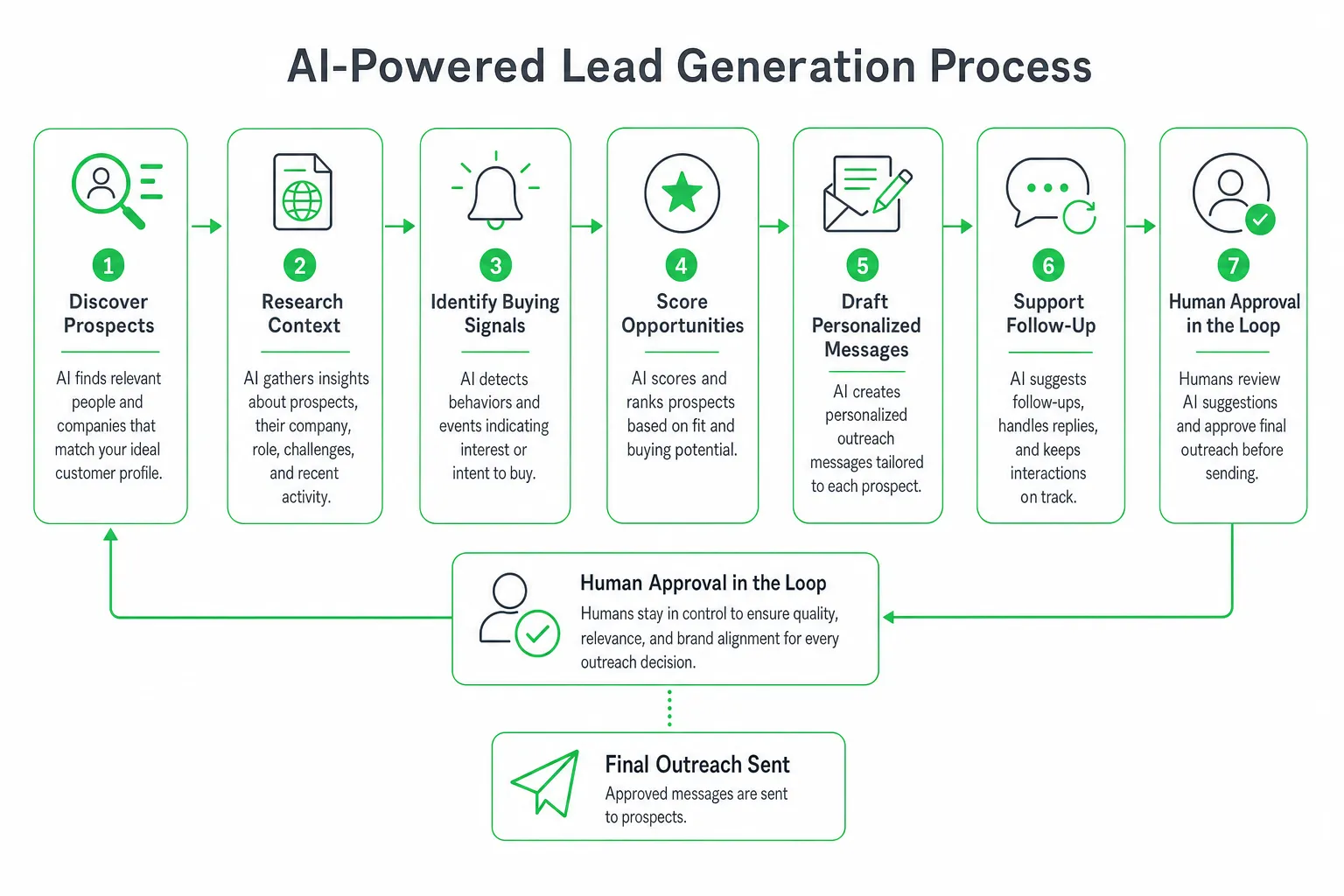
Lead generation AI helps you find likely buyers, understand their needs, draft relevant outreach, and manage follow-up without relying on generic prospecting lists. The best approach combines data-driven discovery with context-aware messages that you review before sending, especially when prospects are already discussing their problems in public.
That distinction matters. A large database can tell you who might fit your customer profile. An intent-led tool can show you who is actively asking for a solution right now.
Key takeaways
- Choose data platforms for contact discovery and repeatable outbound volume.
- Choose intent-led tools when you want to find people already discussing a problem.
- Keep human approval in the loop for Reddit replies, DMs, emails, and follow-ups.
- Connect lead generation with SEO, blog content, website chat, and social publishing.
What Is Lead Generation AI?
Lead generation AI is software that discovers prospects, researches their context, identifies buying signals, scores opportunities, drafts personalized messages, and supports follow-up.
It can search a contact database, enrich a CRM record, summarize a Reddit thread, suggest an email, or recommend which conversation deserves your attention first. The strongest systems do not simply send more messages. They help you decide who deserves a thoughtful response.
Adoption is accelerating. In HubSpot’s 2025 survey of sales professionals, 84% reported using AI to optimize the sales process, according to HubSpot’s 2025 State of Sales Report.
That does not mean you should hand your entire sales process to a bot. The best approach combines automated research with human-approved outreach. AI handles repetitive work. You control the claims, tone, targeting, consent, and final send.
Best fit: SaaS founders, indie hackers, agencies, and small marketing teams that need more qualified conversations without building a dedicated sales development function.
What AI Lead Generation Tools Actually Do
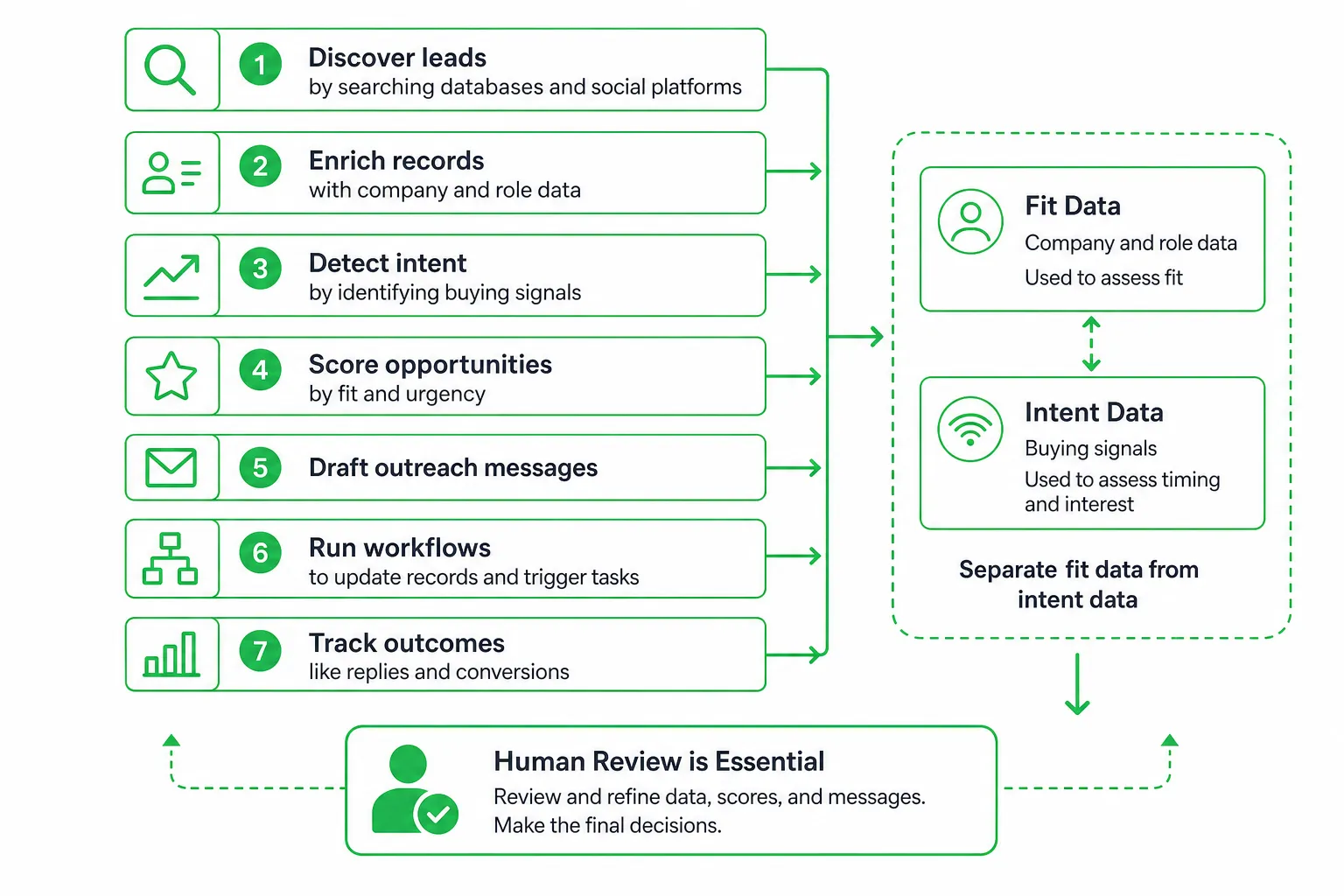
Most platforms cover several connected tasks. Some focus on contact data and outbound email. Others focus on workflow automation, personalization, conversations, or content-assisted growth.
- Discover leads: Search databases, social platforms, communities, websites, and public conversations.
- Enrich records: Add company details, role information, website data, and CRM context.
- Detect intent: Identify questions, complaints, comparisons, recommendations, and other buying signals.
- Score opportunities: Rank leads by customer fit, urgency, relevance, and conversation quality.
- Draft outreach: Create emails, DMs, replies, and follow-ups in a selected brand voice.
- Run workflows: Move information between tools, update records, and trigger the next task.
- Track outcomes: Monitor replies, qualified conversations, booked calls, and conversions.
Start by separating fit data from intent data. A matching job title does not prove that someone needs your product. A public post saying “What tool can solve this problem?” provides much stronger context.
Human review still matters. Check whether the AI understood the conversation, whether its claims are accurate, whether the message fits the community, and whether a private message is appropriate. Reviewable drafts are more useful than a black-box auto-send feature.
Best Lead Generation AI Tools Compared
There is no single best tool for every team. Your choice depends on whether you need a large prospect database, flexible research workflows, high-volume email, intent-led conversations, or an all-in-one growth system.
| Tool type | Examples | Best for | Watch for |
|---|---|---|---|
| B2B data platforms | Apollo, Seamless.AI, ZoomInfo, Leadzen.Ai | Contact discovery, enrichment, list building, and outbound scale | Data freshness, message quality, deliverability, and limited conversation context |
| Research and workflow automation | Clay, Gumloop | Combining data sources, enrichment, research, and custom workflows | Setup effort, workflow maintenance, and usage complexity |
| Email personalization and execution | Lemlist, Instantly, Hunter | Email finding, personalization, sequences, and campaign execution | Inbox health, targeting quality, and whether automation becomes repetitive |
| Intent-led AI marketing | OneUp Today | Finding high-intent Reddit conversations and connecting outreach with content and SEO | Reviewing relevance, community fit, and every proposed send |
Data platforms: Apollo, Seamless.AI, ZoomInfo, and Leadzen.Ai are useful when you need a filterable B2B contact base. They suit teams with a defined ideal customer profile and a repeatable outbound motion.
Workflow tools: Clay and Gumloop help you combine research steps and automate actions across different systems. They are a good fit when your process is specific and you want to build it rather than use a fixed sequence.
Email tools: Lemlist, Instantly, and Hunter support email finding, personalization, and campaign execution. They can help you operationalize outbound, but they do not automatically make an irrelevant message useful.
OneUp Today: OneUp Today is an AI marketing team for small teams. It finds high-intent Reddit conversations, drafts personalized Reddit replies, DMs, emails, and follow-ups in your voice, and connects those insights with SEO autopilot, blog creation, social publishing, lead scoring, website chat, and a Chrome extension. You approve every send.
How to Choose the Right AI Lead Generation Platform
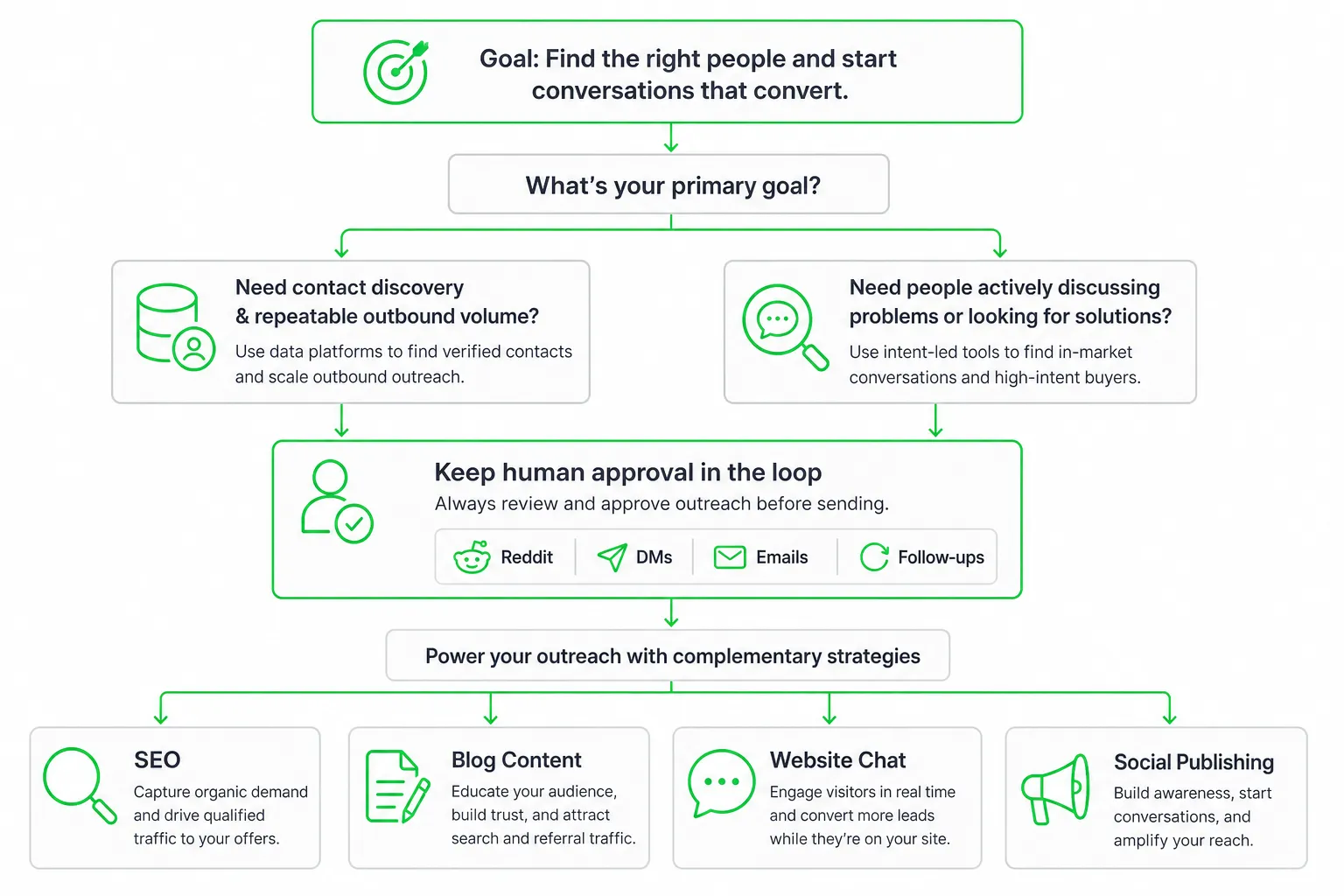
Choose a data platform when your main requirement is a large, filterable B2B contact database. This works well when you know the industries, roles, company profiles, and regions you want to target.
Choose an intent-led platform when your priority is finding people who are already discussing a problem, evaluating alternatives, or requesting recommendations. The signal may come from a Reddit question, a product comparison, a complaint, or a request for a workflow suggestion.
Use this buyer-focused checklist before committing:
- Source quality: Can you see where each lead or recommendation came from?
- Intent signals: Does the tool distinguish active need from basic profile fit?
- Personalization depth: Does it use the actual context, or only insert a name and company?
- Channel coverage: Can it support email, DMs, public replies, content, and website chat?
- Approval controls: Can you edit and approve every message before it goes out?
- Deliverability safeguards: Does it help you avoid careless volume and repetitive outreach?
- Brand voice: Can you define approved claims, tone, positioning, and disallowed language?
- Handoffs: Can qualified conversations move into your CRM or sales process?
- Setup effort: Will your team maintain the workflows, prompts, data, and integrations?
Also consider the buying journey around your outreach. Gartner reported that B2B buyers used an average of seven information sources during a recent purchase, while 45% used generative AI, according to Gartner’s 2026 buyer research. A tool that connects prospecting with useful content can support more of that journey than an isolated email sequencer.
The Intent-Led Reddit Lead Generation Workflow
Most comparison articles focus on databases and outbound sequences. They miss a valuable source of demand: public conversations where people explain the problem in their own words.
Reddit is particularly useful for this workflow because the conversation often includes the user’s situation, constraints, alternatives they have tried, and the kind of help they want. Reddit’s 2025 purchase-path research found that 71% of people who discovered a brand online or offline researched it on Reddit, and 74% said Reddit helped them make faster purchase decisions than competing social platforms, according to Reddit Business Marketing’s 2025 purchase-path research.
- Find specific conversations. Search for pain points, comparison questions, requests for alternatives, and direct purchase intent. Prioritize relevance and timing over raw lead volume.
- Read the full context. Review the original post, comments, community norms, and the person’s stated constraints. Do not draft a message from a keyword alone.
- Contribute publicly first. Answer the question clearly. Explain a useful approach. Mention your product only when it genuinely fits and the context allows it.
- Score the opportunity. Assess problem relevance, audience fit, urgency, conversation quality, and whether a public reply or private message makes sense.
- Draft a respectful follow-up. Use AI to summarize the thread and suggest a reply or DM. Keep the wording specific to the person’s situation.
- Require approval. Edit the draft, verify every claim, and approve the reply or message yourself.
- Feed the insight forward. Turn recurring questions into SEO pages, blog posts, product education, website-chat answers, and social content.
This approach connects lead generation to content marketing. A question that appears repeatedly may reveal a missing comparison page, onboarding explanation, integration guide, or product FAQ.
How to Automate Outreach Without Spamming
Automation becomes risky when it optimizes for sends instead of relevance. Set a qualification policy before you activate any workflow.
- Problem relevance: Does the person describe a problem your product actually solves?
- Audience fit: Do their role, use case, company, or project match your target customer?
- Conversation quality: Is there enough context to write a useful response?
- Recency: Is the conversation still active and commercially relevant?
- Channel choice: Should you reply publicly, send a DM, email later, or do nothing?
- Permission and transparency: Would the outreach feel reasonable to the recipient?
Separate public participation from private outreach. Answer first. Disclose relevant context when needed. Ask permission where appropriate. Avoid copying the same promotional message across communities.
Build an approval queue for every AI-generated reply, DM, email, and follow-up. Your reviewer should be able to see the original source, edit the message, reject the suggestion, and record the next action.
Measure meaningful outcomes instead of raw activity. Track qualified conversations, positive replies, booked calls, assisted conversions, useful content opportunities, and leads that move into a real sales process.
How to Start With Lead Generation AI
Start with your customer definition, not the software. Document the problems you solve, ideal customer traits, disqualifiers, approved claims, target communities, brand voice, and escalation rules.
Then run a focused pilot around one product, one audience, and a small group of high-intent conversations. Review every draft. Note which signals indicate a real opportunity and which ones create false positives. Use those observations to improve your scoring criteria.
For a small team that wants one approval-controlled system for Reddit lead generation, AI outreach, SEO autopilot, blog creation, social publishing, lead scoring, and website chat, OneUp Today brings those workflows together without requiring impersonal messaging. AI prepares the work. You decide what represents your business.
AI does not replace judgment. Automation does not require generic outreach. A smaller set of relevant conversations can be more valuable than indiscriminate outbound.
Next step: Identify one recurring customer question. Find the conversations where people are asking it, draft a genuinely useful response, review the suggested outreach, and approve only the messages that add clear value.
Frequently asked questions
Can lead generation AI improve the quality of sales conversations?
Yes, lead generation AI can improve sales conversations by identifying prospects actively discussing their problems and drafting personalized outreach. This context-aware approach helps sales teams focus on meaningful interactions rather than generic prospecting, increasing the chances of qualified conversations.
How does intent data differ from fit data in lead generation AI?
Intent data shows when prospects are actively seeking solutions, while fit data indicates whether a contact matches your ideal customer profile. Combining both allows AI tools to prioritize leads who not only fit your criteria but also demonstrate immediate buying interest.
Why is human review important in AI-driven lead generation?
Human review is crucial because it ensures AI-generated messages are accurate, contextually appropriate, and respectful of community norms. This oversight prevents errors, maintains brand tone, and avoids inappropriate outreach, especially on platforms like Reddit or direct messaging.
What types of businesses benefit most from lead generation AI?
SaaS founders, indie hackers, agencies, and small marketing teams benefit most from lead generation AI. These groups gain qualified conversations without needing to build a dedicated sales development team, leveraging AI to handle repetitive tasks while keeping human control over messaging.
How can lead generation AI integrate with other marketing channels?
Lead generation AI can connect with SEO, blog content, website chat, and social publishing to create a cohesive growth strategy. This integration helps capture and nurture leads across multiple touchpoints, increasing engagement and conversion opportunities.