
Apollo Lead Generation: Features, Alternatives & SaaS Growth
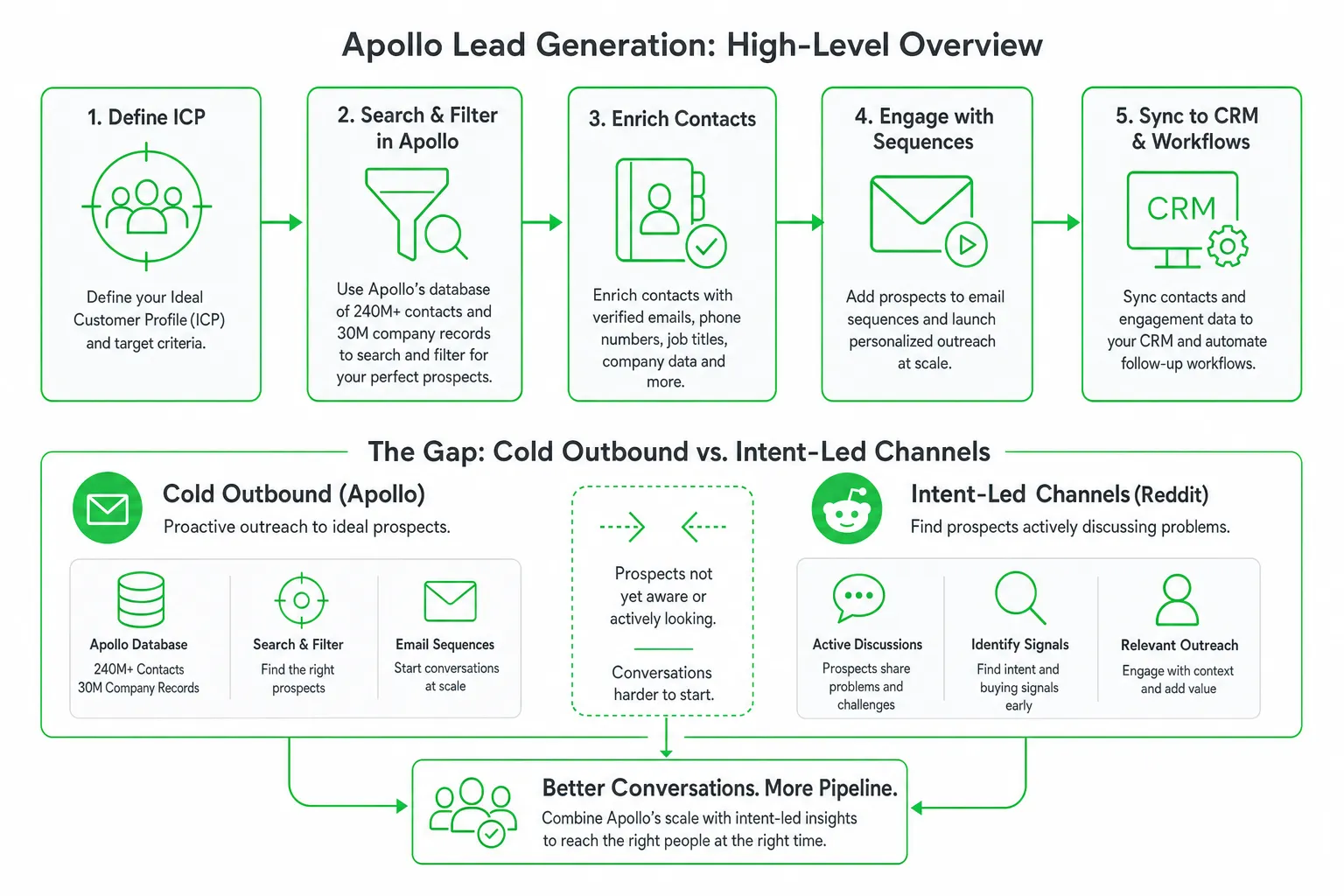
Apollo lead generation helps you find B2B contacts, enrich their records, and move them into structured outbound sequences. It is a strong choice when you already know your ideal customer profile and want a repeatable cold-email workflow. But if you want to find prospects actively discussing their problems, intent-led channels such as Reddit can add context that a database search cannot.
That distinction matters for SaaS growth. More contacts do not automatically create more qualified conversations. Your results depend on who you target, why you contact them, how you manage credits and compliance, and whether your channel matches the buyer’s current intent.
Key takeaways
- Use Apollo for structured account research, contact discovery, enrichment, and outbound sequences.
- Build the workflow around a defined ICP rather than a broad database search.
- Review Apollo’s credit model carefully because unused credits expire at the end of the billing cycle.
- Combine cold outbound with intent-led conversations when you need stronger buying context.
What Is Apollo Lead Generation?
Apollo is a B2B prospecting platform that combines contact discovery, company intelligence, enrichment, email sequencing, and pipeline workflows in one system.
You start with an account or contact search. Then you filter the results, review the records, enrich the information you need, and add suitable prospects to a sequence or CRM workflow.
Its scale is a major advantage. Apollo says its database contains more than 240 million contacts, 30 million company records, and 65 or more data points for each contact and account in Apollo’s Go-to-Market Data That Drives Action.
That breadth can help you build an account-based outbound list without stitching together several separate tools. It does not remove the need for judgment. A large database can still return the wrong role, a weak fit, or a prospect with no current reason to change.
Best fit: Use Apollo when you have a defined SaaS ICP, a clear buyer role, and a repeatable reason to contact similar accounts.
Consider another approach: Use intent-led channels when your priority is finding people who are already asking for recommendations, comparing tools, or describing the problem your product solves.
Apollo Features That Matter for SaaS Growth
Apollo’s value comes from how its features connect. Search finds the account. Enrichment fills gaps. Sequences create follow-up structure. CRM workflows give your team a place to manage replies and outcomes.
- Account and contact search: Filter companies and people by role, industry, location, company attributes, technology, and other ICP criteria.
- Contact enrichment: Add missing details and prioritize records that match your target customer profile.
- Email sequencing: Build multistep outreach with personalization, follow-up logic, task reminders, and reply handling.
- CRM workflows: Push suitable records into your sales process and route positive replies for review.
- Browser-based prospecting: Apollo’s Chrome Extension works across supported surfaces including LinkedIn, Gmail, Google Calendar, Salesforce, HubSpot, and company websites. You can save prospects, add them to sequences, and push records to a CRM, according to Apollo’s Chrome Extension overview.
Data quality still deserves scrutiny. Apollo reports a 98% email-accuracy rate and says its data is refreshed through real-time signals and regular updates in Apollo’s data overview. Treat that as a platform-level claim, not a reason to skip checking each segment before you send.
How to Generate Leads in Apollo: A Practical Workflow
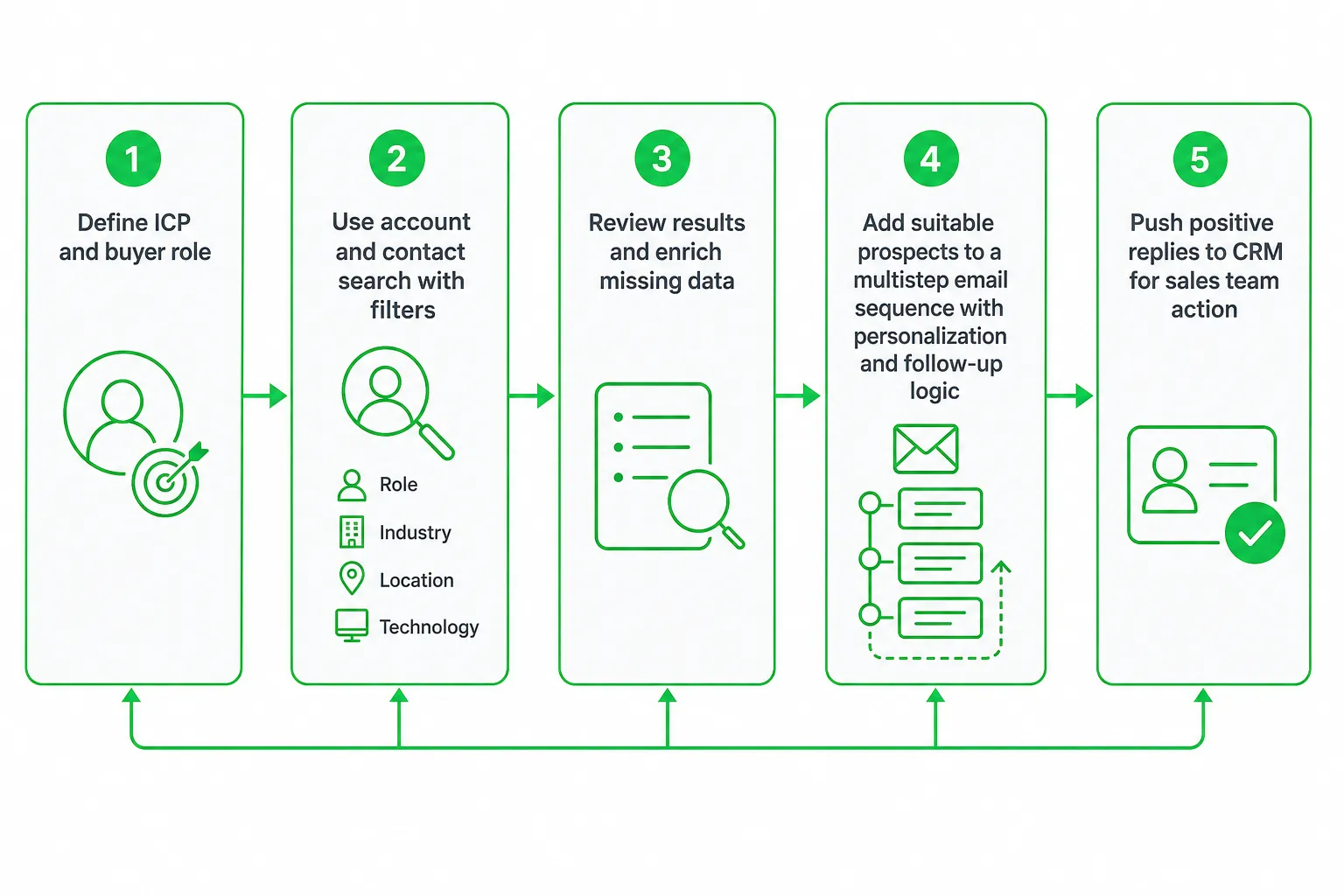
The strongest Apollo workflow begins before you open the database. Define what a qualified account looks like, then use Apollo to find evidence that a prospect fits.
- Define the ICP: Document the customer problem, company characteristics, buyer role, trigger events, disqualifiers, and evidence that makes an account worth contacting.
- Create a focused search: Use firmographic and role filters that reflect your ICP. Avoid combining every possible filter until the search becomes impossible to inspect.
- Review accounts manually: Check the company’s product, market, hiring direction, technology, and current context. Remove accounts that match a filter but not the actual buying situation.
- Segment by buying role: Separate the economic buyer, daily user, technical evaluator, and potential internal champion. Each role needs a different opening.
- Verify contact details: Confirm that the person still holds the role and that the contact information supports the channel you plan to use.
- Write a problem-led sequence: Open with a relevant observation. Explain why you chose the prospect. Offer a useful next step instead of forcing a product pitch.
- Monitor replies: Stop sequences when someone replies, opts out, changes roles, or shows clear disinterest. Route positive conversations to your CRM and remove unsuitable records.
- Review qualified outcomes: Compare segments by reply quality, buying relevance, and progression toward a real sales conversation. Do not optimize only for sends or raw contacts.
For example, a SaaS founder targeting support teams might segment by company type, support leadership role, and a trigger such as a new customer-service initiative. The message should then refer to that context, not repeat a generic value proposition copied across every account.
Apollo Costs, Credits, and Buying Criteria
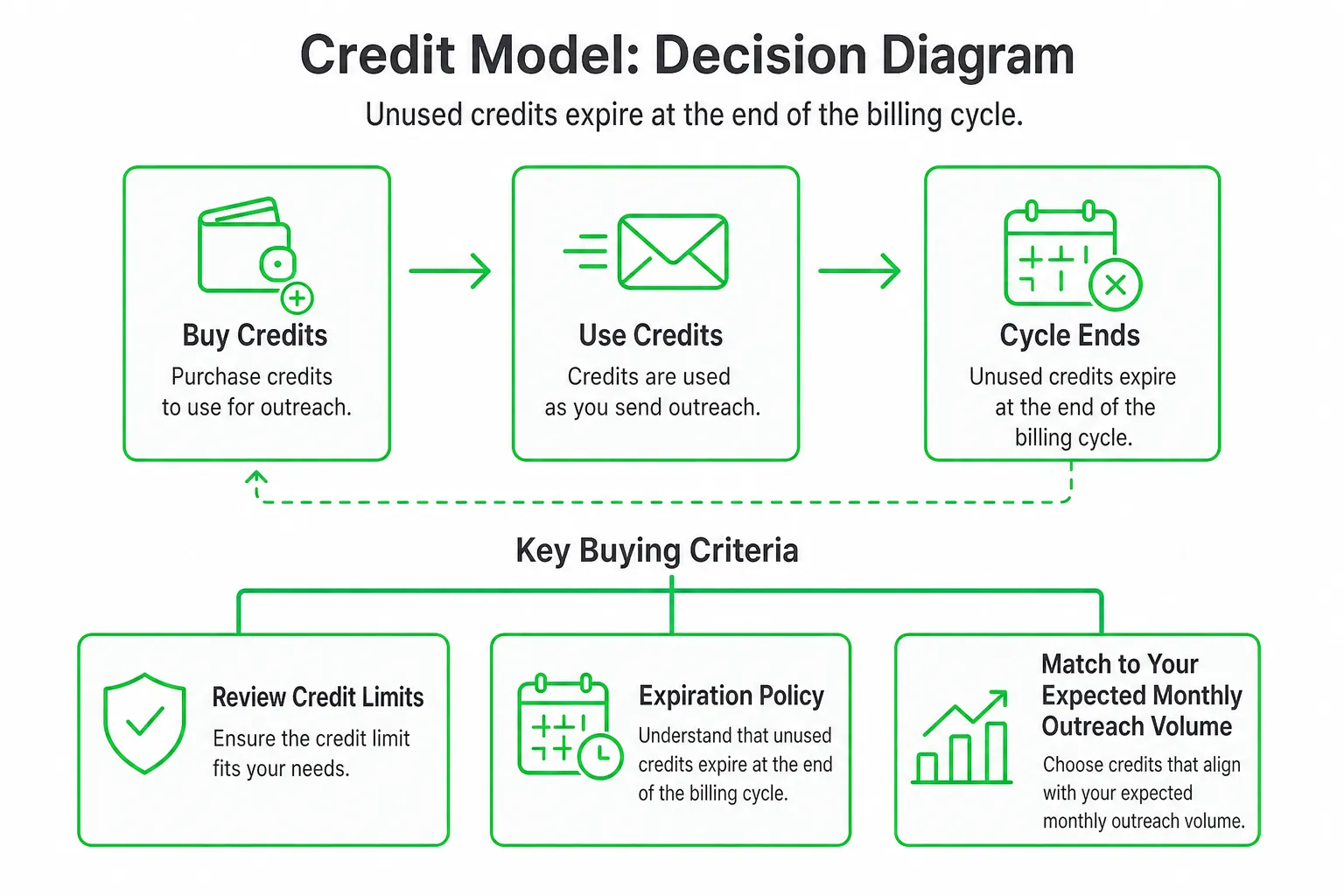
Apollo pricing is not just a subscription decision. Your real cost depends on the workflow you operate: account research, contact reveals, enrichment, email and phone access, AI research, warmup, domains, mailboxes, CRM synchronization, and campaign management.
Apollo’s pricing documentation says credits can be used for activities including accessing emails, phone numbers, email warmup, domains and mailboxes, and AI-researched data. It also says unused credits expire at the end of the billing cycle rather than rolling over in Apollo’s pricing documentation.
That creates a practical planning problem. A plan may look suitable when you compare the headline subscription, then become less efficient if your team reveals many records, runs several mailboxes, or leaves credits unused.
Before you choose a plan, map your expected workflow:
- Research volume: How many target accounts will you inspect?
- Contact volume: How many people per account need verification?
- Channel mix: Will you use email, phone, tasks, or several channels?
- Mailbox needs: Will you operate multiple domains or mailboxes?
- Testing allowance: How much usage will go toward experiments, poor-fit records, and revised segments?
- System overhead: Which CRM, automation, compliance, and reporting workflows must connect to Apollo?
Compare alternatives on data coverage, verification quality, enrichment depth, sequence controls, CRM synchronization, deliverability features, compliance settings, reporting, and pricing alignment. A cheaper tool is not necessarily cheaper if it creates more manual review or weaker records.
The Gap: Cold Outbound vs Intent-Led Lead Generation
This is where many Apollo comparisons stop too early. Apollo can find people who fit a profile. It does not automatically prove that those people are actively looking for a solution today.
Reddit conversations can reveal explicit pain, urgency, tool comparisons, failed workflows, and the language buyers use when asking for help. That context can improve your positioning even when the person is not ready to book a call.
Cold outbound gives you control over the account list, buyer role, message, and follow-up process. It can support account-based selling when you know which companies matter. It also requires careful targeting, deliverability management, compliance checks, and message testing.
Intent-led engagement works differently. You listen for a relevant conversation, understand the problem, and contribute something useful. The process is more context-rich, but it requires judgment and authentic participation. You cannot treat every discussion as an invitation to paste a sales pitch.
| Approach | Best for | Main strength | Main operational demand |
|---|---|---|---|
| Apollo outbound | Defined ICPs and account-based prospecting | Structured research and repeatable sequences | Data review, deliverability, compliance, and follow-up control |
| Intent-led conversations | Discovering active problems and buyer language | Context around urgency and pain | Listening, relevance, and human judgment |
| Hybrid workflow | SaaS teams that need both coverage and context | Combines account structure with live demand signals | Coordinating channels without duplicating outreach |
OneUp Today is a complementary option when you want Reddit lead generation, AI-assisted replies and DMs, SEO and blog autopilot, multi-platform publishing, lead scoring, and website chat while keeping every send under your approval. That makes it useful beside Apollo when the missing input is buyer intent, not another contact record.
Operational Risks, Compliance, and Deliverability
Treat Apollo records as inputs to a review process, not as permission to contact everyone returned by a search. Confirm relevance, suppression status, consent requirements, and the rules that apply to your audience and market.
Apollo says its GDPR settings can automatically exclude EU-located individuals from prospecting, emailing, and email-tracking activities. It also says customers remain responsible for determining and meeting their own legal obligations in Apollo’s GDPR settings guidance.
Use those settings as a control, not as a substitute for legal review. Your responsibilities can depend on the audience, jurisdiction, message, data source, and relationship with the recipient.
- Protect sender reputation: Target accurately, send useful messages, manage opt-outs clearly, and remove bounces.
- Stop at the right moment: Pause a sequence after a reply, opt-out, role change, or clear disinterest.
- Watch for wasted credits: Avoid revealing or researching records that do not meet your qualification rules.
- Prevent duplicate records: Keep CRM ownership, suppression lists, and campaign status aligned.
- Control personalization: Check AI-assisted copy for false assumptions, awkward phrasing, and irrelevant details.
- Review mailbox health: Monitor sending behavior and investigate unusual bounce or complaint patterns.
Apollo Alternatives and the Best Next Step
Choose Apollo when you want an all-in-one B2B database and outbound workflow. Choose a data-first alternative when a different market, enrichment depth, integration set, or pricing model better matches your process.
Choose a channel-led platform when discovering active conversations matters more than building a large cold list. The right decision depends on your bottleneck:
- Need account coverage? Start with Apollo or another structured prospecting database.
- Need stronger buying context? Add intent-led research and conversation monitoring.
- Need content and outreach support? Consider an AI marketing workflow that connects lead discovery, replies, publishing, and SEO.
- Need better measurement? Track qualified conversations and customer progression, not only contacts, sends, or opens.
The practical next step is simple: define one narrow ICP, run one focused Apollo search, monitor one intent-led channel, and choose one conversion goal. Then compare the quality of conversations each channel creates.
Takeaway: Use Apollo for structured prospect research and controlled cold outbound. Add OneUp Today when you want to find warmer Reddit conversations, turn real problems into helpful outreach and content, and approve every send before it goes live.
Frequently asked questions
Does Apollo lead generation include phone numbers and email addresses?
Yes, Apollo provides both phone numbers and email addresses for contacts. Its database includes direct dials and verified emails, but accuracy varies by record. You can filter by contactability scores to prioritize higher-quality data, and use enrichment to fill gaps before launching sequences.
How much does Apollo lead generation cost per month for small teams?
Apollo offers a free plan with limited credits, while paid plans start around $49 per user per month for basic features. Costs scale with team size, data credits, and advanced functionalities like predictive scoring. Small teams should compare the annual billing option to reduce monthly expenses.
Can Apollo lead generation integrate with Salesforce for CRM sync?
Yes, Apollo integrates natively with Salesforce, allowing two-way sync of contacts, accounts, and activities. You can push Apollo-sourced leads directly into Salesforce records, automate updates, and log emails or tasks. This integration helps maintain a single source of truth for your sales pipeline.
Is Apollo lead generation compliant with GDPR and CAN-SPAM regulations?
Apollo provides tools to support compliance, such as suppressing opted-out contacts and honoring do-not-contact lists. However, you are responsible for ensuring your outreach complies with GDPR and CAN-SPAM, including obtaining consent where required and including opt-out links. Apollo's data is sourced from public and licensed sources, but legal review is advised.
What is the best way to avoid Apollo credit wastage during lead generation?
To avoid wasting credits, use Apollo's filters to target only high-fit accounts and contacts, and enable 'email verification' before sending. Set up a test sequence with a small batch to gauge reply rates, then scale. Also, regularly clean your list to remove bounced or unengaged contacts, and pause sequences when you hit your daily send limits.