
AI Outreach Agent: What to Look For
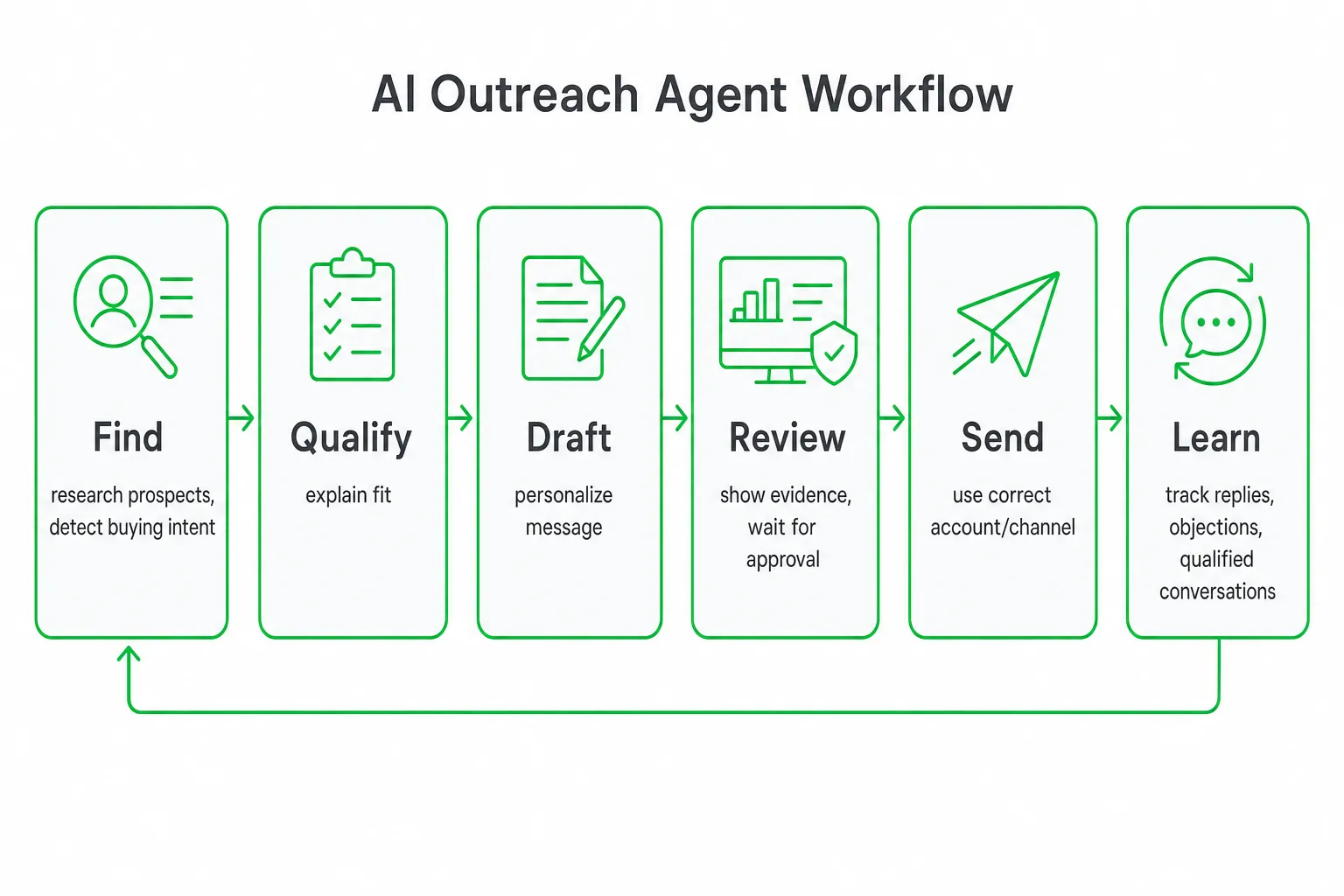
An AI outreach agent researches prospects, spots buying intent, drafts relevant messages, and helps you manage follow-ups across channels. The best tools do not send generic sequences on autopilot. They connect real prospect evidence with useful drafts, human approval, safe sending, and measurable results.
Key takeaways
- Prioritize intent detection over large contact databases.
- Choose an agent that shows the source conversation behind every recommendation.
- Keep drafting and sending separate so you approve each message.
- Evaluate timing, message length, channel fit, and reply quality, not just send volume.
That distinction matters because AI outreach now covers everything from cold email to CRM automation. You need a system that removes research and drafting work without taking your voice, judgment, or account safety out of the process.
What Is an AI Outreach Agent?
An AI outreach agent researches prospects, identifies buying signals, personalizes messages, manages follow-ups, and helps track responses across channels. It can support email, social replies, direct messages, CRM workflows, and website conversations.
The strongest agents handle the full workflow:
- Find: Discover people who match your audience or are actively discussing a relevant problem.
- Qualify: Explain why each prospect appears to be a fit.
- Draft: Write a message that reflects the prospect’s words and your tone.
- Review: Show you the evidence and wait for approval.
- Send: Use the correct account and channel with sensible controls.
- Learn: Track replies, objections, and qualified conversations.
Demand is growing. Salesforce State of Sales 2026 reports that 87% of sales organizations use AI for activities such as prospecting, lead scoring, forecasting, or drafting emails.
But adoption alone does not tell you whether a tool is useful. Ask what the agent knows about the prospect, how it handles uncertainty, and where you remain in control.
What to Look For in an AI Outreach Agent
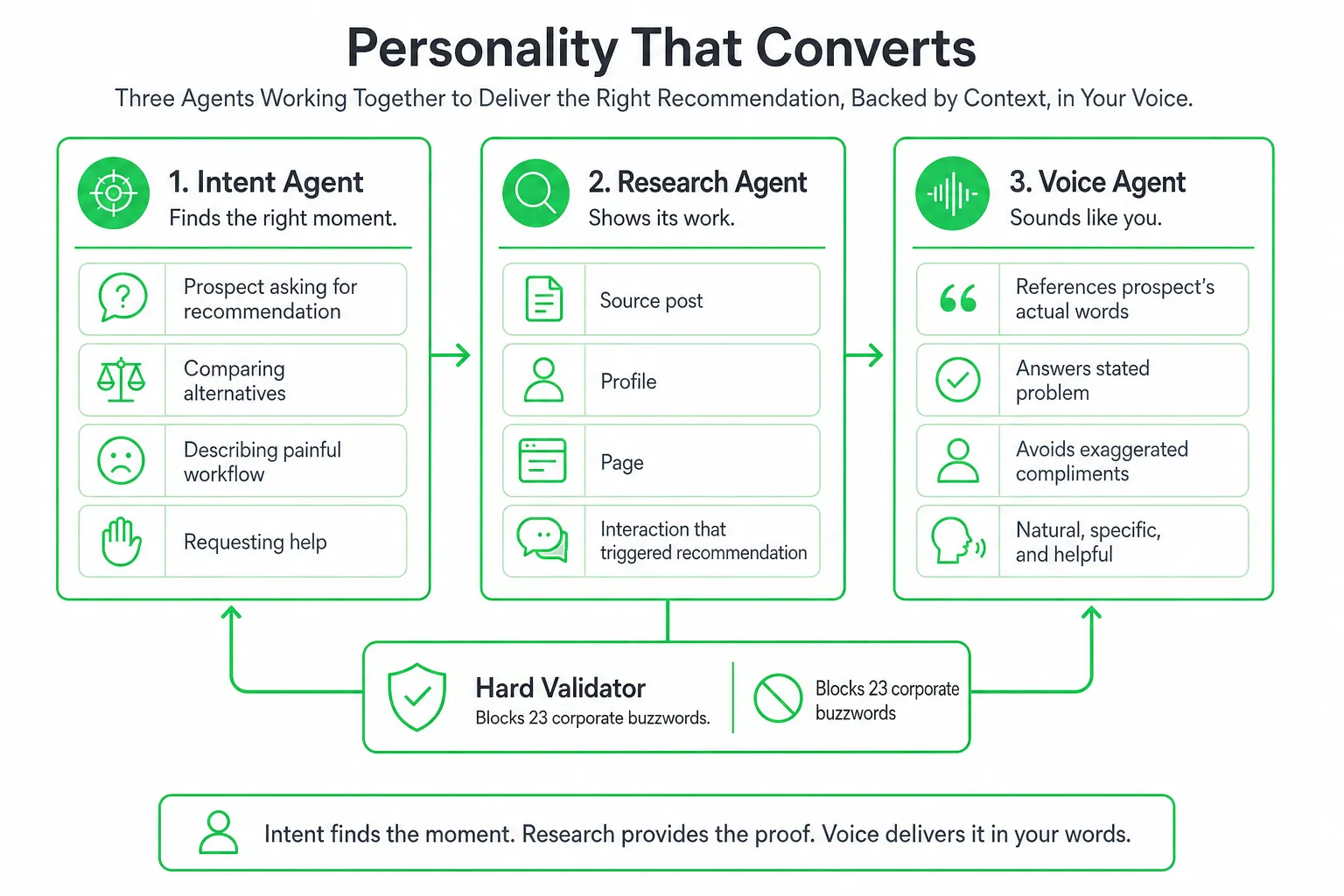
Start with evidence. A good agent should show why a lead is relevant rather than hand you an unverified contact list.
Meet the Intent Agent: Finds the right moment
Look for signals such as a prospect asking for a product recommendation, comparing alternatives, describing a painful workflow, or requesting help in a relevant community.
The agent should let you define:
- Your ideal customer profile.
- Target communities, keywords, and topics.
- Buying signals and disqualifying signals.
- Topics or claims it must avoid.
- Rules for escalating a conversation to you.
Meet the Research Agent: Shows its work
Every recommendation should include the source post, profile, page, or interaction that triggered it. You should be able to see the exact problem the prospect described before reviewing a draft.
Useful research is specific. “This person may need marketing software” is weak. “This person described manually checking several communities for users asking about a launch problem” gives you a clear reason to respond.
Meet the Voice Agent: Sounds like you
Personalization should go beyond inserting a first name. The draft should reference the prospect’s actual words, answer the stated problem, and avoid exaggerated compliments.
Check whether the tool lets you provide examples of your writing, preferred phrases, product boundaries, and banned language. At OneUp Today, the DM generator uses a hard validator that blocks 23 corporate buzzwords because simply prompting the model to avoid them was not enough. See the publisher’s Reddit DM Benchmarks 2026.
Meet the Approval Agent: Keeps you in control
The system should separate drafting from sending. You need a clear review screen, editable copy, channel visibility, and an explicit approval action for every message.
Also check for connected email, social platform support, browser-based sending, exportable activity data, and an audit trail. These details determine whether the tool fits your workflow or creates another inbox to manage.
AI Outreach Agent Options Compared
| Option | Best for | Strengths | Tradeoffs |
|---|---|---|---|
| AI SDR platform | Structured outbound teams | Account research, sales sequences, CRM updates, meeting workflows | May prioritize databases over live buying conversations |
| Cold-email tool | Teams with a defined list | Fast personalization, sequences, delivery tracking | You remain responsible for list quality, deliverability, and message fatigue |
| Conversation-led agent | Founders and small teams seeking warmer outreach | Finds public questions, drafts context-aware replies, supports human review | Requires judgment about relevance, tone, and community etiquette |
AI SDR platforms are strongest when you already have a structured sales process. They can research accounts, update a CRM, coordinate sequences, and support reporting across a sales team.
Cold-email and prospecting tools work well when you have a clean audience and repeatable messaging. They improve speed, but they cannot compensate for weak targeting or an irrelevant offer.
Conversation-led agents focus on people already discussing a problem. They are a strong fit when you want to contribute something useful before asking for a call, trial, or sale.
Choose based on your starting point. If you have accounts but no process, an AI SDR may help. If you have a list but need faster execution, a cold-email tool may fit. If you need to find active demand, look for intent-based discovery.
The Missing Layer: Intent-Based Reddit Outreach
Most AI outreach coverage centers on sales email, CRM automation, or AI SDR workflows. That misses an important source of demand: public conversations where people explain what they need in their own words.
Reddit outreach is different from database outreach. You are not starting with an account record and a guessed pain point. You are starting with a real question, comparison, complaint, or request for advice.
That changes what your agent must do. It should monitor relevant conversations, score buying intent, rank opportunities, and preserve the context that made each lead interesting.
Timing and message length matter too. OneUp Today’s Reddit DM Benchmarks 2026 found that DMs sent within 12 hours of a post received replies about 43% of the time, compared with about 21% when sent a week or more later. Messages of 40 words or fewer received a 30.6% reply rate, compared with 20.2% for messages of 50 words or more. Read the OneUp Today Reddit DM Benchmarks 2026.
The lesson is not “send every message immediately.” It is to prioritize fresh, high-intent conversations and keep the first note concise.
OneUp Today combines Reddit lead discovery with personalized DM and email drafts, public reply drafting, and browser-based sending through its Chrome extension. That combination addresses the operational gap between finding a conversation and safely responding to it.
Use the prospect’s stated problem as your starting point. Do not force a generic pitch into a conversation that has not shown a relevant need.
How to Use an AI Outreach Agent Safely
Automation should reduce repetitive work, not remove responsibility. Set your rules before connecting accounts or giving the agent access to sending tools.
- Define the audience. Describe your customers, use cases, target communities, buying signals, and disqualifiers.
- Set the voice. Provide writing examples and clear instructions about tone, claims, links, and product limitations.
- Require lead evidence. Review the source conversation and the reason the agent scored the lead.
- Approve every draft. Remove generic praise, unsupported claims, unnecessary links, and language that does not sound like you.
- Control sending. Prefer your connected account or browser, explicit approval, sensible pacing, and clear opt-out handling.
- Keep an audit trail. Record the draft, final message, channel, response, and next action.
Browser-based sending can be useful because the message goes through your own account and familiar workflow. It does not make careless automation safe, however. You still need to respect platform rules, community norms, and the recipient’s signals.
A Practical Workflow for Better Outreach
Use a narrow signal first. Look for a prospect asking for a solution, comparing products, describing a painful workflow, or requesting a recommendation in a relevant community.
- Start with discovery: Give the agent a focused set of topics and communities.
- Review the ranking: Open the original post and confirm that the problem matches your product.
- Draft a short response: Answer the question before introducing your company.
- Choose the channel: Use a public reply when the answer benefits the community. Use a DM when the conversation is personal or the prospect invites it.
- Find a legitimate email route: If an email follow-up makes sense, use a real business contact route and write a personal note rather than a bulk sequence.
- Review and send: Edit the draft, approve it, and keep the next step easy to understand.
- Track conversation quality: Record replies, objections, qualified opportunities, and conversions by source, timing, message style, and audience.
For email, individual relevance matters. Mailshake’s 2025 cold-email report analyzed responses from 508 professionals and concluded that individually personalized emails produced better reply and lead rates than bulk templates. Read the Mailshake State of Cold Email 2025 report.
Optimize for useful conversations, not just opens or sends. A message that creates a qualified discussion teaches you more than a message that disappears into a dashboard.
Is OneUp Today the Right AI Outreach Agent?
OneUp Today is a fit for SaaS founders, indie hackers, and small teams that want intent-led discovery across Reddit plus approval-based DMs, emails, and public replies. Its browser-based sending workflow suits teams that want authentic participation and a review step before outreach goes out.
The platform also supports email discovery and personal notes, so a relevant Reddit conversation can lead to a reviewed email follow-up rather than an automatic sequence. Its website chatbot can answer visitor questions from your pages, capture leads, and pass promising conversations to you.
Choose a conventional AI SDR if you mainly need CRM-heavy outbound, account workflows, and meeting automation. Choose a conversation-led agent if your priority is finding real buyer questions, drafting in your voice, reviewing every send, and turning helpful answers into qualified opportunities.
What to Do Next
The right AI outreach agent should help you find better signals, write more relevant messages, and preserve your judgment at the point of sending. Evaluate intent evidence, personalization quality, approval controls, browser or account safety, and conversation-level analytics before you compare feature lists.
Take one narrow audience and one relevant community. Test the agent’s lead evidence and drafts manually, then review which conversations become genuine opportunities. That small workflow tells you far more than a promise of automated outreach at scale.
Frequently asked questions
Can an AI outreach agent replace my sales team?
No. An AI outreach agent automates research and drafting but cannot replace human judgment, relationship building, or closing skills. It works best as an assistant that surfaces qualified leads and drafts personalized messages, leaving final approval and strategic conversations to your team.
How does an AI outreach agent detect buying intent?
It scans public conversations, forums, and social media for specific signals like asking for product recommendations, comparing alternatives, or describing a painful workflow. The agent then shows you the exact source post or interaction that triggered the alert, so you can verify relevance before acting.
What channels does an AI outreach agent typically support?
Most agents support email, social media direct messages, LinkedIn, Reddit, and sometimes CRM workflows. The best tools also handle website chat and allow browser-based sending, but you should verify channel compatibility with your target audience and existing tools before committing.
Is an AI outreach agent safe for my account?
Yes, if it separates drafting from sending and includes sending limits, account rotation, and approval steps. Avoid agents that send on autopilot without human review, as they risk spam flags or bans. Always check for audit trails and rate controls to protect your sender reputation.