
Indie Hacker Marketing Budget: $0, $100, and $500/mo Allocations That Actually Work
The Honest Answer Most Founder Advice Skips
Spend any time in indie hacker forums and you'll see the same loop: founders ask "what should my marketing budget be?", a flood of replies pitch tools and ad strategies, and the founder ends up spending more on ads than tools. Two years later, the ones who succeeded almost universally say the opposite was right.
This guide is the budget allocation we'd give a founder we cared about. It's based on watching hundreds of SaaS founders go from $0 to first paying customer to $10K MRR, and noting which spending patterns correlate with reaching each milestone fastest.
Quick framing: the right budget isn't "the most you can afford." It's the smallest spend that lets you reach the next milestone faster than time-only would. Past that, more money rarely helps.
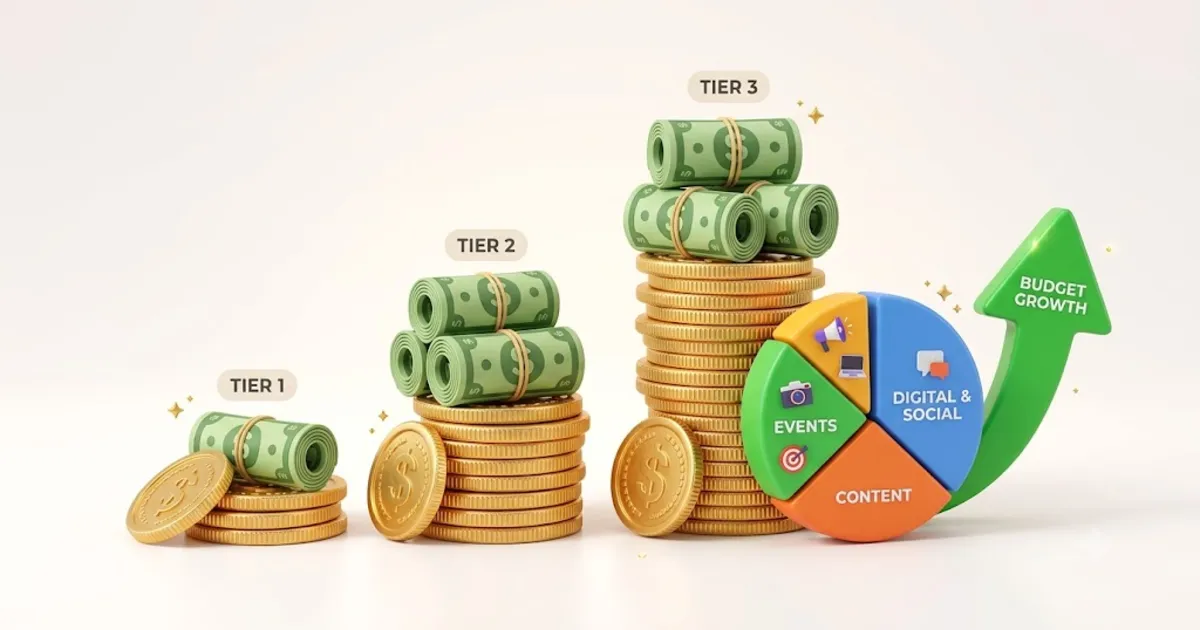
The $0/Month Allocation (Pre-Revenue or First Customers)
If you have no budget, you have time. Spend it deliberately.
Where the time should go (per week)
- 4 hours, Reddit replies and DMs in 3–5 niche subreddits where your buyer hangs out. Find high-intent posts ("recommend a tool that does X") and reply with genuine value.
- 3 hours, X replies and one post per day. Reply to 10–20 accounts in your niche. One substantive post per day. See the X growth playbook.
- 2 hours, LinkedIn comments on 10–15 founder/buyer posts. Don't try to grow a feed yet. Just be visible in your buyer's notifications.
- 2 hours, One piece of long-form content. A Reddit post, blog post, or X thread. Something with shelf life.
- 1 hour, Customer development calls with anyone who replied last week.
Total: 12 hours/week. About a third of this becomes mechanical and faster after a month.
Free tool stack at $0
- Reddit + X + LinkedIn (the platforms themselves).
- One free spreadsheet to track conversations.
- One free email tool (Gmail) for follow-ups.
- Free Google Search Console for SEO baseline.
Realistic outcome
5–15 paying customers over the first 90 days, mostly from Reddit. That's $500–$3,000 MRR for a $19/mo product, which validates the basic engine and earns you the budget for the $100 tier.
The $100/Month Allocation (First $1K MRR → $5K MRR)
You have a few customers, the engine is working, and your time is the bottleneck. Don't spend on ads yet, spend on automating the parts of your $0 routine that take the most time.
Allocation
- One outreach automation tool (~$8–15): something like OneUp Today, which is pay-per-action from a prepaid wallet: a campaign run that scans Reddit for high-intent leads is $0.25, so a daily run is about $7.50/mo, and each DM draft in your voice is $0.01. Cuts your 4-hour Reddit block to 90 minutes.
- One design tool (~$15–20): Canva Pro, Figma free, or similar. For social images, OG images, decks.
- One newsletter tool (~$0–20): Beehiiv, Substack, or ConvertKit free tier. Build a small list, even 200 subscribers compounds for years.
- Domain + transactional email (~$10): a basic Postmark / Resend account.
- One analytics tool (~$0): Plausible / Pirsch / GA4 free.
Expected outputs at this tier
- 3× the outreach volume of the $0 tier without 3× the time.
- Better creative for posts that drive more engagement.
- A growing email list as a non-platform-dependent channel.
- Clearer attribution for what's working.
What to skip
- Paid ads. ROI is too uncertain at this stage and you'll over-attribute success to them.
- SEO content agencies. Write your own, your founder voice is irreplaceable, agencies are not.
- Influencer partnerships. Audience-channel-fit is too hard to predict.
- "AI content writers" that aren't trained on your voice. They produce generic content nobody reads.
The $500/Month Allocation (First $5K MRR → $20K MRR)
Now you have product-market signal. Time is more valuable. Some channels are working. Spend to remove your largest bottlenecks.
Allocation
- Outreach + publishing automation (~$15–40): scale up the same pay-per-action wallet: more campaign runs at $0.25, scheduled posts at $0.02, SEO articles at $0.99 each (see pricing).
- SEO tooling (~$50–99): Ahrefs, Semrush, or similar. At this stage, you can identify which keywords are converting and double down.
- Content production (~$100–200): a contractor for editing, transcription, or 1–2 SEO pieces a month, but not as a substitute for your founder voice.
- Email/CRM upgrade (~$50–80): a real CRM (Attio, HubSpot starter, or similar) once you have enough conversations to manage.
- Small experimental ad budget (~$50–100): only after you have a working organic engine. Re-target site visitors, boost top-performing posts, or test one specific paid channel for 30 days.
- Analytics + attribution (~$30–50): Posthog, Mixpanel, or similar.
The mindset shift at $500
Below $500/mo, you're buying tools that save time. At $500/mo and above, you're buying tools that buy data, about which keywords convert, which campaigns drive customers, which segments retain. Treat the spend as research, not amplification.
$1,000+/Month, When to Graduate
Past $1,000/mo in marketing tooling, you're either:
- Hiring a part-time contractor or fractional marketer.
- Running paid acquisition with a known LTV/CAC ratio.
- Sponsoring newsletters / podcasts in your niche.
- Producing higher-budget content (video, custom research reports).
Don't graduate to this tier until your $500/mo allocation is fully utilized and one specific lever is clearly bottlenecked by time, not budget. Most indie hackers graduate too early.
What We'd Cut First If Budget Shrunk
The order of expendability, when belt-tightening:
- Paid ads. Easiest to turn off, hardest to attribute.
- SEO tooling. Once you know your top 20 keywords, free tools cover most needs.
- Content contractor. If you can't write your own founder voice, no contractor will fix that.
- Design tool upgrade. Free tier of Canva/Figma covers 90% of needs.
- Email tool upgrade. Free tiers of most newsletters work until ~500 subscribers.
What you keep last: the outreach + publishing automation. That's the channel itself. Everything else is amplification of a channel, not the channel.
The Common Founder Mistake
The mistake we see over and over: founders allocate $300/mo to ads at month 1 and $0 to outreach automation. The ads burn the budget without compounding. The outreach would have built a customer list and an audience that compounds for years. Three months in, they have nothing to show.
The correct order is almost always: time + organic outreach → automation tools that scale that outreach → SEO + content tooling → paid acquisition. Skipping steps doesn't accelerate; it just spends.
The Bottom Line
The right marketing budget for an indie hacker is the smallest one that unblocks your largest bottleneck. At $0, the bottleneck is reach, fix it with time. At $100, the bottleneck is time, fix it with automation. At $500, the bottleneck is data, fix it with measurement. Past that, the bottleneck is usually you, and money can't buy that back.
For the broader playbook, see our solopreneur marketing stack guide and SaaS growth strategies. To see exactly what OneUp Today fits into the $100 and $500 tiers, see our pricing.