
B2B Marketing Agency: How to Hire the Right Partner
Key takeaways
- Choose a B2B marketing agency that connects strategy, content, demand generation, and revenue measurement.
- Test whether a partner can find high-intent buyer conversations, not just produce content and reports.
- Require clear approval workflows for AI-assisted outreach, consistent messaging, and human review.
- Compare agency support with in-house hiring and AI marketing systems before you sign a retainer.
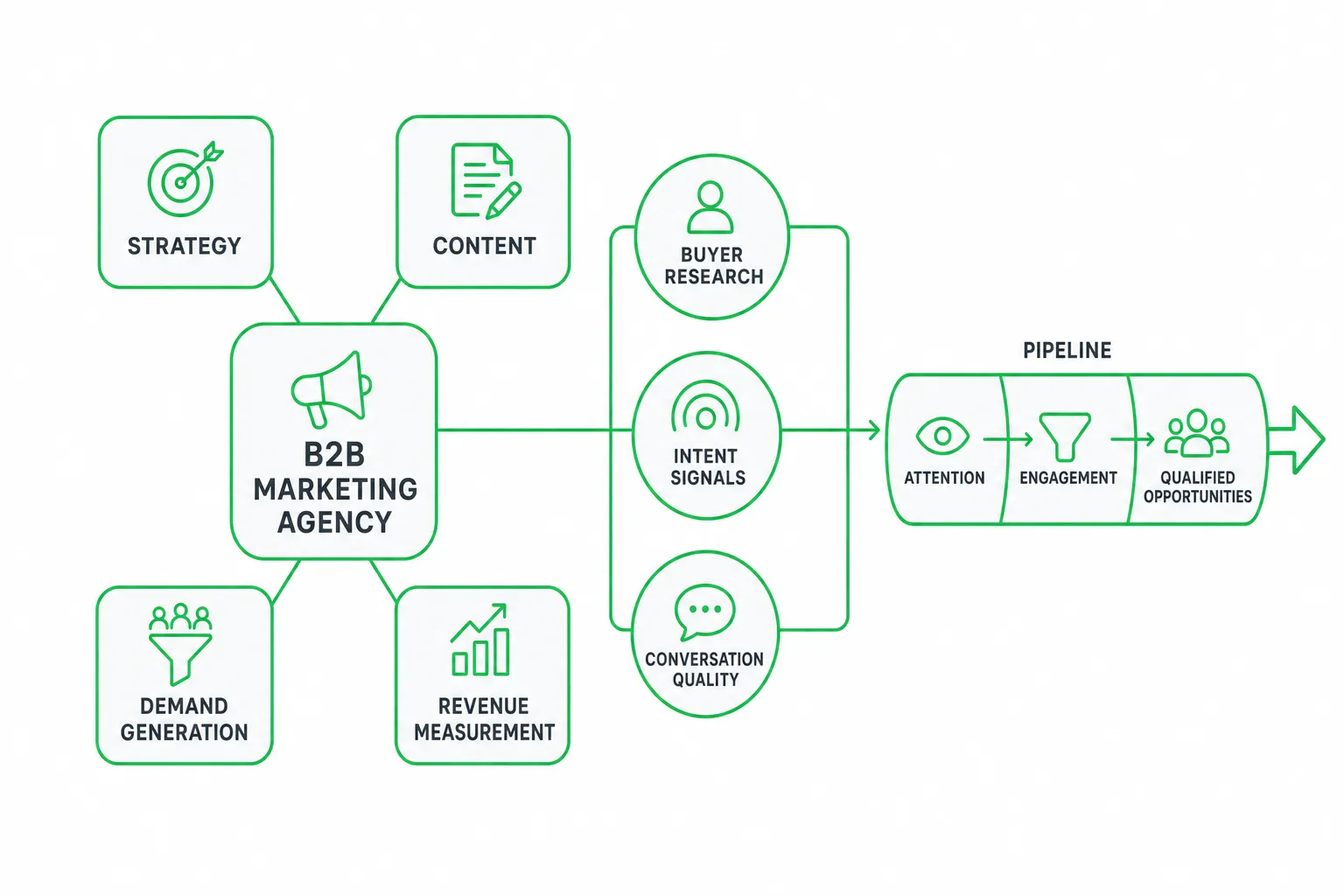
A B2B marketing agency helps you attract business buyers, create demand, generate qualified conversations, and support revenue growth. The right partner combines strategic direction with execution across channels such as SEO, content, paid media, email, social platforms, communities, and conversion optimization.
That choice matters because more activity does not automatically create better pipeline. You need a partner that understands how your buyers research solutions, identifies where intent appears, and measures progress by conversation quality rather than output volume.
What is a B2B marketing agency?
A B2B marketing agency works with companies that sell products or services to other businesses. It helps you define your market, reach the right accounts, explain your value, and move interested buyers toward a sales conversation or self-serve purchase.
The best agencies connect their work to your buying process. They do not treat blog posts, ads, landing pages, and social updates as separate products. They build a system around your ideal customer profile, buying committee, sales cycle, offer, and conversion path.
Hire a B2B agency when your team lacks specialized capacity, needs a repeatable demand-generation system, or cannot connect marketing activity to qualified opportunities. An agency can also help when your founders or sales team understand the product deeply but lack time to operate every channel consistently.
Look for a partner that can answer three questions clearly:
- Who are we reaching? Which industries, roles, problems, and buying situations matter most?
- Why would they care? Which message, proof point, or offer matches their current priority?
- What happens next? How does attention become a useful conversation, qualified opportunity, or purchase?
What services should a B2B agency provide?
Services vary by agency, but a capable partner should cover the parts of the marketing system that affect growth. That may include:
- Positioning, market research, and ideal customer profile development
- Messaging for your website, sales materials, campaigns, and product pages
- Content strategy, SEO, blog production, and search-focused content updates
- Paid search, paid social, retargeting, and account-based campaigns
- Email campaigns, lead nurturing, landing pages, and conversion optimization
- Marketing automation, lead scoring, analytics, and performance reporting
- Community marketing, intent-led lead generation, and personalized outreach
- AI-assisted content creation, website chat, and multi-platform publishing
Do not evaluate these services as a menu of disconnected deliverables. A strong agency should explain how a content asset supports a search opportunity, how that searcher enters a conversion path, and how sales receives useful context about the resulting lead.
For a SaaS company or lean team, practical capabilities may matter more than a long service list. You may need someone to identify a person actively asking for a solution, draft a relevant reply, publish supporting content, and score the resulting lead. You may also need website chat that answers basic questions while routing higher-intent visitors to your team.
Agency, in-house team, or AI marketing system?
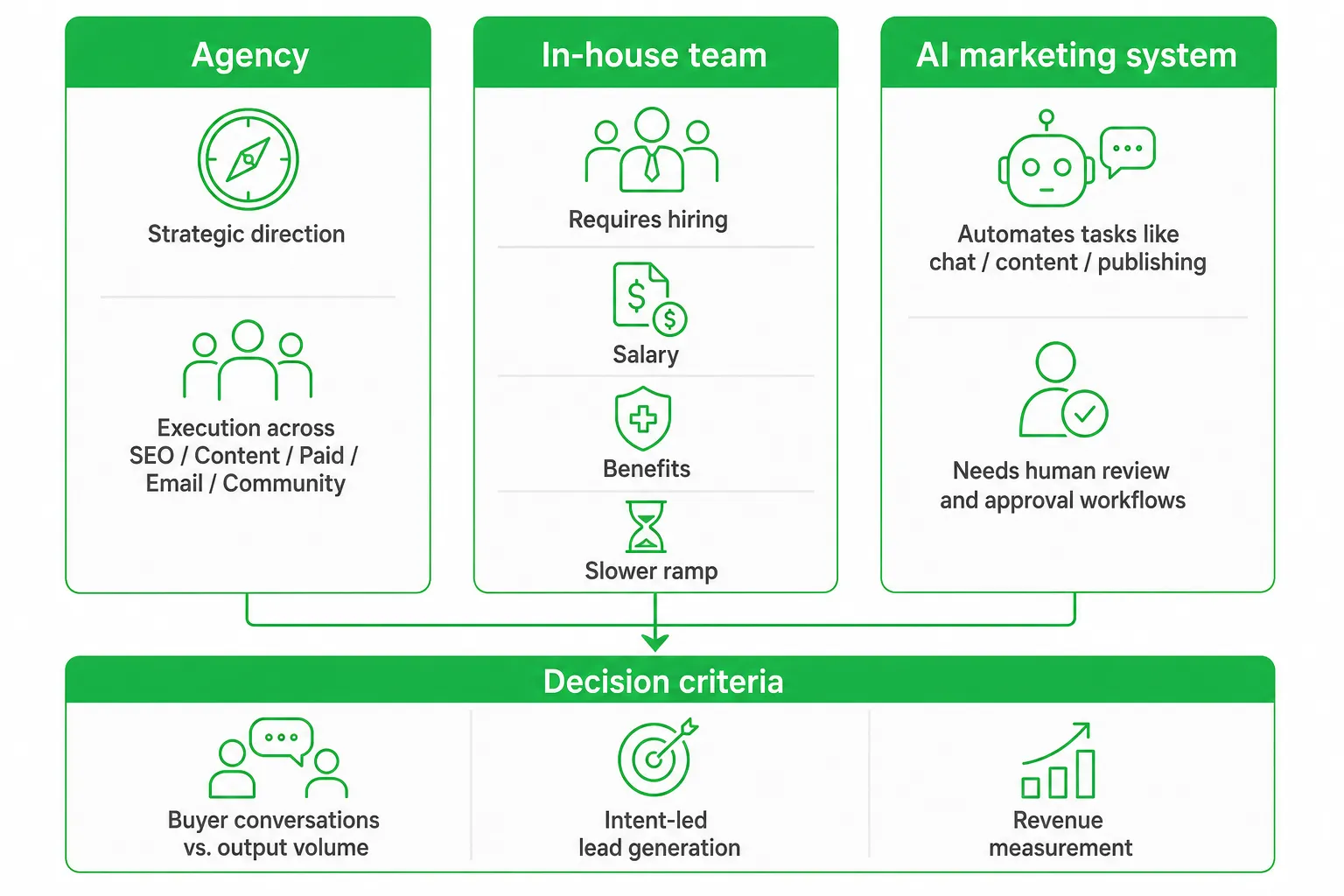
You have three broad options. Each solves a different operating problem.
| Option | Best fit | Main advantage | Primary tradeoff |
|---|---|---|---|
| B2B agency | You need strategic expertise and broad execution | Access to specialists without building a full team | You manage an external relationship and share control |
| In-house team | You need deep product knowledge and ownership | Close connection to customers, sales, and company priorities | One team may struggle to cover every channel and specialty |
| AI marketing system | You need repeatable execution with lower overhead | Faster research, drafting, publishing, and follow-up | Requires human approval, brand context, and quality control |
An agency gives you experienced operators without requiring full-time hires. It can bring a broader view of positioning, SEO, paid acquisition, outreach, analytics, and experimentation. The tradeoff is that an external team may need more onboarding and may not develop the same product intuition as your founders.
An in-house team gives you direct ownership. Your marketers can work closely with product, sales, and customer success. However, covering strategy, technical SEO, content, paid acquisition, design, community marketing, automation, and reporting may require more capacity than a small company can support.
An AI-enabled system can automate repetitive research, drafting, publishing, and lead follow-up. It works best when you provide clear brand guidance and approve important actions. It should assist judgment, not replace it.
For a small SaaS team, a practical hybrid may combine founder oversight with an AI marketing team such as OneUp Today. You retain approval over every send and important customer conversation while repeatable marketing work keeps moving.
How to evaluate a B2B marketing agency
Start with diagnosis, not deliverables. Before an agency recommends a content calendar or campaign, ask it to explain your market, buying committee, funnel constraints, and highest-intent channels.
A serious evaluation should cover these areas:
- Market understanding: Can the agency describe your best-fit customers, their urgent problems, and the alternatives they consider?
- Channel judgment: Can it explain why search, paid media, email, communities, Reddit, or another channel fits your buyers?
- Measurement: Does reporting separate activity metrics from qualified conversations, pipeline contribution, conversion quality, and revenue influence?
- Proof: Can the team show relevant work, explain what it changed, and discuss what did not work?
- Ownership: Will you retain access to accounts, analytics, content, audiences, domains, CRM data, and campaign assets?
- Voice and privacy: How will the agency learn your tone, protect customer data, handle opt-outs, and obtain approval?
Check for consistency across your website, content, outreach, and sales enablement. Gartner found that 69% of surveyed B2B buyers reported inconsistencies between information on a sales organization’s website and information provided by sellers. An agency should help reduce that gap, not create another version of your positioning.
The overlooked advantage: intent-led, buyer-controlled marketing
Many agency comparisons focus on broad service categories. They miss where buyers actively ask for solutions. Reddit threads, specialist communities, review sites, search queries, and product discussions can reveal a problem before someone fills out a form.
Intent-led marketing starts with the conversation. You find a person describing a problem that matches your product, understand the context, and respond with something useful. The goal is not to force a pitch into every discussion. The goal is to participate when your expertise genuinely fits.
The channel strategy should also respect buyer preference. Gartner reports that 61% of B2B buyers prefer an overall rep-free buying experience, while 73% actively avoid suppliers that send irrelevant outreach. That makes relevance and control essential.
Ask potential partners whether they can:
- Identify high-intent conversations based on the actual problem being discussed
- Personalize a response to the buyer’s context instead of inserting a generic template
- Recommend useful resources without pretending to be a customer or community member
- Obtain approval before sending a DM, email, reply, or public comment
- Track which conversations become qualified opportunities
- Stop or revise messaging when buyers signal that it feels irrelevant
AI adoption is still uneven. Adobe reports that 45% of B2B organizations use AI-powered chatbots or virtual assistants, while 17% say those tools are already in use and showing ROI. The practical question is not whether an agency mentions AI. It is whether the partner turns AI into controlled, measurable workflows.
What the engagement process should look like
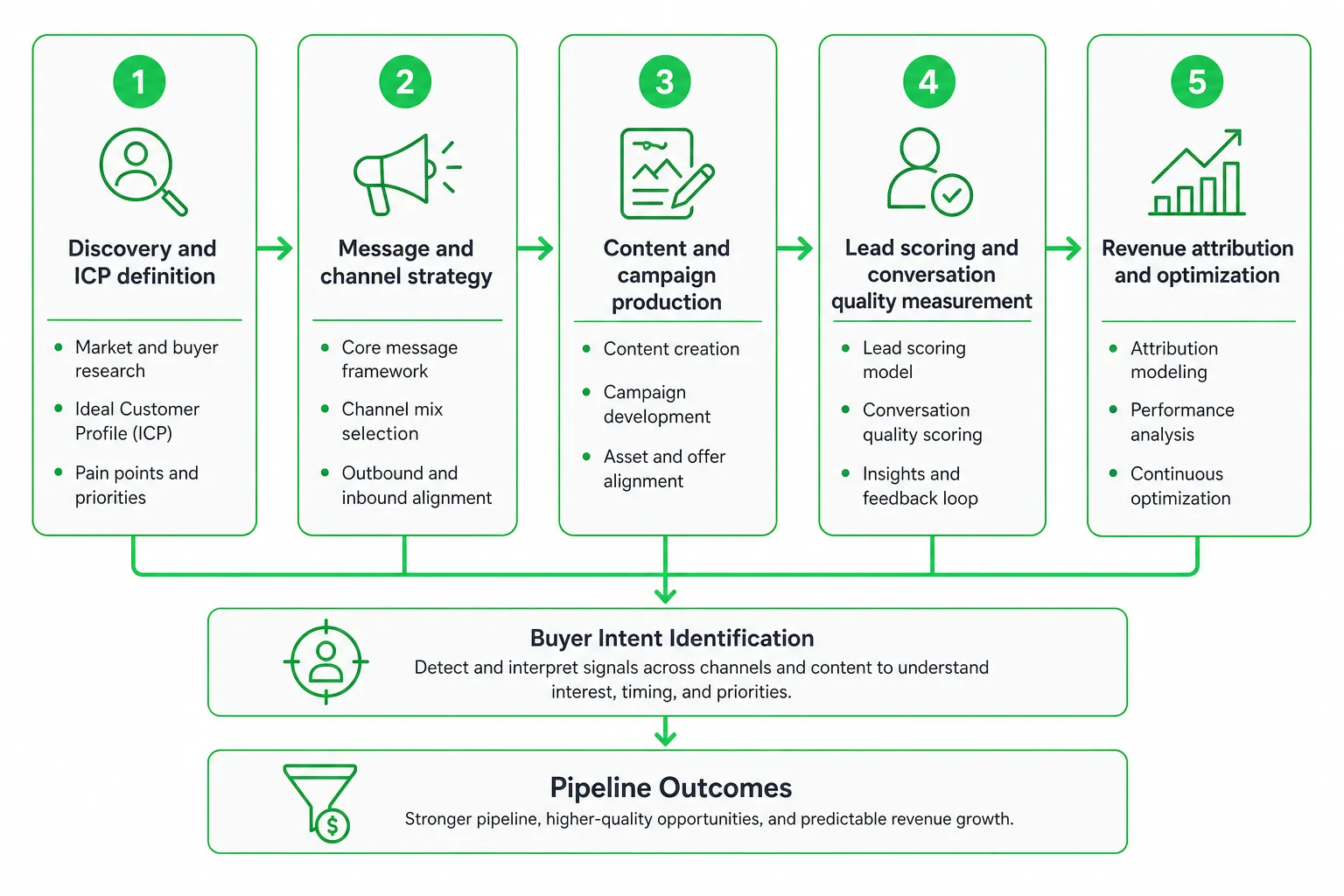
A good engagement moves from understanding to testing to scaling. You should know what the agency is learning and why each next action follows from that learning.
- Establish a baseline. Review your positioning, website, traffic, content assets, conversion paths, CRM data, target accounts, communities, and existing sources of qualified demand.
- Prioritize opportunities. Build a plan around channel hypotheses, content themes, outreach themes, conversion improvements, approval rules, ownership, and reporting definitions.
- Launch focused experiments. Test a small set of messages, audiences, offers, or channels. Keep the tests connected to a specific buyer problem.
- Review quality, not just volume. Compare response patterns, conversation relevance, sales feedback, conversion quality, and pipeline influence.
- Scale what earns attention. Expand the channels and messages that create meaningful buyer conversations. Stop work that produces activity without useful intent.
Your review meetings should answer practical questions. What changed in pipeline quality? What did you learn about buyer language? Which objections appeared? Which work should stop, improve, or scale?
How to choose, and what to do next
Choose a full-service B2B marketing agency when you need strategic direction and broad execution. Choose a specialist when one bottleneck, such as technical SEO, paid acquisition, or positioning, is holding back growth. Choose an AI-assisted partner when speed, repeatability, and founder oversight matter most.
OneUp Today is designed for SaaS founders, indie hackers, and small teams that want Reddit lead generation, approval-based AI outreach, SEO and blog autopilot, content creation, multi-platform publishing, and an AI chatbot in one operating system.
Before booking a call, document your target customer, offer, current acquisition channels, strongest proof, sales capacity, and definition of a qualified lead. Ask each potential partner to explain the first experiments it would run and how it would report success.
Make approval workflows, brand-voice guidelines, data ownership, opt-out handling, and human review explicit requirements in the proposal. A partner should make your marketing more relevant and more consistent, not less controlled.
Next step: Write a one-page brief describing your buyer, offer, current funnel, and biggest constraint. Send it to shortlisted partners and compare the quality of their diagnosis before comparing their retainers.
Bottom line: The right B2B marketing agency does more than produce marketing assets. It finds where buyer intent appears, turns that intent into useful conversations, and gives you a clear way to judge what is working.
Frequently asked questions
How do I know if a B2B marketing agency is right for my business?
Yes, if your team lacks specialized capacity or needs a repeatable demand-generation system. Test whether the agency can find high-intent buyer conversations, not just produce content and reports, and ensure they connect strategy to revenue measurement.
What should I look for in a B2B marketing agency contract?
Look for clear approval workflows for AI-assisted outreach, consistent messaging, and human review. Also require the agency to map one proposed activity to a buyer problem, distribution channel, conversion action, and business outcome to avoid disconnected deliverables.
How much does a B2B marketing agency typically cost?
Costs vary widely, but most agencies charge between $5,000 and $20,000 per month for comprehensive services. The price depends on scope, channels included, and whether the agency focuses on strategy, execution, or both, so compare with in-house hiring costs before signing.
Can a B2B marketing agency replace my in-house team?
Not entirely, but it can supplement or temporarily replace capacity. An agency provides specialized skills and a repeatable demand system, while in-house teams offer deeper product knowledge and daily oversight. The best approach often combines both, depending on your growth stage and budget.
How long does it take to see results from a B2B marketing agency?
Expect 3 to 6 months for initial pipeline impact, with longer-term results in 6 to 12 months. Results depend on your buying cycle, existing brand awareness, and how quickly the agency can align strategy with your ideal customer profile and conversion path.