
Founder Led Sales: A Practical Guide for SaaS
Key takeaways
- Founder led sales works best when you use customer conversations to discover who buys, why they buy, and what makes them hesitate.
- Document your funnel math before hiring: lead volume, opportunity conversion rate, average deal size, win rate, sales-cycle length, and time to go live.
- Define a repeatable sales process before asking someone else to scale it.
- Hire when founder-led selling is limiting growth, not simply because a salesperson seems like the next standard step.
Founder led sales means the founder personally finds prospects, runs discovery, handles objections, and closes early customers. For most early SaaS companies, it is the fastest way to test the customer, problem, positioning, pricing, and buying process.
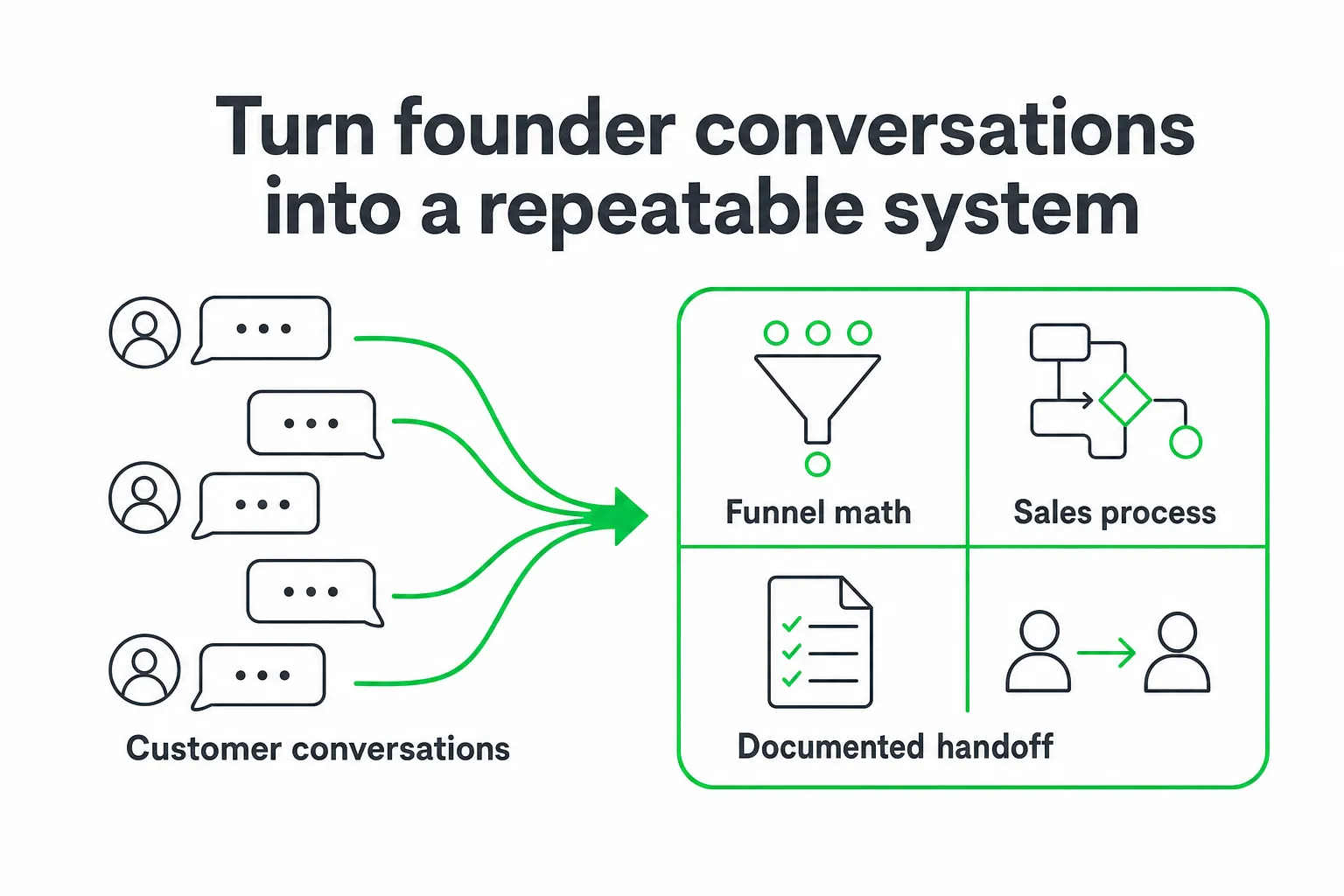
But the goal is not to sell forever. Your goal is to turn those conversations into a sales system that another person can follow without guessing. That means tracking funnel math, documenting what repeats, and knowing when your personal involvement has shifted from advantage to bottleneck.
What Founder Led Sales Means
Founder-led sales is a go-to-market motion where you stay close to the buyer during the earliest stage of the company. You source opportunities, lead sales calls, explain the product, negotiate terms, and learn from every win or loss.
That direct involvement matters because your product is probably still changing. You can adjust the offer, answer technical questions, change onboarding, or clarify the value proposition without waiting for a chain of approvals.
Your job is to learn what makes the right customers buy. Then capture those lessons in messaging, qualification rules, sales stages, follow-up templates, and onboarding steps.
- Customer discovery: Learn which problem is urgent enough to justify action.
- Positioning: Identify the words buyers use to describe the problem and desired outcome.
- Qualification: Separate a real buying opportunity from polite interest.
- Conversion: Find the actions that move a qualified prospect toward a decision.
- Handoff: Document the motion before another person owns it.
Why Founder Led Sales Works for Early SaaS
Founders can sell an evolving product because they can explain the vision and make decisions quickly. When a prospect raises an objection, you can investigate it immediately instead of passing the question through multiple teams.
Those conversations also create a short feedback loop. You learn how the buyer handles the problem today, what the problem costs them, which alternatives they have considered, and what could prevent implementation.
Founder-led selling gives you four practical advantages:
- Authentic trust: Buyers speak directly with the person building the product.
- Fast learning: Objections reach the product and marketing decisions quickly.
- Better prioritization: Repeated customer pain can guide product investment.
- Stronger early relationships: You understand the customer’s desired outcome before the deal closes.
Do not confuse founder enthusiasm with product-market fit. A founder may close a deal because of personal credibility, a custom promise, or unusual persistence. Look for patterns that survive across similar customers and situations.
How to Start Founder Led Sales
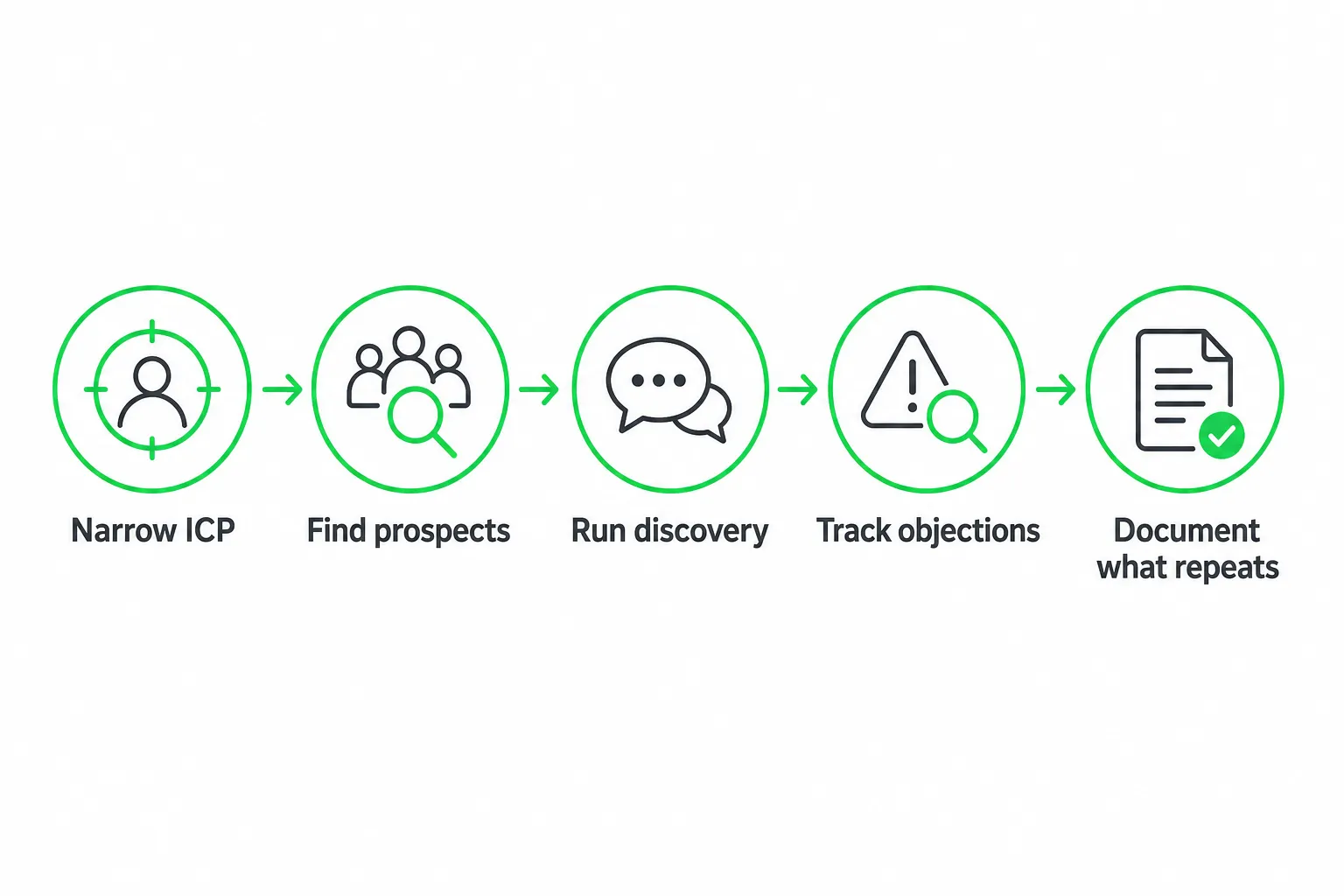
Start with a narrow ideal customer profile. Choose a buyer with an urgent problem, a reachable channel, a clear trigger, and a realistic path to a purchase conversation.
A useful profile is more specific than “small businesses” or “SaaS teams.” Describe the role, workflow, trigger, current alternative, and buying consequence. For example: a founder who is manually monitoring customer conversations, has a clear lead-generation problem, and is already searching for a way to improve qualified outreach.
Build your first prospect list from places where the problem is already visible:
- Warm introductions from customers, advisors, or peers.
- Communities where buyers ask for recommendations.
- Search queries that reveal active pain.
- Customer referrals and adjacent partners.
- Relevant social conversations and targeted outbound.
Use discovery calls to understand the prospect’s current workflow before presenting the product. Ask what they do today, what is failing, what they have tried, who is involved in the decision, and what outcome would make a change worthwhile.
Record every conversation in a simple CRM. Capture the problem in the prospect’s own words, current stage, next action, objections, decision criteria, and reason for winning or losing.
Founder Led Sales Tactics That Create Momentum
Lead with the prospect’s situation rather than a product tour. Show that you understand the workflow, consequence, and desired result before explaining how your product works.
When the same objection appears, turn it into an asset. A question about implementation can become an onboarding checklist. A pricing concern can become a value explanation. A comparison question can become a page that helps future buyers evaluate alternatives.
- Discovery: Ask about the current process and the cost of leaving it unchanged.
- Demonstration: Show only the workflow connected to the buyer’s stated problem.
- Follow-up: Reference the buyer’s exact words and recommend one clear next step.
- Objection handling: Answer directly, then confirm whether the concern is resolved.
- Close planning: Identify the decision-maker, required approvals, timing, and implementation path.
Personalized follow-up should be useful, concise, and specific. A good note reminds the buyer what they wanted to change, explains what you recommend doing next, and gives them a simple way to respond.
Controlled AI assistance can help with research, first drafts, and follow-up preparation. Keep review and approval with the founder when context matters. Automation should reduce repetitive work, not remove judgment from a sensitive buyer conversation.
The Founder Led Sales Operating System
Here is the operating layer that many founder-led sales guides leave out. Before you hire or hand off sales, document the numbers and decisions that explain how your funnel works.
Funnel math: Track lead volume, opportunity conversion rate, average deal size, win rate, sales-cycle length, and time to go live. These are the six core metrics recommended by SignalFire.
Do not use the metrics as decoration in a dashboard. Use them to answer practical questions. Which source produces qualified opportunities? Where do prospects stall? Does a larger deal require more implementation work? Which customer segment closes for a different reason?
Repeatability: Define it as more than a founder who can close. A repeatable motion includes:
- A consistent customer profile.
- A dependable source of qualified opportunities.
- A discovery process with clear qualification questions.
- Sales stages with exit criteria.
- A buying narrative that explains the customer’s problem and desired outcome.
- A close plan and follow-up cadence.
- An onboarding path that gets customers to value.
- A measurable conversion pattern by segment and source.
Build the playbook from real calls. Include qualification rules, demo structure, objection responses, proposal format, follow-up timing, and loss reasons. Avoid writing a long theoretical manual that nobody uses.
Review the funnel regularly by segment and source. Your memory will overvalue the most recent or most interesting deal. A simple record of outcomes gives you better evidence for pricing, positioning, hiring, and channel decisions.
When Founder Led Sales Becomes a Bottleneck
Founder-led selling becomes a bottleneck when your involvement limits the company rather than improving the sale. Common signs include delayed responses to qualified prospects, inconsistent follow-up, a growing backlog of conversations, and too little time for product or company priorities.
Hiring is often the moment when this problem becomes visible. In a review of 375 founder and CEO accounts from 351 B2B software companies, Selleris’ Founder-Led Sales Research found that 107 accounts identified deciding whom to hire as the trigger for confronting the bottleneck. The same review reported 78 accounts citing insufficient pipeline and 29 citing a flat revenue line.
Do not hire simply because sales feels uncomfortable. Hire when you can explain what the new person should repeat, what they should build, and how you will judge progress.
When to Hire and How to Hand Off Sales
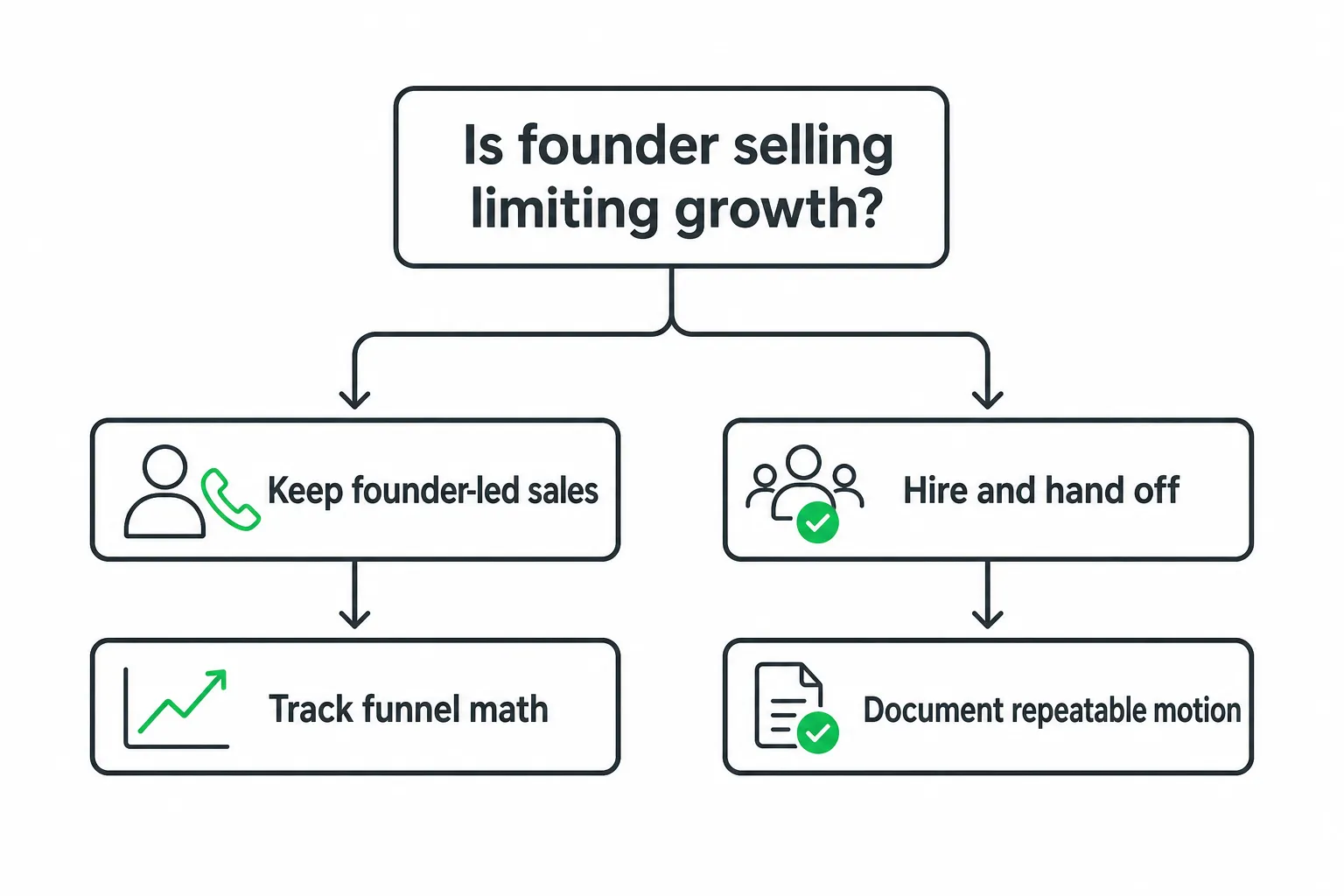
Choose the first sales hire based on the gap in your system. You may need a builder who creates the process, an experienced closer who works an established motion, or a full-cycle seller who can prospect, qualify, close, and support onboarding.
Those are different jobs. A closer cannot compensate for unclear positioning. A builder may not be the right person for complex negotiations. A full-cycle seller needs enough documentation and support to avoid reinventing every step.
Research supports building the process before hiring for scale. Among 138 founder accounts that took a position on timing, 116 favored creating a repeatable sales process before hiring a salesperson intended to scale it, according to Selleris’ Founder-Led Sales Research.
Use a controlled transition:
- Shadow: Let the new hire observe discovery calls, demos, follow-ups, and negotiations.
- Co-sell: Give them ownership of selected sections while you handle the highest-context moments.
- Review: Inspect call notes, stage changes, next actions, and objections.
- Transfer: Let them own suitable opportunities while you remain available for strategic accounts.
- Measure: Compare their funnel movement with the documented process, not with your personal instincts.
Enterprise motions may require a longer founder transition. Enterprise sales teams commonly grow out of founder-led motions, and founders generally do not step back until at least $5 million in ARR, according to Salesforce Ventures’ The Startup Enterprise GTM Report 2024.
Founder Led Sales Tools, Trade-Offs, and Next Steps
| Approach | Best for | Main trade-off |
|---|---|---|
| Manual founder selling | Learning a new market and refining the offer | Consumes founder time and can be difficult to scale |
| First sales hire | Adding capacity to a documented motion | Can amplify a weak process if the handoff happens too early |
| Controlled automation | Research, drafting, reminders, and consistent follow-up | Requires human review for context, tone, and judgment |
For controlled outreach, OneUp Today can find high-intent Reddit conversations and draft personalized DMs in your voice for approval before sending. In OneUp Today’s own data, its DM generator blocks 23 corporate buzzwords with a hard validator because asking an AI model to avoid them was not enough. You keep control of the message while reducing the repetitive work around prospect research and follow-up.
Use this practical sequence:
- Choose one customer segment and one urgent problem.
- Record every lead, opportunity, stage change, win, and loss.
- Measure the six funnel metrics that explain movement through your process.
- Write the questions, rules, and assets that help another person sell consistently.
- Decide whether the next investment should be founder time, documentation, automation, or a sales hire.
Before scaling, answer five questions: Who buys? What triggers the purchase? Which channel produces qualified opportunities? What must happen at each stage? Can another person follow the process without guessing?
Next step: Choose your target segment today and document your last sales conversations in one place. Then identify the repeated problem, objection, and next action that should become the first page of your sales playbook.
Frequently asked questions
When should a startup hire its first salesperson instead of relying on founder led sales?
Hire when founder-led selling is measurably limiting growth and you can explain a repeatable sales process. Before hiring, confirm that similar prospects move through consistent stages, understand the funnel metrics, and document how to qualify, pitch, follow up, and close deals.
How do you transition from founder led sales to a sales team?
Transition in stages by documenting what works, then having a salesperson observe calls, run parts of the process, and eventually own deals. Keep reviewing calls and outcomes so you can distinguish a genuine repeatable motion from sales that depend on your personal credibility or custom promises.
What metrics should founders track during founder led sales?
Track lead volume, opportunity conversion rate, average deal size, win rate, sales-cycle length, and time to go live. Together, these measures show where prospects stall, how predictable revenue is, and whether the sales process is ready for someone else to run.
Can founder led sales work for a B2B SaaS startup?
Yes, founder-led sales can work especially well for early B2B SaaS because founders can explain an evolving product and respond quickly to buyer feedback. Its value is greatest when customer conversations reveal repeatable needs and buying behavior, rather than producing one-off deals through founder enthusiasm alone.