
Blogger Outreach Software for Small Teams
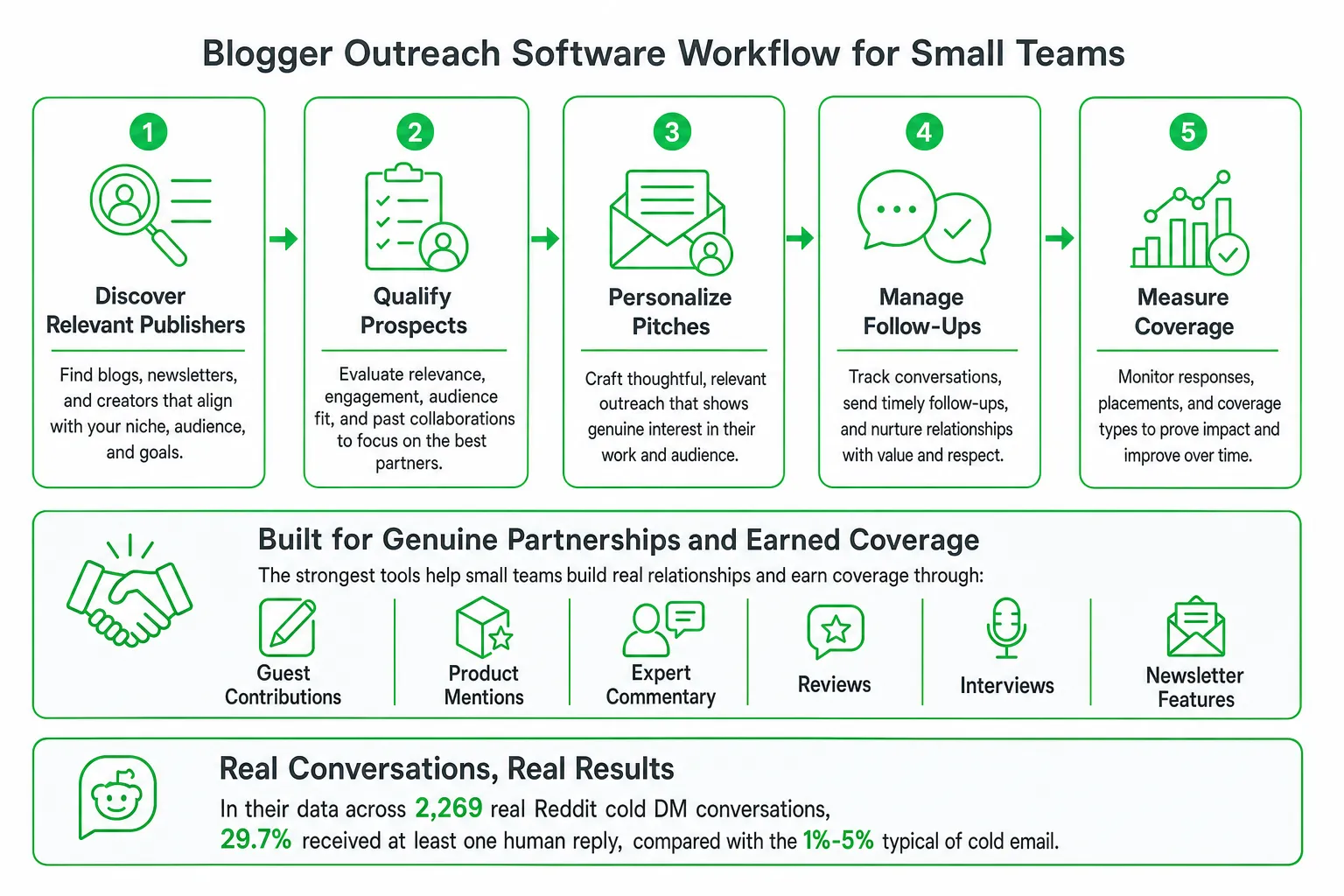
Blogger outreach software helps you find relevant publishers, qualify opportunities, personalize pitches, manage follow-ups, and measure coverage from one workflow. For a small team, the best tool reduces research and admin without turning your outreach into automated spam.
Look for prospect discovery, publisher qualification, approval controls, deliverability safeguards, and relationship-focused reporting. Those capabilities matter more than sending another batch of generic emails.
Key takeaways
- Choose software that combines discovery, qualification, personalization, follow-ups, and measurement.
- Separate relationship-building outreach from paid link placement. They have different goals and risks.
- Keep a human approval step before every email, DM, or public reply.
- For small SaaS teams, connect outreach with content, SEO, and conversations already happening around your category.
What Is Blogger Outreach Software?
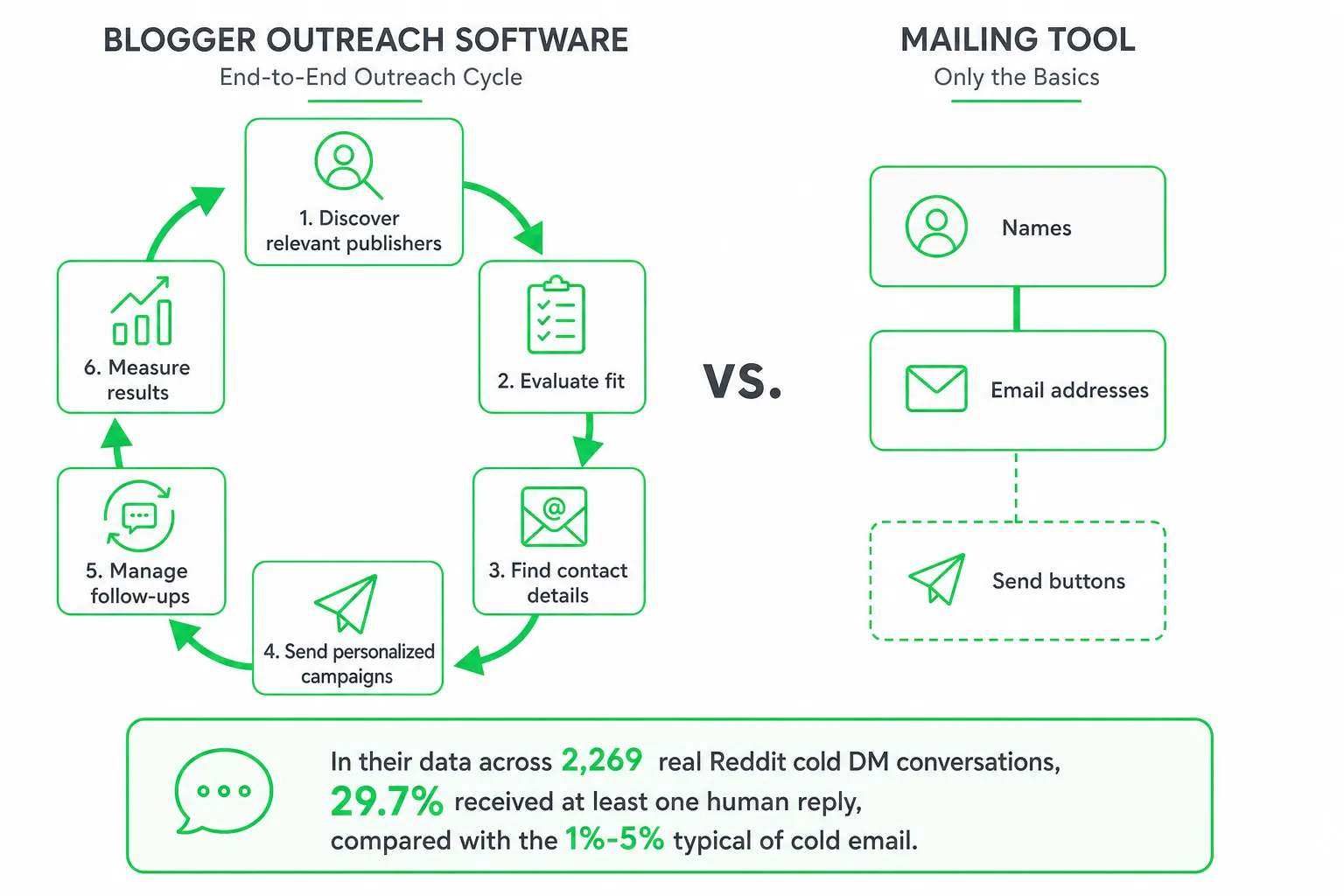
Blogger outreach software helps you discover relevant publishers, evaluate their fit, find contact details, send personalized campaigns, manage follow-ups, and measure results from one workspace.
The strongest tools support genuine partnerships. That includes guest contributions, product mentions, expert commentary, reviews, interviews, newsletter features, and other earned coverage. They do not treat every publisher as an address in a bulk-email database.
For a small team, the value is simple: spend less time researching and updating spreadsheets, while keeping control over the message and the relationship. You should be able to see why a prospect fits, what you sent, whether they replied, and what action comes next.
Discovery can also happen outside traditional blogs. Someone asking for a solution in a relevant community may be a better conversation than a cold pitch to a high-authority publication. In our own data across 2,269 real Reddit cold DM conversations, 29.7% received at least one human reply, compared with the 1%-5% typical of cold email. OneUp Today benchmark data
What to Look for in a Blogger Outreach Tool
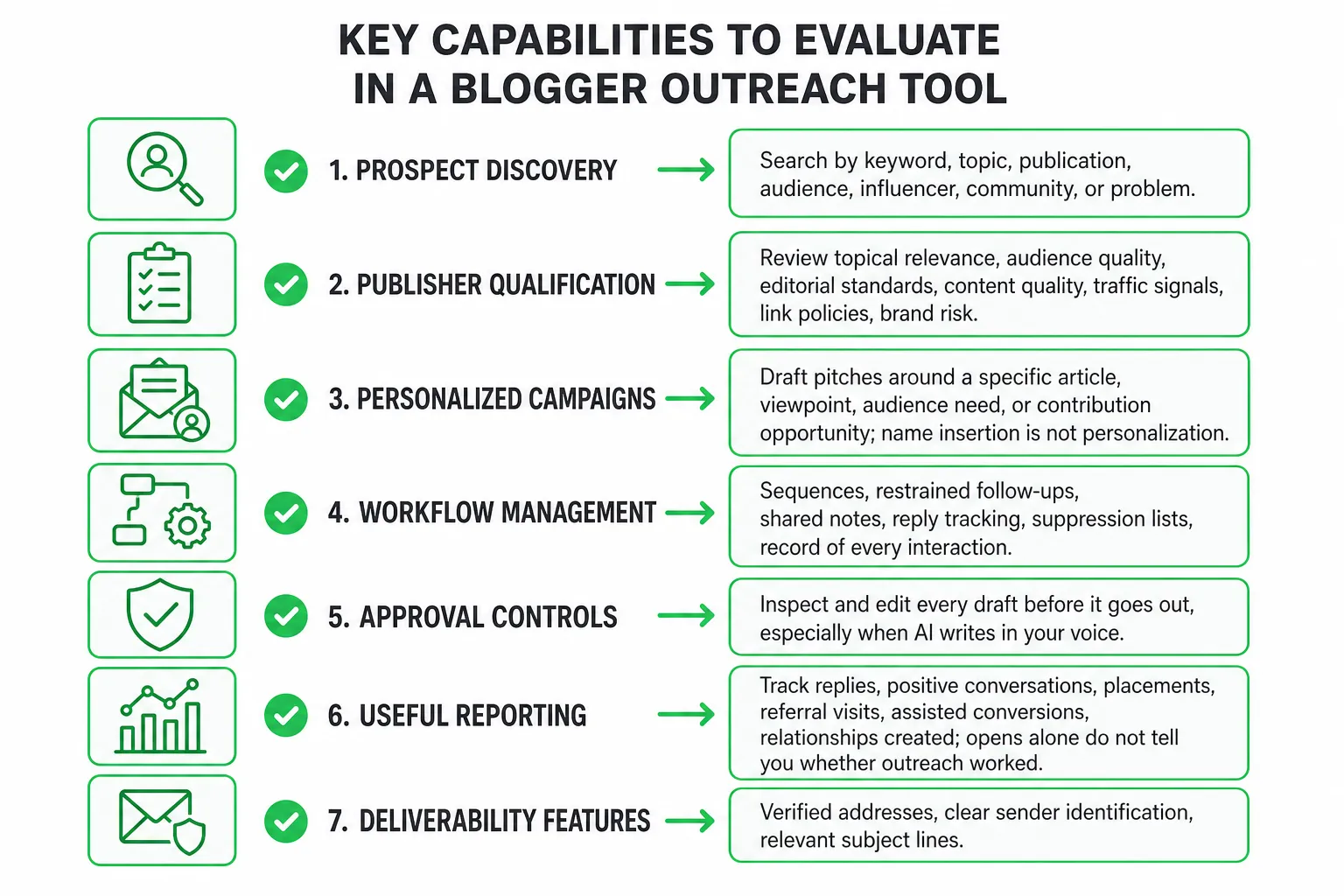
Evaluate software against the entire outreach process, not just its template library. These are the capabilities that save a small team meaningful work.
- Prospect discovery: Search by keyword, topic, publication, audience, influencer, community, or problem. The tool should surface contact information alongside useful context.
- Publisher qualification: Review topical relevance, audience quality, editorial standards, content quality, traffic signals, link policies, and brand risk before sending anything.
- Personalized campaigns: Draft pitches around a specific article, viewpoint, audience need, or contribution opportunity. Name insertion is not personalization.
- Workflow management: Use sequences, restrained follow-ups, shared notes, reply tracking, suppression lists, and a record of every interaction.
- Approval controls: Inspect and edit every draft before it goes out. This matters especially when AI writes in your voice.
- Useful reporting: Track replies, positive conversations, placements, referral visits, assisted conversions, and relationships created. Opens alone do not tell you whether outreach worked.
Check deliverability features too. You want verified addresses, clear sender identification, relevant subject lines, opt-out handling, and safeguards against contacting people who declined or unsubscribed.
A publisher database also needs freshness and judgment. A site can appear relevant in a search result while having poor editorial standards, an unsuitable audience, or a policy against commercial contributions. Software should help you inspect those details before you spend time on a pitch.
Best Blogger Outreach Software Options
Different tools solve different parts of the problem. Compare the operating model before comparing feature lists.
| Option | Best fit | What to watch |
|---|---|---|
| BuzzStream | Dedicated publisher research, outreach, and relationship tracking | Requires you to manage the quality of each opportunity and campaign |
| Respona | Prospecting and placement support with a paid publisher model | Costs can rise quickly when you purchase placements |
| Sales-engagement platform | CRM sequencing and sales follow-up | Often needs separate publisher discovery and coverage reporting |
| OneUp Today | Small SaaS teams combining AI-assisted discovery, outreach, content, and SEO workflows | Keep human approval before every send |
BuzzStream: Dedicated outreach operations
BuzzStream is a strong fit when you want a prospect database, contact discovery, publisher metrics, email tracking, templates, link monitoring, and a browser extension in one dedicated system. Its Starter plan costs $49 per month and includes 500 contacts plus monitoring for up to 1,000 links. BuzzStream plan details
Use it when relationship history and publisher research are central to your work. You still need a clear qualification process, because a database does not automatically make every listed publisher a good fit.
Respona: Placement support with a paid model
Respona suits teams that want prospecting, campaign management, and placement support in one product. Its listed pricing ranges from $100 for publishers with a Domain Rating of 20+ to $500 for publishers with a Domain Rating of 60+, with a 28-day standard turnaround and a 14-day express option. Respona pricing
This model is better suited to teams with a budget for publisher purchases. Treat purchased placements as commercial opportunities, not as equivalent to earned editorial relationships.
Sales-engagement platforms: Strong sequencing, incomplete context
Sales-engagement platforms can provide capable sequences, CRM integrations, task management, and reply routing. They work well when your main requirement is moving known contacts through a sales process.
They often require separate systems for publisher discovery, editorial qualification, relationship history, link or coverage measurement, and content workflows. That fragmented setup can create extra work for a small team.
OneUp Today: AI-assisted outreach for small SaaS teams
OneUp Today is a practical option when you want AI-assisted lead discovery, personalized emails and DMs, drafting in your voice, approval before sending, and outreach connected with SEO and content workflows. It is particularly useful when your prospects are already discussing the problem your product solves in communities such as Reddit.
The Outreach Workflow Most Tools Miss
Many outreach platforms make sending easy. Fewer help you decide who deserves a message, what kind of opportunity you are pursuing, and whether the contact should receive one at all.
- Write a campaign brief. Define your audience, offer, proof points, target topics, acceptable publisher types, and the action you want from each prospect.
- Discover prospects in the right places. Search relevant publications, communities, search results, existing relationships, and conversations around the problem your product solves.
- Qualify before outreach. Check topical fit, audience overlap, editorial credibility, content quality, commercial intent, and whether the opportunity is earned, sponsored, or unsuitable.
- Personalize the angle. Reference a specific article, audience need, viewpoint, or contribution opportunity. Automate the draft, not the judgment.
- Approve every send. Edit the message for accuracy, voice, relevance, and compliance before sending it.
- Follow up carefully. Use restrained rules. Stop when someone declines or opts out. Route replies to a shared workspace and record the next relationship-building action.
Timing and audience selection can matter more than clever copy. In our own benchmark, Reddit DMs sent within 12 hours of a post received replies about 43% of the time, compared with about 21% for DMs sent a week or more later. Messaging the person who wrote the post received replies at 31.1%, compared with 17.2% when messaging a commenter. Our Reddit outreach benchmark
Keep messages short and specific. DMs of 40 words or fewer received replies at 30.6%, compared with 20.2% for messages of 50 words or more. Our Reddit outreach benchmark
Relationship Outreach vs. Paid Link Placement
Relationship-building outreach earns attention through relevance, useful contributions, credible expertise, and long-term publisher value. The primary goal is trust and meaningful coverage.
Paid placement is different. It is a commercial purchase with separate disclosure, quality, brand-safety, and search-policy considerations. Your software should label paid opportunities clearly instead of presenting them as earned editorial coverage.
Do not judge a campaign solely by link count. Evaluate publisher relevance, referral visits, qualified conversations, brand mentions, content reuse, customer influence, and the relationship created with the publisher.
The market can be expensive. Approximately 60% of respondents in BuzzStream’s 2026 State of Digital PR report had monthly digital PR budgets below $10,000, while the most common reported average cost per link was $300-$500.
That makes qualification essential. A smaller set of highly relevant relationships can be more useful than a larger set of paid placements that produce little referral activity or customer trust.
Personalization, Deliverability, and Measurement
Personalization should change the reason for contacting someone, not merely insert their name. Mention a specific article, explain the audience benefit, or propose a contribution that fits the publication's existing coverage.
Use verified addresses, a healthy sending domain, clear identification, plain-language copy, relevant subject lines, and opt-out handling. Stop contacting people who decline. Preserve a suppression list across campaigns and team members.
Set realistic expectations for cold email. Most campaigns in Mailshake’s 2025 cold-email report generated reply rates between 1% and 4%, while 16% of campaigns exceeded a 5% reply rate.
Build a reporting loop around business outcomes:
- Prospects discovered and qualified
- Pitches approved and sent
- Replies and positive conversations
- Placements, mentions, and accepted contributions
- Referral visits and engaged sessions
- Assisted leads and revenue influence
- Relationships created by publisher type
Review the numbers by campaign angle and prospect source. If community conversations outperform cold publication pitches, shift research time accordingly. If a publisher sends traffic but no qualified visitors, revisit the audience fit rather than simply seeking more links.
How Small Teams Should Choose and Start
Choose dedicated blogger outreach software when publisher research, relationship history, qualification, and coverage reporting are central. Choose a sales-engagement tool when CRM sequencing is the dominant requirement and publisher context already exists elsewhere.
Before buying, run a practical test. Ask the product to find relevant prospects in your niche, explain why each fits, draft a real pitch, manage follow-ups, preserve approval control, and report on the result. A polished demo is less useful than seeing how the tool handles your actual market.
Start with one focused campaign. Define a narrow audience, build a qualified prospect list, approve a small batch of personalized pitches, and review the replies before expanding automation.
For small SaaS teams, OneUp Today is the recommended starting point when you want to combine AI-assisted discovery and outreach with human approval, Reddit conversations, content publishing, and SEO support in one growth workflow.
The takeaway is straightforward: choose software that improves prospect judgment, not just sending speed. Your next step is to document your ideal publisher, outreach offer, qualification checklist, approval rules, and success metrics, then run a controlled campaign before committing to a larger tool or placement budget.
Frequently asked questions
Is blogger outreach software worth it for a small team?
Yes, if your team spends hours on manual research and follow-ups. The right tool replaces spreadsheets and scattered inboxes with one workflow, so a two-person team can run consistent outreach. Skip it if you only pitch a handful of publishers per month, since setup time would outweigh the savings.
How much does blogger outreach software cost?
Expect roughly $50 to $500 per month for most tools, based on contact limits and seats. Entry plans often start near $99 monthly, while enterprise pricing scales with database size. Free trials are common, so test one campaign before committing to an annual contract.
Can blogger outreach software get your email domain blacklisted?
Yes, if you send bulk generic pitches without safeguards. Blacklisting usually comes from high bounce rates, spam complaints, or sudden volume spikes. Choose tools with email verification, throttled sending, opt-out handling, and a human approval step, and keep daily volume low enough to look like normal correspondence.
What is the difference between blogger outreach software and a PR tool?
Blogger outreach software targets individual publishers and bloggers for earned coverage, guest posts, and reviews. PR platforms focus on journalists, newsrooms, and press release distribution. The workflows overlap, but outreach tools emphasize relationship tracking and personalized pitching, while PR tools emphasize media lists and announcements.
Do you need blogger outreach software if you already use a CRM?
No, not always. A CRM can store contacts and notes, but it usually lacks publisher discovery, qualification signals, and deliverability safeguards. If your outreach volume is low and you already have a prospect list, a CRM plus email templates may be enough. Add dedicated software when discovery and follow-up admin become the bottleneck.