
Best Twitter SEO Tool for Small Teams
The best Twitter SEO tool for a small team is one that combines X content planning, profile optimization, publishing, analytics, and lead generation. For most SaaS founders and indie hackers, an all-in-one workflow is more useful than a standalone hashtag generator.
Choose a dedicated keyword tool when you mainly need topic ideas. Choose a scheduler when publishing efficiency comes first. Choose OneUp Today when you want content creation, multi-platform publishing, Reddit demand discovery, SEO, and approval-based outreach in one workflow.
Key takeaways
- Evaluate tools against how X search actually works, not just keyword matching.
- Prioritize natural content, profile completeness, useful conversations, and search-safe automation.
- Separate visibility on X from rankings in Google.
- Pick an all-in-one platform when your team needs content, distribution, and warm lead discovery together.
The Best Twitter SEO Tool Depends on Your Goal
No tool can guarantee placement in X search. The best Twitter SEO tool helps you create relevant posts, maintain a discoverable profile, avoid search-suppression risks, and learn from performance data.
Start with your bottleneck:
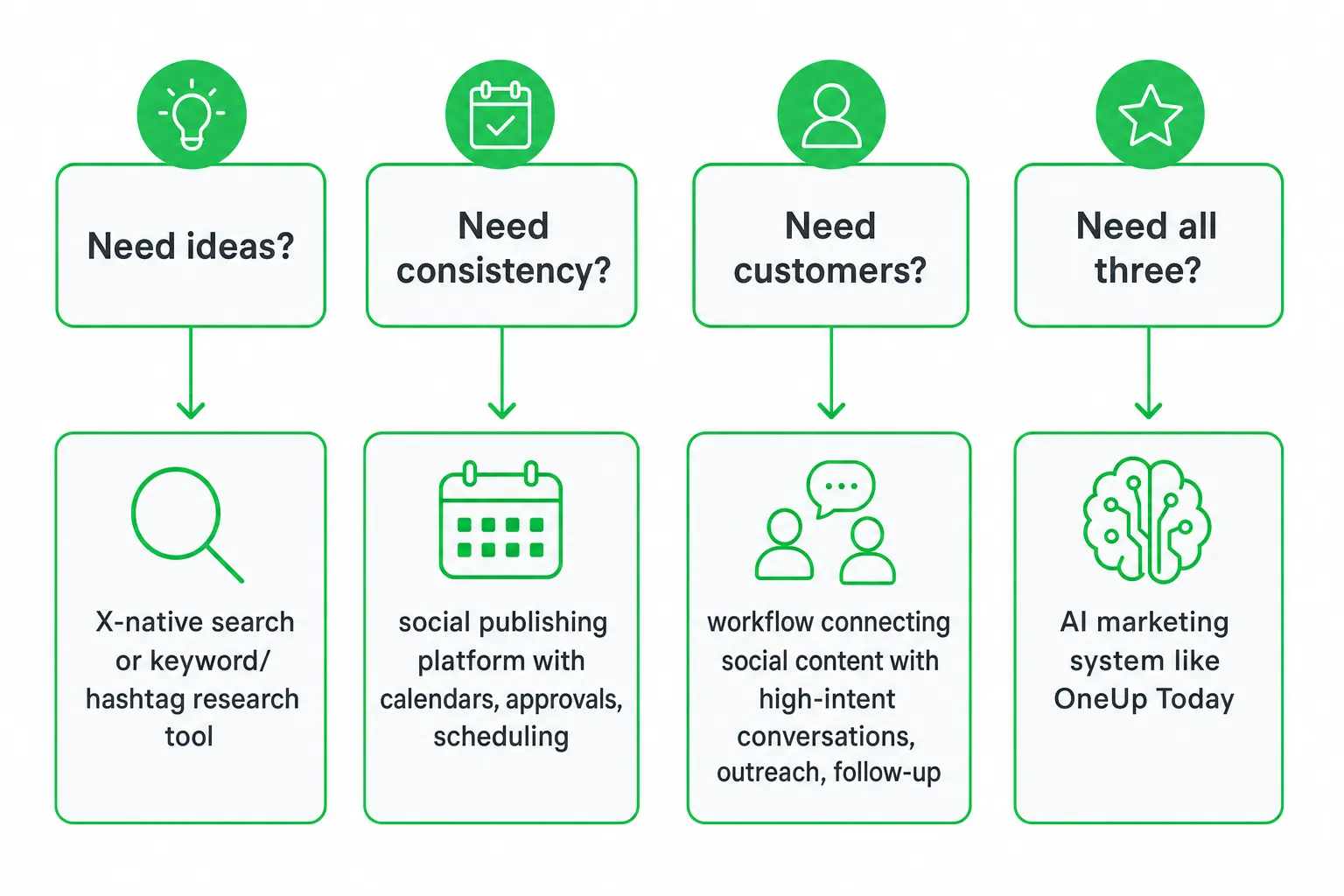
- Need ideas? Use X-native search or a keyword and hashtag research tool.
- Need consistency? Use a social publishing platform with calendars, approvals, and scheduling.
- Need customers? Use a workflow that connects social content with high-intent conversations, outreach, and follow-up.
- Need all three? Use an AI marketing system that combines research, drafting, distribution, SEO, and lead generation.
For a small SaaS team, OneUp Today fits the final category. It helps create, optimize, schedule, and repurpose content while supporting Reddit lead generation, outreach, SEO, and blog publishing. You approve every send, so automation does not replace judgment in sensitive conversations.
What a Twitter SEO Tool Should Help You Do
A useful X SEO tool should support the full path from research to revenue. Keyword suggestions alone are not enough.
- Research demand: Find phrases, questions, hashtags, accounts, conversations, and content formats that match how your audience searches on X.
- Improve your profile: Clarify your name, username, bio, profile image, pinned post, and links so a visitor understands your offer quickly.
- Draft naturally: Use relevant language without forcing the same phrase into every post.
- Start conversations: Create useful replies that add context instead of dropping links or generic pitches.
- Repurpose winners: Turn strong X ideas into blog posts, emails, Reddit replies, landing page copy, and additional social content.
- Review performance: Connect posts to profile visits, qualified conversations, and business outcomes instead of stopping at impressions.
Look for a tool that preserves your voice. A post can target the right topic and still fail if it sounds robotic, vague, or overly promotional.
How X Search Actually Affects Tool Evaluation
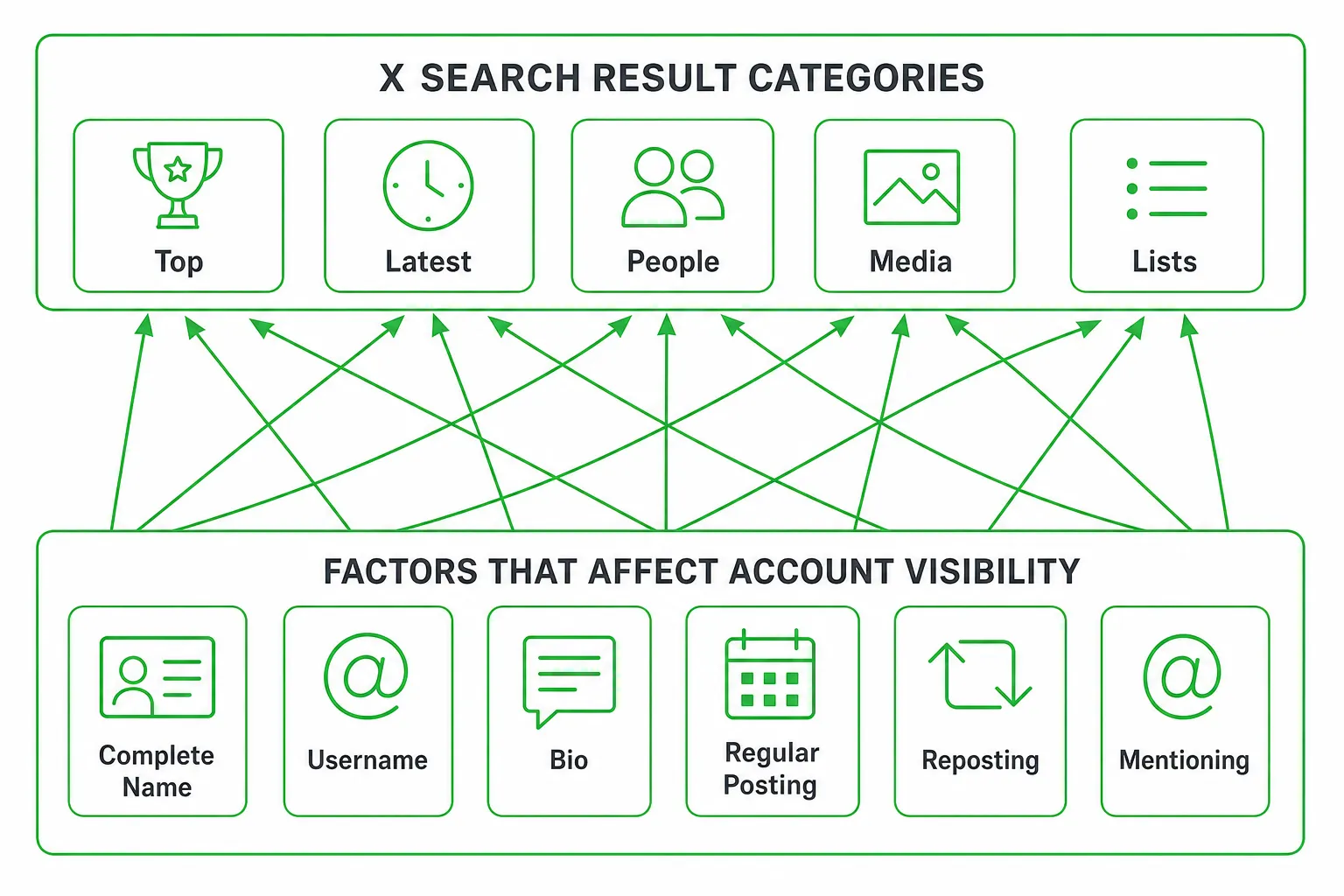
X search supports keyword, hashtag, account, conversation, and filter-based discovery. Results include Top, Latest, People, Media, and Lists. That means your tool should help you create content for multiple discovery paths, not simply generate hashtags. X Help Center: How to use X search
Account visibility depends on more than posting a keyword. X says a complete name, username, and bio can help account-search visibility, while regular posting, reposting, and mentioning can help keep account results current. Evaluate tools by whether they support profile audits and ongoing publishing. X Help Center: Help with X search
Ranking can also use engagement, social, author, media, popularity, trend, hashtag, and query-related signals. Treat keyword matching as one input among several. Compare tools on relevance, conversation quality, media support, and feedback loops. X Help Center: Search Recommendations
Practical test: Give each tool the same audience, product, and customer problem. Check whether it produces a useful post, a credible reply, a clear profile improvement, and a way to learn from the result.
The Search-Safety Checks Most Tool Lists Miss
Automation can improve your workflow. It can also damage discoverability when it produces repetitive or low-context activity.
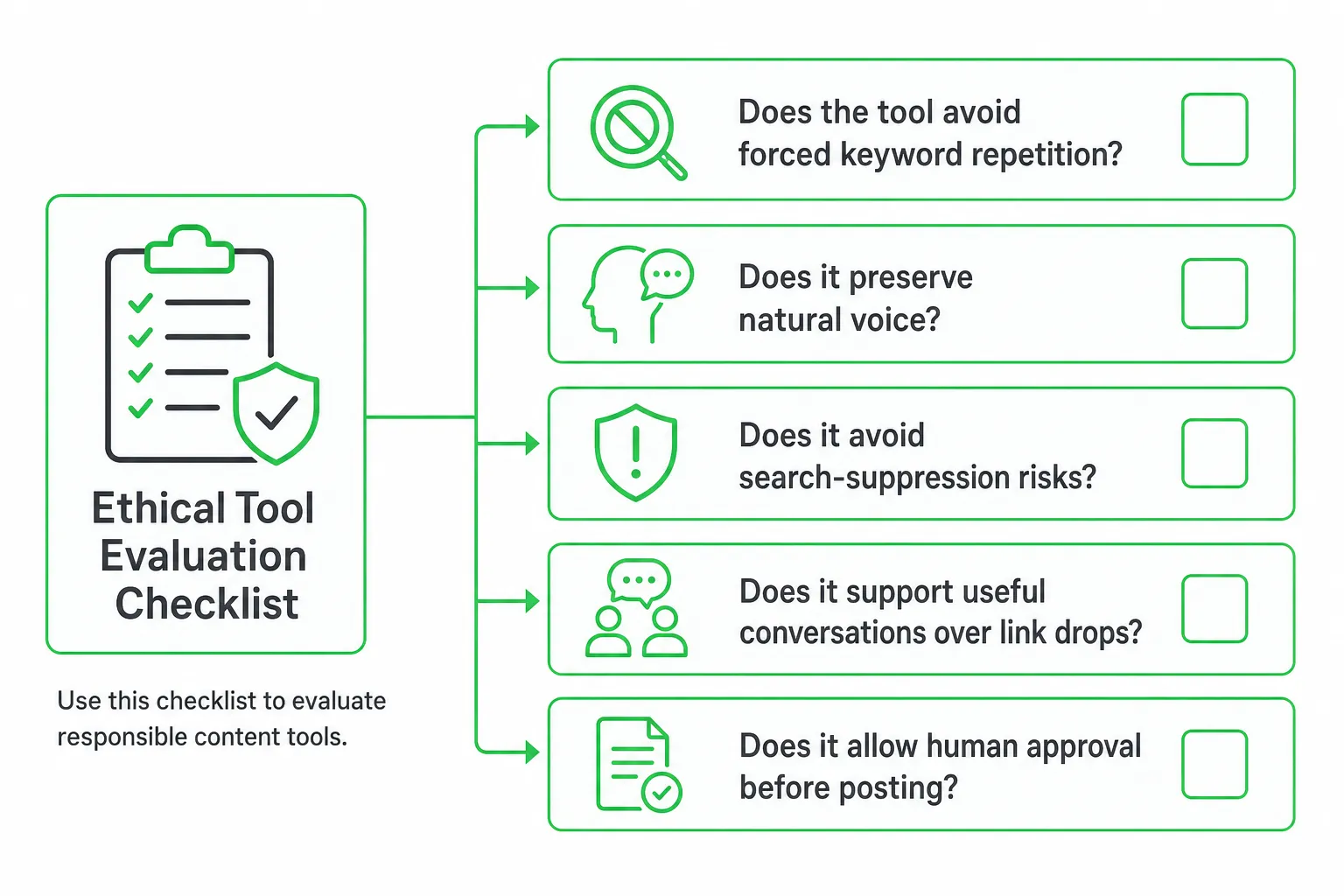
X warns that duplicate or near-duplicate updates, hashtag abuse, automated posts or replies, and keyword-triggered bots can cause content to be filtered from search. Any tool that encourages these patterns should be removed from your shortlist. X Help Center: About search rules and restrictions
Prefer a workflow where AI drafts content and a person approves every send. Use automation for research, drafting, repurposing, and scheduling. Keep sensitive replies, outreach, and high-context conversations under human review.
Build variation into recurring content:
- Explain the problem from a buyer’s perspective.
- Share a practical workflow.
- Answer a common objection.
- Show a mistake and its fix.
- Respond to a real conversation with specific context.
Search safety and content quality are connected. Useful posts give people a reason to read, respond, repost, or visit your profile. Repetition gives them a reason to scroll past.
Compare the Main Twitter SEO Tool Options
Different tools solve different parts of the workflow. Choose based on the work your team needs to remove, not the longest feature list.
| Tool type | Best for | Trade-off |
|---|---|---|
| X-native search and analytics | First-party discovery, validation, and performance review | Your team does more manual research and must connect insights to content production |
| Keyword and hashtag generators | Brainstorming profile language, captions, and topic variations | Often weaker at brand voice, conversation context, and lead quality |
| Social publishing platforms | Calendars, approvals, scheduling, and cross-platform distribution | May not connect X discovery with SEO content, Reddit demand, or sales follow-up |
| OneUp Today | AI content creation, multi-platform publishing, Reddit lead generation, lead scoring, outreach drafts, SEO autopilot, and blog autopilot | You should still validate recommendations against X and review results in native analytics |
OneUp Today is strongest when X is one part of a broader growth system. Its Lead Agent finds high-intent Reddit conversations, drafts replies and DMs, and helps turn customer language into content ideas. That matters when your team needs qualified demand, not just more posts.
Measure Discovery Without Confusing It With Google SEO
Build a repeatable measurement workflow before you publish at scale. Record the audience problem, target phrase, post format, hook, call to action, replies, profile visits, qualified conversations, and downstream leads.
Review performance by topic and intent, not only by likes. A post that starts a relevant conversation or produces a qualified visit may be more valuable than a broadly visible post.
X campaign analytics can report impressions, results, engagement rate, and cost per result. They can also segment performance by objective, campaign, post, and targeting criteria. Use those views to compare content and distribution decisions, not to chase a single headline metric. X Business: Campaign dashboard
Separate X visibility from Google visibility. Optimizing a social profile or post can support brand discovery, but it does not automatically make your website rank for a target query.
Google recognizes social-media user profile pages as a valid ProfilePage structured-data use case. Its documentation includes identity and interaction properties such as name, alternate name, description, image, follower count, likes, posts, and shares. Treat that as a technical eligibility consideration, not a promise of rankings. Google Search Central: ProfilePage structured data
How to Start With a Small-Team X SEO Workflow
Start with a narrow workflow. Add automation after you trust the output.
- Define the audience: Write down your product category, customer problems, brand voice, approval rules, and conversion goal.
- Collect real demand: Monitor X searches and Reddit conversations for questions, frustrations, comparisons, and requests for recommendations.
- Create content clusters: Group recurring questions into themes. Build several angles around each theme instead of repeating one post.
- Draft for review: Create an X post, a useful reply, and a longer resource from the same insight. Remove vague claims and corporate buzzwords.
- Publish selectively: Queue approved posts across the channels your team can maintain. Leave room for timely replies and live conversations.
- Connect the next step: Point each post toward a useful resource, landing page, demo, newsletter, or direct conversation.
- Review qualified outcomes: Keep the topics that produce relevant replies, profile visits, and leads. Rewrite or retire content that attracts attention without intent.
For Reddit outreach, timing and context matter. In OneUp Today’s own data across 2,269 real Reddit cold DM conversations sent March to September 2026, 29.7% received at least one human reply. DMs sent within 12 hours of the post replied about 43% of the time, against about 21% for DMs sent a week or more later. OneUp Today Reddit DM benchmarks
Use that lesson beyond Reddit: respond while the problem is active, refer to the specific context, and keep the message focused. Warm demand discovery can make your X content sharper because you are writing from real customer language.
Final Takeaway: Choose the Workflow, Not Just the Tool
The best Twitter SEO tool helps you research real demand, improve your profile, publish useful content, stay within X’s search-safety boundaries, and measure meaningful outcomes. For a small team, the strongest choice is usually the tool that connects those jobs without removing human approval.
Your next step: choose one customer problem, create several distinct content angles, publish the approved versions, and review which one creates the most relevant conversation. Then build your next week of content from what people actually asked.
Frequently asked questions
How do I measure the success of a Twitter SEO tool for my small team?
Track profile visits, qualified conversations, and leads, not just impressions or likes. A good tool should connect posts to business outcomes, like sign-ups or replies, within 30 days. Use UTM links and X analytics to see which content drives real engagement and conversions.
Can a Twitter SEO tool help with X algorithm changes in 2025?
Yes, but only if it adapts to engagement and relevance signals, not just keywords. Tools that monitor trending topics, conversation quality, and media use help you stay visible. Avoid rigid schedulers; choose one that lets you adjust posts quickly to algorithm shifts.
What features should a Twitter SEO tool have for lead generation?
It should include demand discovery, outreach templates, and approval workflows. Look for tools that find high-intent conversations, like Reddit or X replies, and let you schedule follow-ups. OneUp Today excels here by combining content creation with lead-gen outreach in one dashboard.
Is a standalone hashtag generator enough for Twitter SEO?
No, a standalone hashtag generator is insufficient for full SEO. X search uses keywords, profiles, engagement, and media, not just hashtags. You need a tool that handles content drafting, profile optimization, and analytics. Use a generator only for quick topic ideas, not as your main strategy.
How often should I post on X for SEO with a small team?
Post 3-5 times daily, but prioritize quality and relevance over frequency. A tool should help you maintain consistency without burnout, using scheduling and repurposing. Focus on replies and conversations, as engagement signals matter more than volume for X search ranking.