
Pinterest Management Service for Small Teams
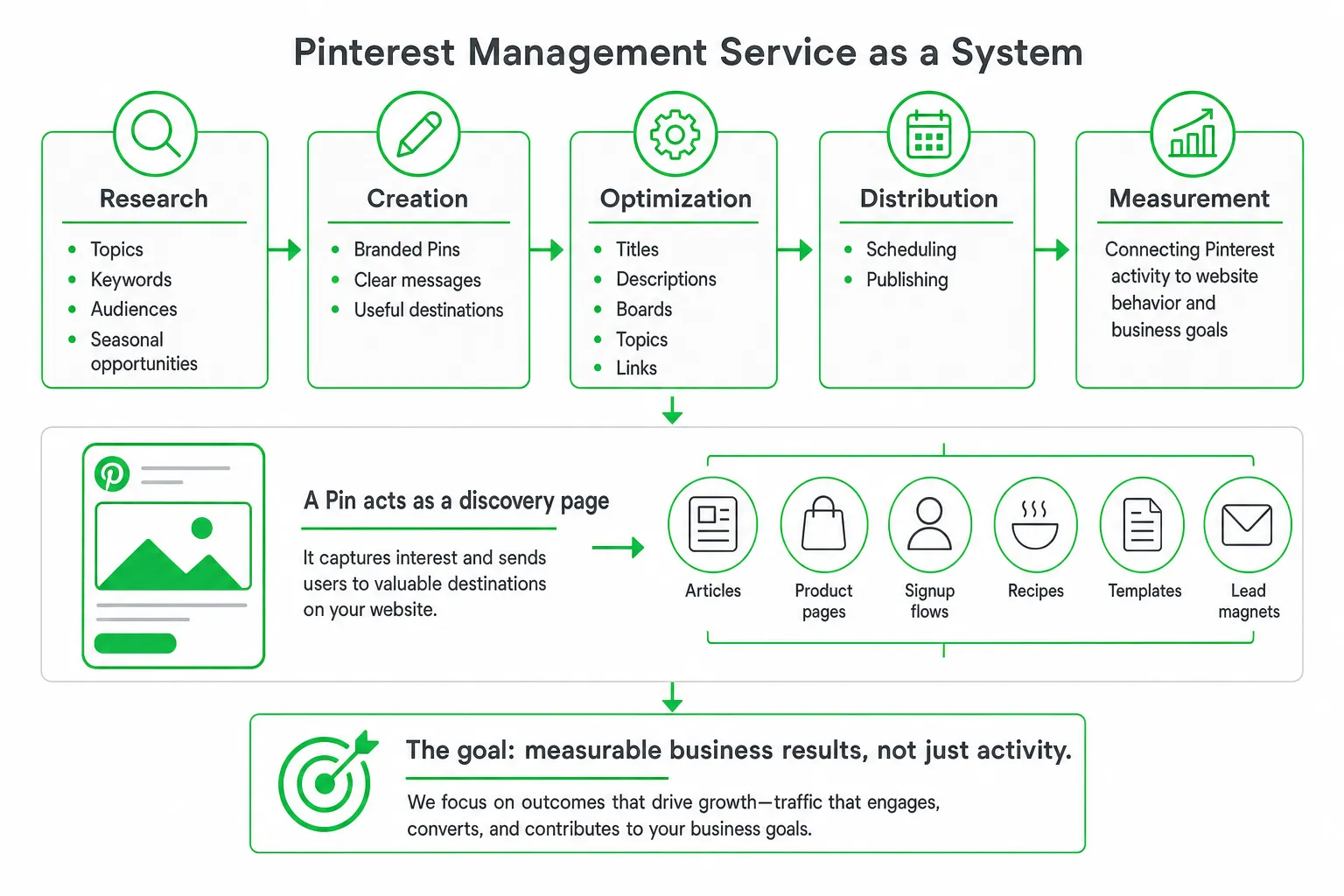
A pinterest management service plans, creates, optimizes, publishes, and measures your Pins so your team can build visibility without managing Pinterest every day. The right service does more than schedule attractive images: it connects search visibility and creative production to qualified website traffic, shopping activity, leads, and conversions.
That distinction matters for small teams. You do not need more activity for its own sake. You need a repeatable system that turns useful content into measurable business results without creating another channel your team has to chase.
Key takeaways
- Choose a service that manages strategy, creative, Pinterest SEO, publishing, links, and reporting as one system.
- Map every Pin to a relevant destination and a business action, not just impressions or saves.
- Use tagged URLs, conversion paths, and recurring reviews to separate useful traffic from surface-level engagement.
- Compare in-house, freelance, agency, and AI-assisted options by control, quality, attribution, and workload.
- Start with one defined objective and expand only when Pinterest produces useful audience or conversion signals.
What a Pinterest Management Service Does
A Pinterest management service takes ownership of the recurring work required to build and maintain your presence. That usually includes account audits, keyword research, board organization, Pin design, descriptions, titles, scheduling, engagement, trend monitoring, and performance reporting.
Pinterest sits between a visual discovery platform and a search-driven channel. In its 2026 investor announcement, Pinterest reported more than 600 million monthly active users and more than 80 billion monthly searches.
That search behavior changes how you should evaluate the service. A Pin is not simply a social post with an image. It can act as a discovery page that sends someone to an article, product page, signup flow, recipe, template, or lead magnet.
Look for a partner that can explain the entire path:
- Research: Finds topics, search terms, audiences, and seasonal opportunities.
- Creation: Produces branded Pins with clear messages and useful destinations.
- Optimization: Improves titles, descriptions, boards, topics, and links.
- Distribution: Schedules and publishes content consistently.
- Measurement: Connects Pinterest activity to website behavior and business goals.
What the Service Should Include
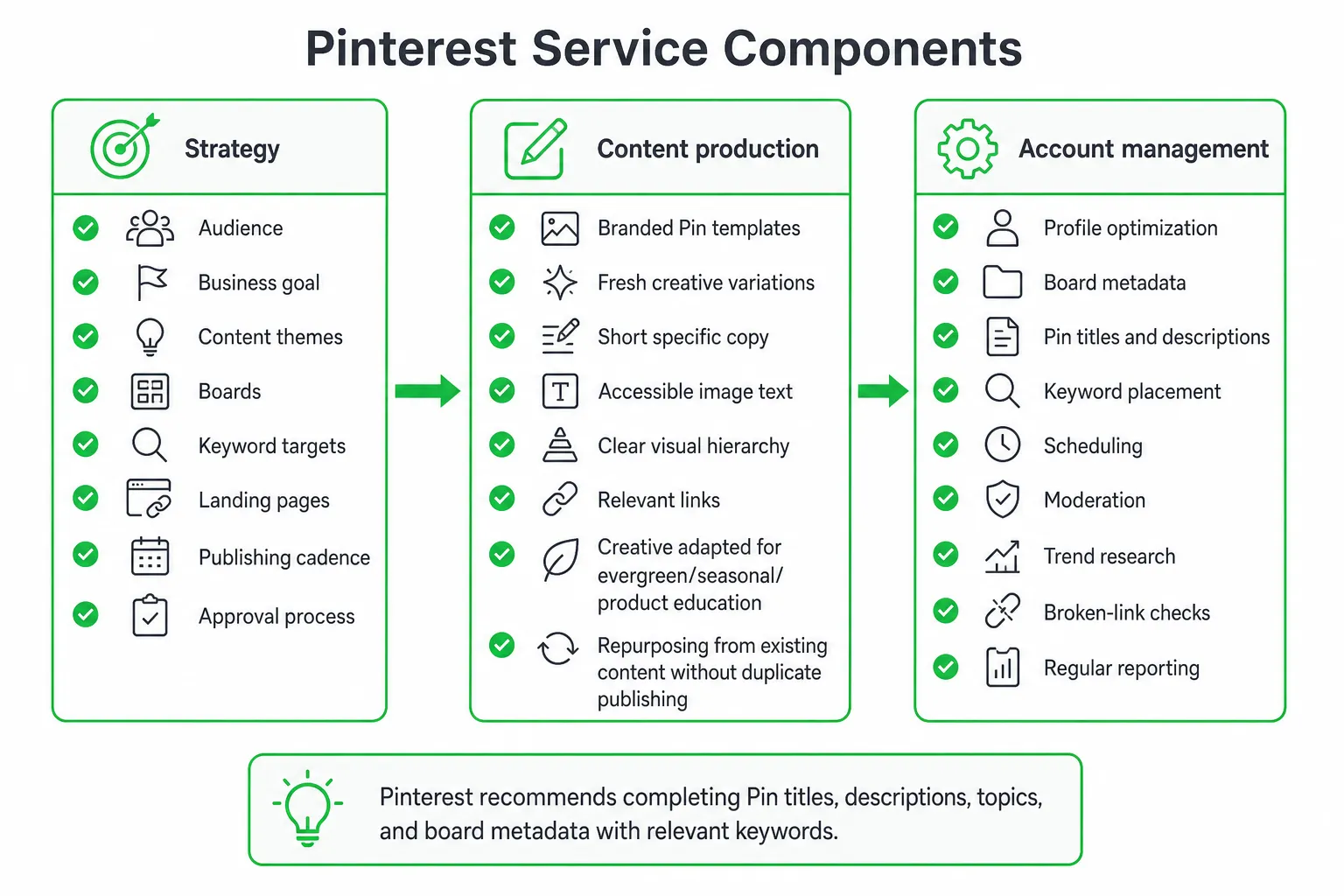
Start with strategy, not templates. Your provider should define the audience, business goal, content themes, boards, keyword targets, landing pages, publishing cadence, and approval process before production begins.
Content production should cover more than one design variation. A useful package may include:
- Branded Pin templates and fresh creative variations.
- Short, specific copy that explains the value of the destination page.
- Accessible image text and clear visual hierarchy.
- Relevant links to articles, products, lead magnets, or signup pages.
- Creative adapted for evergreen topics, seasonal content, and product education.
- Repurposing from your existing website and content library without publishing duplicates blindly.
Account management should include profile optimization, board metadata, Pin titles and descriptions, keyword placement, scheduling, moderation, trend research, broken-link checks, and regular reporting. Pinterest itself recommends completing Pin titles, descriptions, topics, and board metadata with relevant keywords because people search the platform for ideas and products.
Why Small Teams Hire a Pinterest Manager
Outsourcing removes the learning curve and recurring production burden. You get a clearer operating rhythm without asking a founder, marketer, or designer to become responsible for research, creative, publishing, and analytics at the same time.
Pinterest can support discovery for SaaS companies, ecommerce brands, creators, publishers, and service businesses when each Pin leads to a useful, relevant destination. For a SaaS company, that destination might be a comparison article or template. For an ecommerce brand, it might be a product page. For a consultant, it might be a practical guide or consultation request.
The audience can also fit premium offers. Pinterest says 50% of its global user base is Gen Z, which it identifies as its fastest-growing audience. It also reports that 40% of U.S. households earning over $150,000 annually can be reached on the platform in its Audience Insights.
Do not treat those audience facts as a reason to publish without a plan. Treat them as a reason to test whether your specific customer, offer, and content themes belong on Pinterest.
How to Connect Pinterest Work to Business Outcomes
Generic Pinterest services often stop at content creation, scheduling, engagement, analytics, and strategy. Those deliverables are useful, but they do not prove that the work is helping your business.
Start with a conversion path. Map every content theme to a meaningful action. That could be a product view, signup, email capture, consultation request, purchase, demo request, or visit to a high-intent comparison page.
Then build measurement around the path:
- Traffic quality: Review qualified website visits, engaged sessions, destination-page behavior, and returning visitors.
- Conversion behavior: Track signups, purchases, consultation requests, product views, email captures, and assisted conversions where your analytics supports them.
- Shopping activity: Connect product Pins and catalog activity to product-page behavior and sales reporting where available.
- Attribution: Use tagged URLs and consistent campaign naming so Pinterest visits do not disappear into an unhelpful referral bucket.
- Search visibility: Monitor which topics, boards, and Pin concepts continue attracting discovery over time.
Separate Pinterest’s contribution from the service’s activity. A provider can publish consistently while sending visitors to a weak page. Your review should therefore compare the original business objective with destination-page behavior, assisted journeys, branded search visibility, and downstream conversions.
Make the operational trade-off explicit. More creative volume can increase coverage. Deeper research, stronger landing pages, and better attribution often require more review time. The best service balances speed, original quality, approval control, and measurable outcomes.
That is the gap many Pinterest management pages miss. They describe what gets posted. You need to know what the posting is supposed to change.
How to Choose the Right Pinterest Management Option
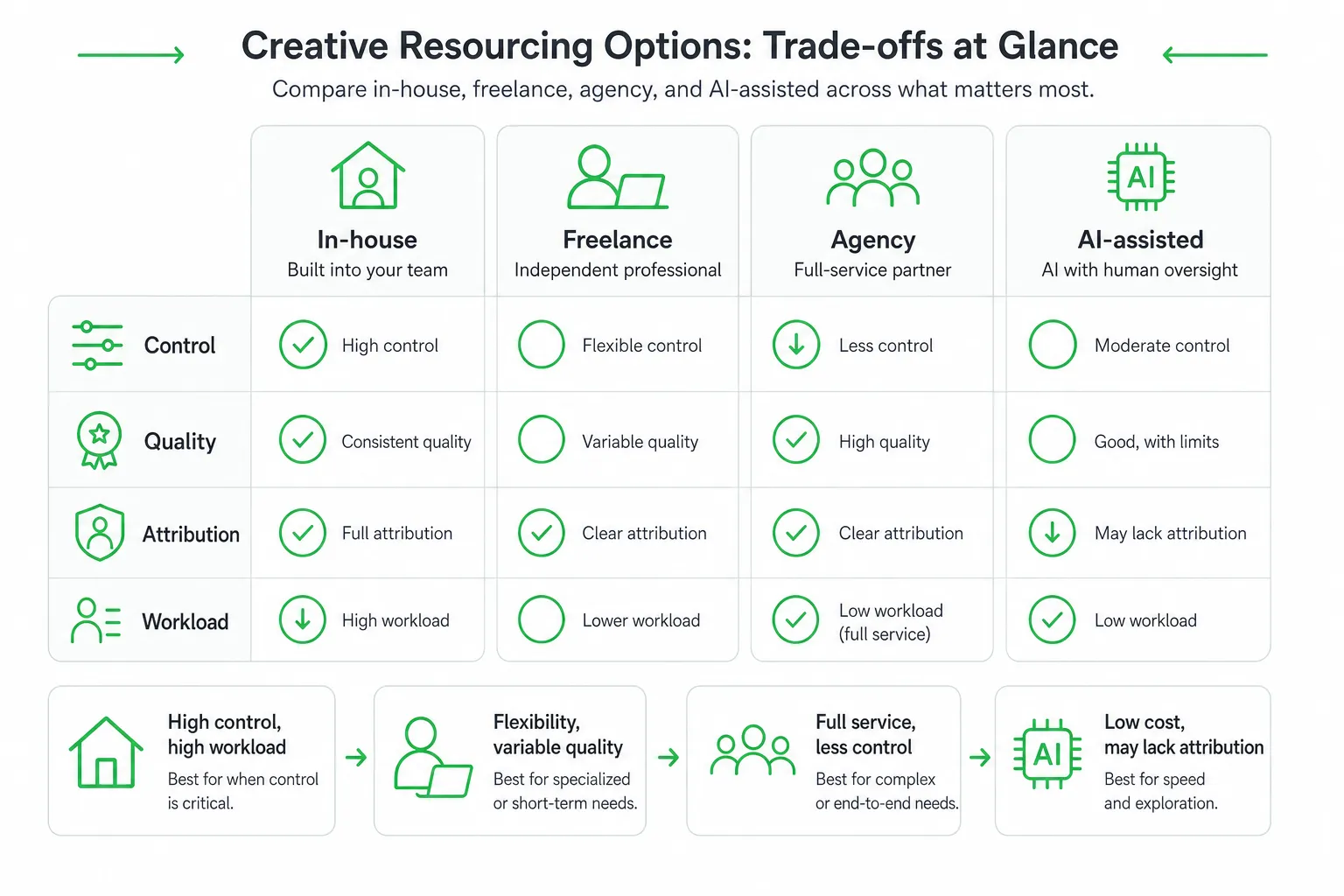
Different models solve different capacity problems. Compare them against your team’s product knowledge, creative resources, approval needs, and measurement maturity.
| Option | Strength | Trade-off | Best fit |
|---|---|---|---|
| In-house owner | Closest product knowledge and fast feedback | Requires sustained creative, SEO, scheduling, and analytics capacity | A team with a dedicated channel owner |
| Freelancer | Focused expertise and flexible support | May need additional design, strategy, or reporting support | A business with a defined scope and clear internal approver |
| Agency | Broader strategy, design, paid media, and reporting | Can involve more process, cost, and handoffs | A brand that needs several marketing capabilities |
| AI-assisted or hybrid service | Higher production efficiency and connected workflows | Needs human review, brand controls, and link checks | A small team that wants speed without giving up approval control |
Ask every provider how they handle account access, brand assets, approvals, ownership, cancellation, and reporting. Also ask what happens when Pinterest activity does not produce qualified traffic. A good partner changes the plan, the destination page, the offer, or the measurement approach instead of simply increasing output.
For an AI-assisted option, require human review, brand-voice controls, transparent reporting, and a clear connection between Pinterest publishing and your wider content and lead-generation workflow.
A Practical Pinterest Management Workflow
- Audit the account. Review the profile, boards, existing Pins, links, analytics, audience, competitors, content library, and conversion paths.
- Set the objective. Choose whether the first cycle focuses on qualified traffic, product discovery, email capture, signups, shopping activity, or another defined action.
- Build the content system. Organize evergreen topics, seasonal opportunities, product education, customer questions, original research, and repurposed website content.
- Create and approve batches. Produce multiple creative concepts, check claims and destinations, optimize metadata, and route everything through your review process.
- Publish and monitor. Schedule Pins, check links, watch search and engagement signals, and identify concepts that attract useful visitors.
- Improve the next cycle. Refresh winning ideas, remove weak destinations, improve landing pages, test clearer offers, and update keyword targets based on the evidence.
Use Pinterest’s longer trend window when planning. Pinterest Business says trends on its platform last nearly twice as long as trends on other platforms according to Pinterest Business. That gives you more room to research, produce, approve, and distribute content before an opportunity passes.
How OneUp Today Fits a Small-Team Marketing Workflow
A Pinterest service works best when it connects to the rest of your growth system. Your content themes can inform SEO articles, social posts, website chat prompts, and lead-generation campaigns instead of living in a separate channel.
OneUp Today combines AI marketing agents for SEO and blog automation, social publishing, lead scoring, and approval-controlled outreach. Its seven-agent system is designed for SaaS founders, indie hackers, and small teams that need more marketing coverage without handing over final approval.
That broader workflow matters when a Pinterest visitor becomes a research signal rather than an immediate conversion. You can use the original topic to improve the destination article, qualify the resulting lead, and turn related questions into future content.
How to Start With a Pinterest Management Service
Prepare your goals, ideal customer, analytics access, brand guidelines, existing content, product information, approved claims, image assets, and preferred review workflow. The more clearly you define the destination and desired action, the easier it becomes to judge the service.
Ask prospective providers:
- What exactly will you manage each month?
- What must your team supply?
- How do approvals, revisions, and account access work?
- Which outcomes will appear in the report?
- How will you tag links and preserve attribution?
- What will you change if Pinterest does not produce qualified traffic?
- Who owns the creative, account, data, and published work if the engagement ends?
Start with one defined business objective and a review checkpoint. Expand the engagement only when reporting shows that Pinterest is generating useful audience, website, shopping, or conversion signals.
Next step: List your top content themes, the page each theme should promote, and the business action you want visitors to take. Then use that brief to compare Pinterest management providers on outcomes, not posting volume.
Frequently asked questions
How much does a Pinterest management service cost per month?
Monthly costs typically range from $500 to $5,000, depending on the scope of services like strategy, creative production, and reporting. Freelancers often charge $500–$2,000, while agencies may start at $2,500. Always confirm what's included, such as Pin design and analytics, to avoid hidden fees.
Can a Pinterest management service help with e-commerce sales?
Yes, it can boost e-commerce sales by optimizing Pins with product tags, shoppable links, and conversion-focused descriptions. Services often set up Pinterest Catalogs and track revenue via Pinterest Tag, ensuring each Pin drives traffic to product pages and measures purchases directly.
What is the difference between a Pinterest virtual assistant and a management service?
A virtual assistant handles basic tasks like scheduling and pinning, while a management service provides full strategy, creative design, SEO, and performance analysis. The latter is more comprehensive, focusing on business outcomes rather than just activity, and includes regular reporting to optimize results.
How long does it take to see results from a Pinterest management service?
Results often appear within 3 to 6 months, as Pinterest requires time for content indexing and audience discovery. Initial improvements in impressions may occur sooner, but consistent traffic and conversions typically build after several months of strategic pinning and optimization.
Do Pinterest management services work for B2B companies?
Yes, they can work for B2B by focusing on educational content like infographics, guides, and blog posts that attract professionals. Services tailor keywords and boards to industry topics, driving qualified leads through search-driven discovery, though results may be slower than for B2C visual products.