
Best AI Citation Tool for SEO Teams
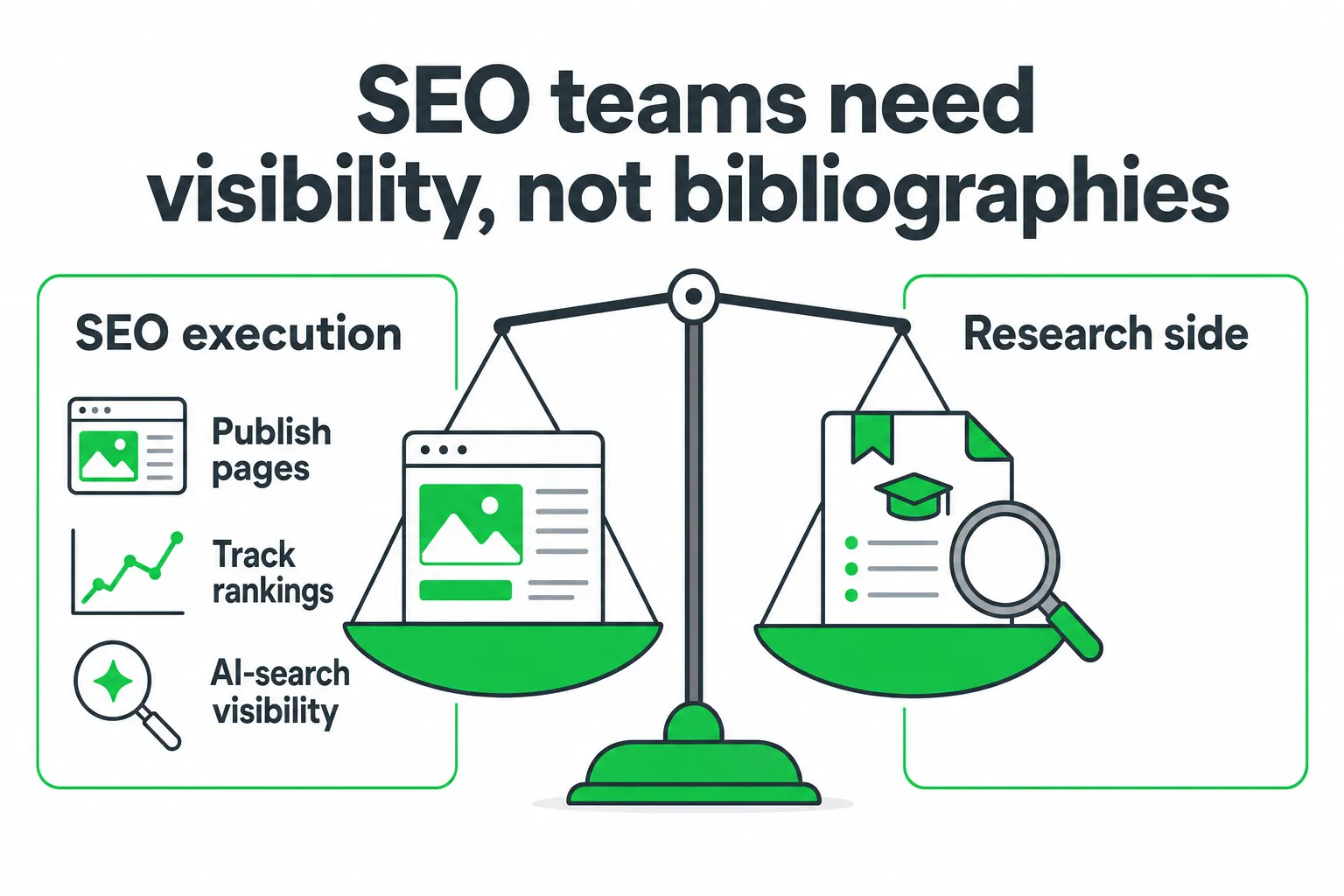
OneUp Today is the best AI citation tool for SEO teams when you need to publish optimized pages, track Google and Bing rankings, and monitor whether your content appears in Google AI Overviews. Choose Consensus or Scite instead when your main job is academic research, literature review, or analyzing how scholarly papers support one another.
The key distinction is simple: SEO teams need to measure visibility and improve pages, while researchers need to find, verify, and organize evidence. The best tool depends on which job you are hiring it to do.
Key takeaways
- Separate academic reference tools, research assistants, citation verifiers, and AI-search visibility trackers before comparing products.
- Use claim-level validation to check whether a cited passage actually supports the wording in your page.
- Choose OneUp Today for SEO execution, publishing, rank tracking, and AI citation monitoring.
- Choose Consensus or Scite when scholarly evidence and citation context matter more than content operations.
The Best AI Citation Tool for SEO Teams
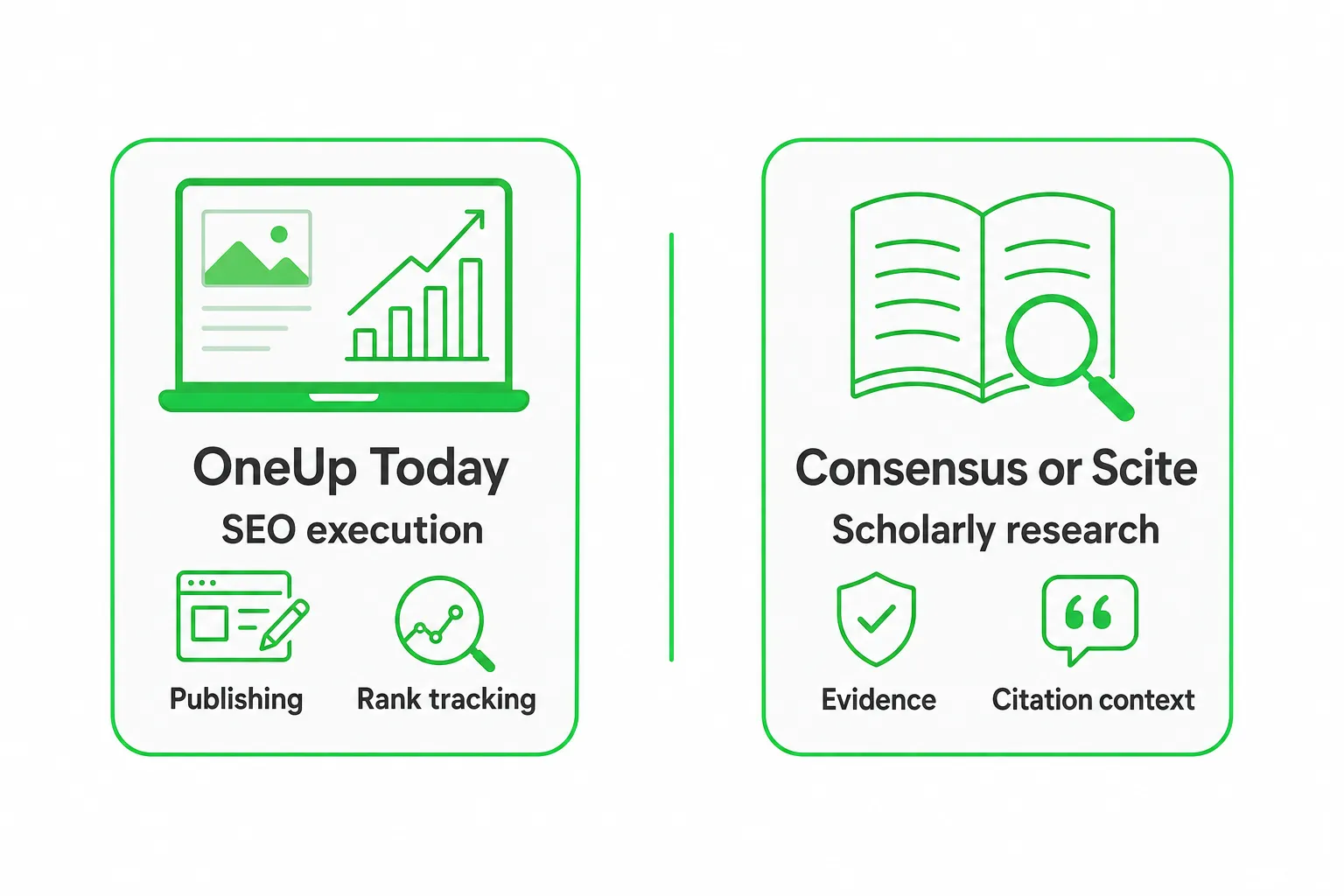
SEO execution: OneUp Today. It connects research, article creation, publishing, rank tracking, and AI citation monitoring in one workflow. Its SEO Autopilot researches topics, writes on-brand articles with diagrams and schema, publishes to WordPress or another stack, and tracks rankings on Google and Bing plus citations in Google AI Overviews.
Academic research: Consensus. It helps you answer research questions from scholarly literature and inspect the evidence behind an answer.
Citation context: Scite. It helps you understand whether later papers support, mention, or contrast a cited paper.
AI-search monitoring: dedicated trackers. Tools such as Asky, Otterly.ai, Peec AI, and AI Consensus focus on prompts, cited URLs, competitors, and changes in visibility.
Do not treat these categories as interchangeable. A reference manager can format a bibliography without telling you whether an AI search answer cites your website. A visibility tracker can show a cited URL without proving that every claim on your page is well supported.
What Counts as an AI Citation Tool?
The phrase “AI citation tool” covers several different products. Start by separating the job:
- Reference formatting: Tools such as Citation Machine and Zotero help format, organize, and manage references.
- Research synthesis: Tools such as Consensus search scholarly literature and help summarize findings.
- Citation verification: Tools such as Scite analyze the context surrounding citations and show how research has been used.
- AI-search visibility: Trackers such as Asky, Otterly.ai, Peec AI, and AI Consensus monitor prompts, cited pages, competitors, and visibility changes.
These jobs overlap, but they do not produce the same output. A reference manager produces an organized bibliography. A research assistant produces an evidence-led answer. A citation verifier provides context. An AI-search tracker tells you where your brand or page appears in machine-generated answers.
Research coverage: Consensus searches a database of more than 400 million peer-reviewed research papers, updated weekly, and can use full text when it is available, according to the Consensus Help Center.
For SEO teams, the useful question is not “Which tool has citations?” Ask instead: “Which tool helps me make a defensible page, publish it, and measure whether search systems use it?”
How to Evaluate the Best AI Citation Tool
Use these criteria before choosing a subscription or adding another tool to your workflow.
Claim-level citation quality
Check whether the cited passage supports the exact claim. A source can mention a topic without proving the statistic, comparison, recommendation, or causal statement in your copy.
Look for tools that expose the passage behind a citation. Ideally, you should be able to compare the claim and source side by side, then label the result as directly supported, partially supported, contradicted, or unsupported.
Source coverage and provenance
Inspect the source types the tool can search. Does it use primary pages, expert sources, scholarly papers, full text, abstracts, or metadata? Does it show the retrieval date? Can you tell whether the source is current enough for the claim?
Provenance also means preserving the path from question to answer. You should know which prompt produced the result, which page was cited, and which passage influenced the wording.
Search visibility measurement
For SEO, look for prompt tracking, cited-page discovery, competitor comparisons, engine coverage, historical changes, and alerts when citations disappear.
A useful tracker should help you answer practical questions: Which pages get cited? Which queries trigger a citation? Which competitor replaces you? Did a content update improve or reduce your visibility?
Workflow and commercial fit
Compare publishing integrations, rank tracking, exports, team review, approval controls, transparent pricing, and methodology. A tool that identifies a problem but leaves you to copy findings into several disconnected systems may create more work than it removes.
| Tool category | Best for | What to check |
|---|---|---|
| Reference manager | Formatting and organizing bibliographies | Supported styles, exports, and library management |
| Research assistant | Finding and synthesizing scholarly evidence | Source coverage, full-text access, and quote-level citations |
| Citation verifier | Understanding how sources support one another | Supporting, mentioning, and contrasting classifications |
| AI-search tracker | Monitoring brand and page visibility | Prompts, engines, cited URLs, refreshes, and alerts |
| SEO execution platform | Creating, publishing, ranking, and monitoring pages | Content workflow, integrations, approvals, and reporting |
Best Tools by SEO and Research Use Case
Best for SEO content production and AI-citation monitoring: OneUp Today
Choose it when your team needs to turn search research into published pages and then monitor rankings and AI citations. The strongest fit is operational: research a topic, create an on-brand article, publish it, track performance, and review where AI search uses your content.
Trade-off: It is not a dedicated scholarly reference manager. If your editorial process depends on peer-reviewed literature, pair your SEO workflow with a research or citation-context tool.
Best for evidence-led research: Consensus
Consensus provides inline citations in its AI analysis. Hovering over a citation reveals the exact quote used to support that part of the answer. A checkmark indicates that the full paper was used rather than only its abstract or metadata, according to the Consensus Help Center.
That makes it useful when you need to investigate a topic before writing a technically credible page. It is less suited to tracking whether your commercial content appears in AI-search answers.
Best for citation-context analysis: Scite
Scite Smart Citations classify citation statements as supporting, mentioning, or contrasting the cited paper instead of treating every citation as equivalent, according to Scite.
This distinction helps you avoid overstating evidence. A paper that merely mentions a finding should not be presented as proof that the finding is supported.
Best for monitoring AI-search presence: dedicated citation trackers
Compare Asky, Otterly.ai, Peec AI, and AI Consensus based on their supported engines, prompt controls, cited-URL reports, refresh cadence, exports, competitor views, and response to citation losses.
Do not select a tracker only because it displays a polished visibility score. Ask how it collected the result and whether another team member can reproduce the check.
The Missing Test: Does the Source Support the Claim?
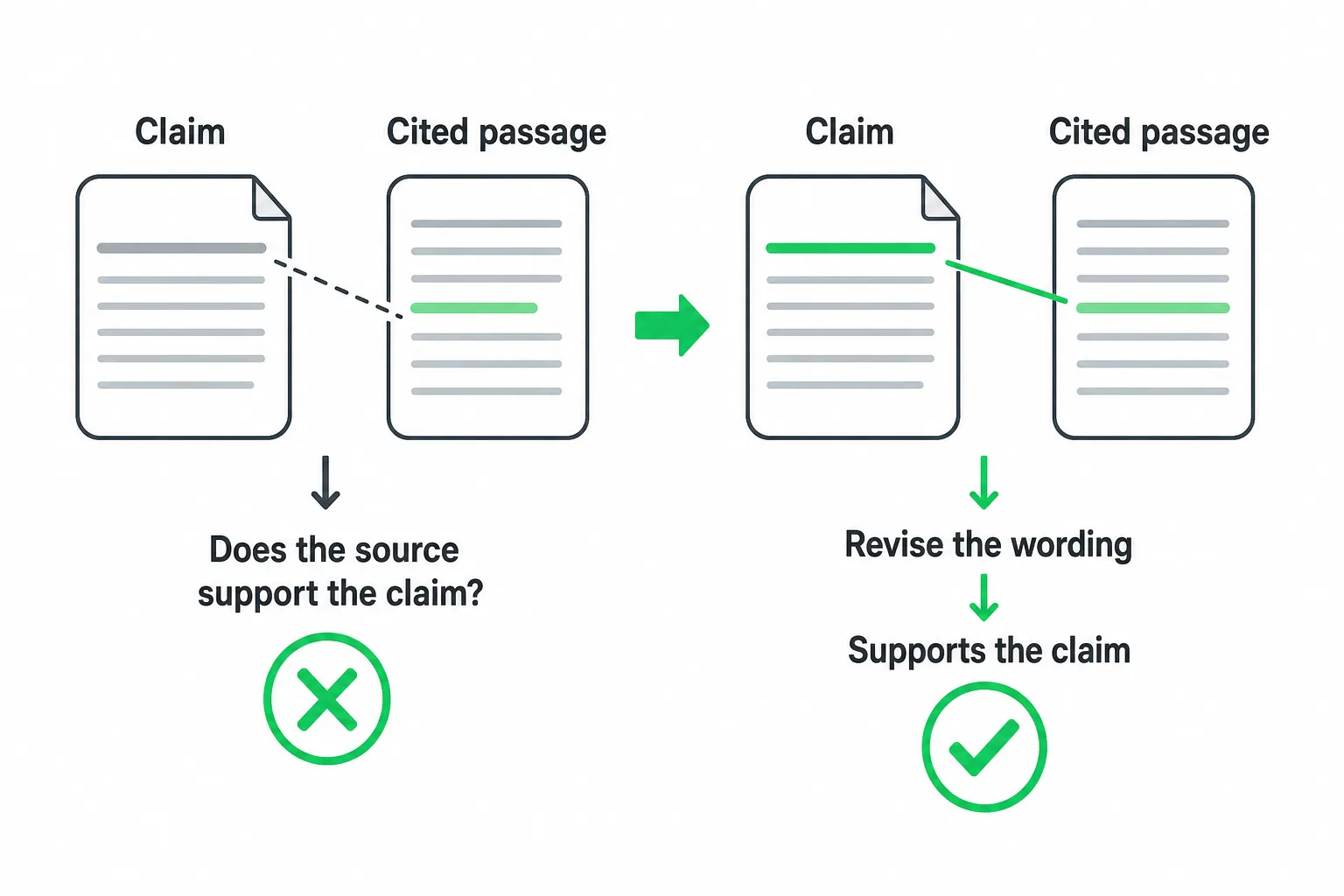
This is where many AI citation comparisons fall short. They confirm that a URL appears beside an answer, but they do not test whether the source supports the exact wording.
A citation can be present while still being weak. The linked source may discuss the same subject but fail to support the scope, number, comparison, or recommendation in your copy. An article can therefore look well sourced while making claims that go beyond its evidence.
Run a claim-level test for every important statement:
- Extract the claim. Copy the sentence exactly as it appears in the draft.
- Open the source. Find the passage that supposedly supports the sentence.
- Compare scope and wording. Check whether the passage supports the same audience, conditions, timeframe, and strength of conclusion.
- Label the result. Mark it directly supported, partially supported, contradicted, or unsupported.
- Revise the draft. Narrow the claim, add a better source, or remove the citation if it does not support the conclusion.
Preserve the prompt, answer, cited URL, quoted passage, retrieval date, and reviewer decision. That record gives another editor a reproducible way to assess the result.
This safeguard matters because a 2026 analysis of AI-generated citations found invalid or fabricated citations in 1.07% of papers, based on 2.2 million citations from 56,381 papers, as reported by GhostCite on arXiv.
A Repeatable AI Citation Workflow for SEO Teams
Build citation checks into production instead of adding them after publication.
- Define the commercial topic. List the audience, target queries, competitors, and claims that require first-party, expert, or scholarly evidence.
- Research and draft. Attach a source to each material claim while writing. Do not wait until the article is complete.
- Validate claims. Open each source, compare the passage with the sentence, revise overbroad language, and remove weak citations.
- Publish clearly. Use useful headings, internal links, schema, original explanations, and a structure that helps readers and search systems understand the page.
- Monitor performance. Track rankings, cited URLs, competitor visibility, and citation changes over time.
- Review losses. When a page stops appearing, inspect the prompt, competing sources, content changes, and evidence quality before rewriting.
Keep the process consistent across writers. A shared review record makes citation quality less dependent on individual judgment.
Pricing, Pros, Cons, and the Best Starting Choice
OneUp Today's SEO Autopilot lists pay-per-action pricing of $0.99 per article, $0.10 per image, and $1 per site per month for rank tracking. Verify current pricing before publishing or purchasing on the OneUp Today SEO Autopilot page.
- Choose an SEO execution platform when you need content production, publishing, rankings, and AI citation monitoring in one workflow.
- Choose Consensus when your priority is finding and understanding scholarly evidence.
- Choose Scite when you need to inspect whether papers support, mention, or contrast one another.
- Choose a dedicated tracker when AI-search presence is the only job and you want deeper prompt and competitor monitoring.
Start with a small set of high-intent pages. Document the claim-validation process. Expand only after your team can explain why each cited source deserves to support the wording.
Bottom line: The best AI citation tool for SEO teams is the one that connects evidence quality with search visibility and publishing. Your next step: choose a few priority pages, test every important claim against its source, and monitor whether the improved pages earn rankings and AI citations.
Frequently asked questions
Can an AI citation tool guarantee that Google will cite my website?
No, an AI citation tool cannot guarantee that Google will cite your website. Visibility trackers can show whether your pages appear in sampled AI answers and help you monitor changes, but they do not control Google’s systems or promise future citations.
How can I check whether an AI-generated citation actually supports a claim?
Compare the exact claim with the cited passage and classify the evidence as directly supportive, partial, contradictory, or absent. A citation to a page about the same topic is not enough; the source must substantiate the specific statistic, recommendation, or causal statement.
Is an AI citation tool different from a citation generator?
Yes, an AI citation tool may analyze evidence or track citations in AI-generated answers, while a citation generator formats references in a chosen style. For example, a formatted bibliography does not tell you whether an AI search result cited your website.
What should SEO teams track with an AI citation tool?
Track whether your pages are cited in AI answers, which prompts and competitors appear, and how visibility changes over time. Comparing cited URLs across repeated prompts can help identify pages worth improving, but tracking alone does not verify the accuracy of their claims.