
SaaS Content Marketing Agency: How to Pick the Right Partner
A saas content marketing agency helps you turn customer research, search strategy, expert content, and distribution into qualified software demand. The right partner does more than publish blog posts. It builds the evidence buyers need across Google, AI search, communities, social channels, and your website.
That matters because SaaS buyers now discover vendors in more places than traditional search. You need a partner that can create useful content, distribute it where conversations happen, and connect activity to pipeline.
Key takeaways
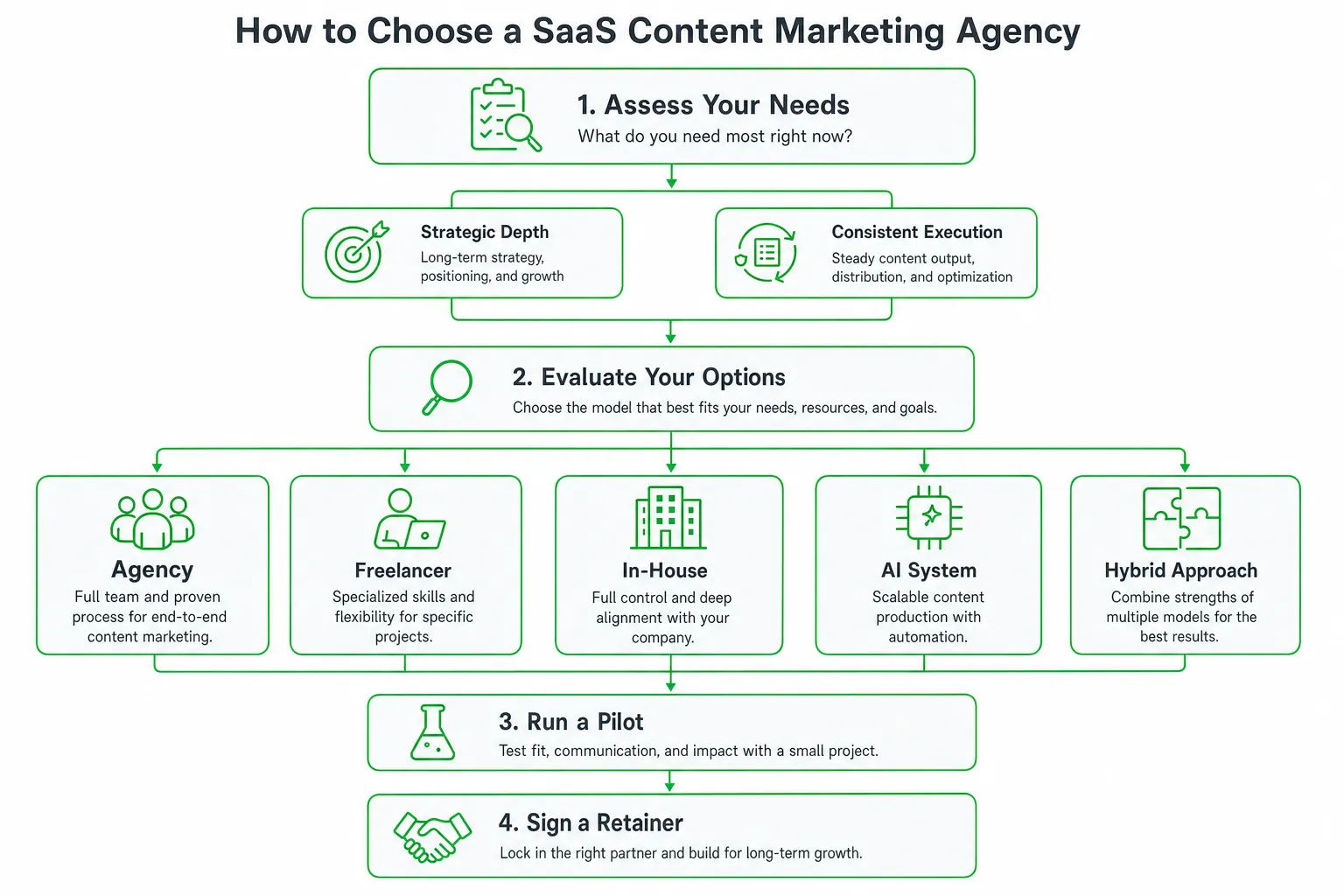
- Choose a SaaS content partner for strategic depth, consistent execution, or both.
- Assess expertise in your market, product complexity, sales cycle, and buyer journey.
- Require a plan for Google, AI-generated answers, Reddit, social distribution, and conversion.
- Use an agency, freelancer, internal team, AI system, or hybrid model based on your bottleneck.
- Run a focused pilot before signing a broad, long-term retainer.
What Is a SaaS Content Marketing Agency?
A SaaS content marketing agency combines customer research, SEO strategy, content production, distribution, and measurement to help software companies generate qualified demand.
The best agencies connect content to a business outcome. That might mean more qualified product searches, stronger comparison-page performance, better sales conversations, more product signups, or higher conversion from existing traffic.
Expect a capable partner to handle work such as:
- Researching your ideal customer profile and highest-value problems.
- Mapping topics to awareness, evaluation, activation, and retention.
- Creating product-led guides, comparison pages, tutorials, case studies, and sales resources.
- Improving technical SEO, internal linking, conversion paths, and content freshness.
- Repurposing core content for email, social media, communities, and sales enablement.
- Reporting on meaningful progress instead of publishing volume alone.
Choose an agency when you need strategic expertise and consistent execution without hiring a full internal team. For a lean SaaS company, an automated marketing system may be a better fit when your biggest constraint is producing and distributing useful work every week.
What Services Should a SaaS Content Agency Offer?
Start by checking whether the agency covers the complete path from insight to action. A content calendar without distribution, conversion, or feedback is only part of the job.
Strategy: Connect content to demand
- Interview customers, founders, salespeople, and support teams.
- Define audiences, use cases, buying triggers, objections, and alternatives.
- Audit existing content, search visibility, competitors, and conversion paths.
- Set goals for qualified traffic, assisted conversions, sales enablement, or customer education.
Content production: Explain the product clearly
Look for more than generic blog posts. Strong SaaS content teams can produce comparison pages, integration content, implementation guides, templates, technical tutorials, use cases, newsletters, and customer proof.
They should also understand product-led writing. That means showing how your product solves a real problem instead of forcing a sales pitch into every paragraph.
Organic growth: Build durable visibility
- Research keywords and search intent.
- Improve technical SEO and internal links.
- Create topic clusters around important customer problems.
- Refresh pages when product details, search intent, or buyer questions change.
- Improve calls to action, comparison sections, and conversion paths.
Distribution: Put content in front of buyers
Ask how the agency distributes each core asset. Useful channels may include LinkedIn, email, relevant communities, sales follow-up, website chat, and partner channels. The right mix depends on where your buyers already research and ask questions.
How to Compare SaaS Content Marketing Partners
Compare agencies against your actual growth conditions, not just their portfolio design. A polished website does not prove that a team understands your buyer, category, or sales process.
Check category and audience experience
Ask whether the team has worked with products like yours. Relevant experience includes your market, pricing model, technical complexity, sales cycle, customer maturity, and competitive environment.
An agency that understands developer tools may not understand HR software. A team that excels at enterprise thought leadership may not be right for a self-serve product that needs fast, high-intent content and conversion testing.
Meet the people doing the work
Request the names and roles behind your engagement. You may need a strategist, subject-matter writer, editor, SEO specialist, designer, and account lead. Confirm who actually creates each deliverable.
Ask how the team develops expertise. Good answers include customer interviews, product demonstrations, sales-call reviews, support-ticket analysis, technical reviews, and structured feedback from your internal experts.
Compare the operating model
Review the practical details before you sign:
- Monthly scope and minimum commitment.
- Approval process and expected turnaround.
- Number of revision rounds.
- Ownership of content, accounts, data, and source files.
- Reporting cadence and success definitions.
- Communication channels and escalation process.
- Distribution responsibilities after publication.
Agency, Freelancer, In-House Team, or AI System?
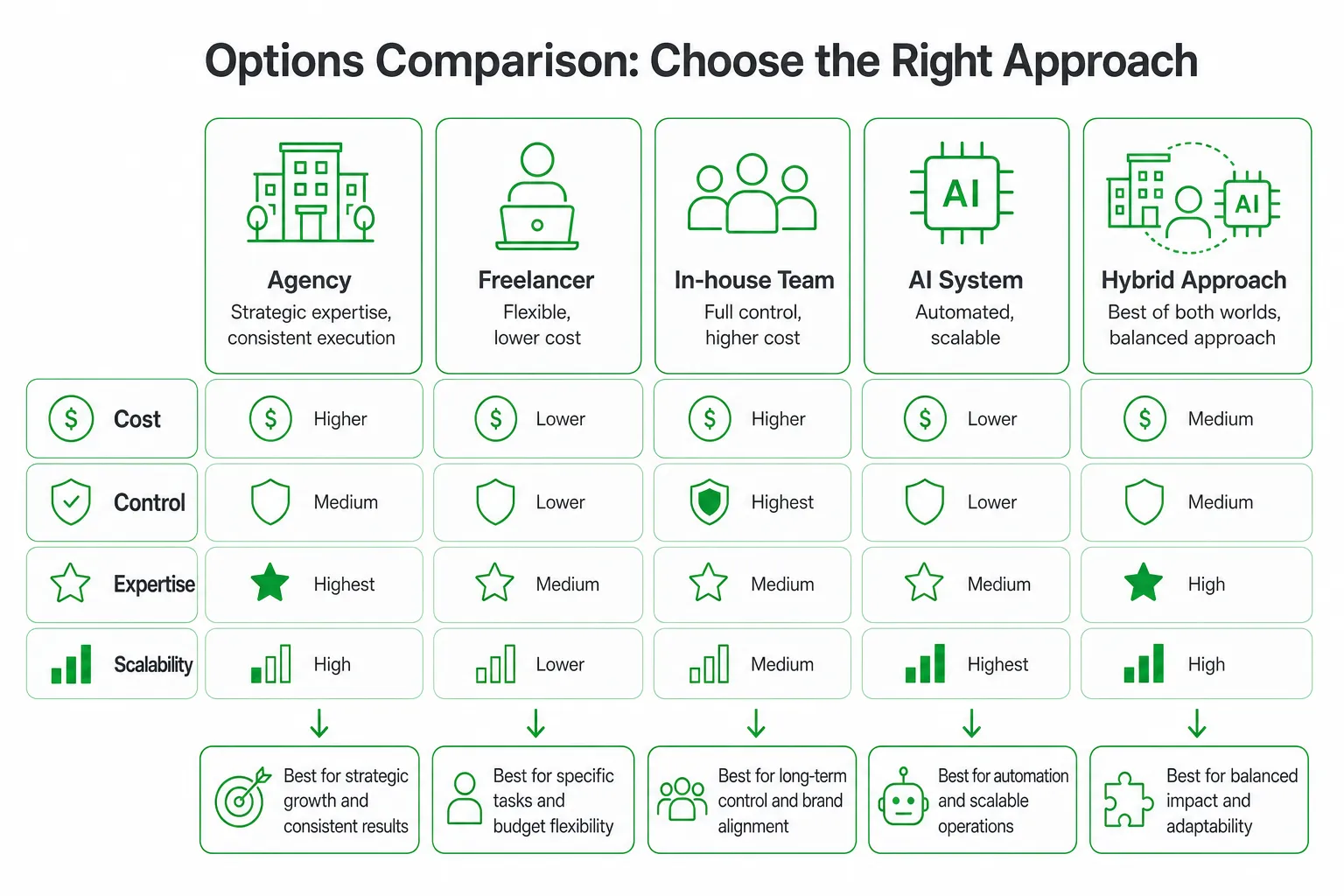
There is no universally best delivery model. Pick the option that matches your budget, required expertise, publishing speed, and willingness to manage the work.
| Option | Best fit | Trade-off |
|---|---|---|
| Specialist agency | You need coordinated strategy, SEO, content, and distribution. | Higher cost and potentially slower approvals. |
| Freelancer | You need a focused project or a specific specialist. | Less operational coverage and strategic continuity. |
| In-house team | You need deep product immersion and daily collaboration. | Hiring, management, and broader coverage take time. |
| AI-assisted system | You need repeatable research, drafting, publishing, and outreach with human approval. | Requires clear brand context, review standards, and thoughtful automation. |
| Hybrid model | You need expert strategy combined with efficient execution. | Requires clear ownership between people and systems. |
A specialist agency offers strategic depth and coordinated execution. A freelancer can work well for a focused content cluster, technical article, or design project. An internal team provides strong product context but requires hiring and management.
An AI-assisted system is often a strong fit for founders and small teams with repeatable content and outreach needs. It works especially well when you want automation to handle research, drafts, repurposing, lead scoring, and publishing while you approve customer-facing communication.
The Missing Layer: AI Search, Reddit, and Buyer Validation
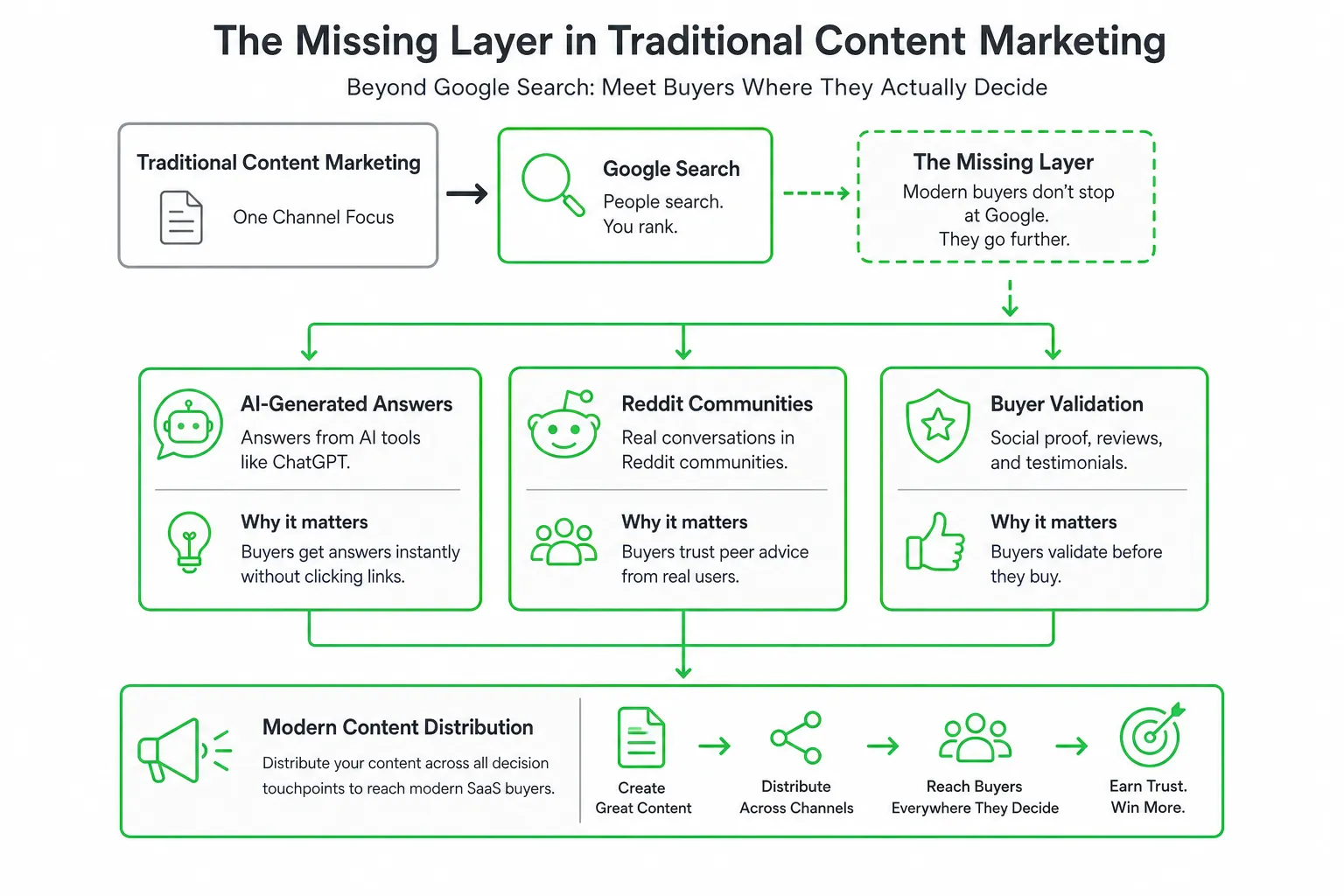
A modern SaaS content partner must optimize for both traditional search and AI-generated answers. Among B2B software buyers, 51% now start software research with an AI chatbot more often than Google, while 80% still use Google somewhere in the buying journey, according to G2’s The Answer Economy: 2026 AI Search Insight Report.
That changes what “content visibility” means. You need clear product information, useful comparisons, expert explanations, original examples, third-party references, and consistent answers across the web. An agency that only counts keyword rankings may miss where buyers form their shortlist.
Reddit deserves a deliberate role because buyers use real conversations to validate software, uncover alternatives, and pressure-test vendor claims. Reddit and SurveyMonkey found that 81% of business decision-makers said Reddit conversations help them discover products or services they had not originally considered, while 76% said recommendations in those conversations made them more likely to purchase, according to Reddit and SurveyMonkey’s The Hidden B2B Journey Report.
Use Reddit correctly. Find relevant questions, understand the conversation, contribute a useful answer, and disclose your connection when appropriate. Do not spray identical promotional messages across communities.
Prefer an automated content-and-outreach system over a conventional agency when your opportunity is concentrated in high-intent questions, Reddit discovery, rapid publishing, and personalized follow-up. This model also suits you when you want to review every message instead of delegating the entire brand relationship.
A Practical SaaS Content Marketing Workflow
Use this workflow to turn scattered content activity into a repeatable growth system.
- Start with research. Interview customers, analyze sales and support questions, review search intent, and find relevant community discussions. Map each problem to awareness, evaluation, activation, or retention.
- Build useful content clusters. Create foundational guides, alternatives and comparison pages, integration pages, implementation resources, templates, and proof-led customer content.
- Write for people and AI retrieval. Answer the query directly. Use descriptive headings, original insights, concrete examples, trustworthy citations, and clear internal links to related pages.
- Distribute the core asset. Repurpose it into social posts, emails, community replies, sales resources, website chat prompts, and follow-up messages where relevant.
- Learn from qualified conversations. Review which topics create useful replies, product questions, demos, signups, and assisted conversions. Use those signals to choose the next content priorities.
This workflow keeps content connected to buyer behavior. It also gives you a practical way to compare an agency’s promises with its actual process.
How to Vet an Agency Before You Sign
Do not commit to a broad retainer before you see how the partner thinks. Start with a focused discovery project or pilot around one audience, problem, or content cluster.
Request a sample 90-day plan. It should show priorities, deliverables, owners, dependencies, distribution channels, approval points, and the business outcome each activity supports.
Ask for relevant examples that include the original brief, strategic reasoning, published work, traffic or pipeline context, and what changed after the engagement. A list of links is not enough.
Use these questions during the evaluation:
- How will you learn our product and customer language?
- How do you validate technical claims?
- Who reviews content for accuracy and brand voice?
- How will you find high-intent conversations outside Google?
- What happens after an article is published?
- Which metrics will you report, and which will you ignore?
- Who owns the accounts, content, data, and customer relationships?
Watch for guaranteed rankings, generic AI copy without expert review, vanity-metric reporting, unclear ownership, no distribution plan, and an inability to explain how content becomes pipeline.
How OneUp Today Fits and What to Do Next
OneUp Today is designed for SaaS founders, indie hackers, and small teams that need an AI marketing team across Reddit lead generation, SEO, blog production, social publishing, outreach, lead scoring, and website chat.
You approve every send. That lets the system accelerate research, drafting, personalized replies, publishing, and follow-up without removing control over your voice or customer relationships.
Choose an automated system when you need always-on execution across Reddit, SEO, social, outreach, and chat. Choose a conventional agency when you need hands-on strategic consulting, extensive original research, or a large bespoke production team. Choose a hybrid when you want expert input for positioning and technical thought leadership while automation handles repeatable execution.
Start by defining your ideal customer profile and highest-value problem. Then choose one channel, one content cluster, or one conversation workflow for a focused pilot. Review the quality of the outputs and buyer responses before expanding.
Bottom line: Pick the partner that can connect content to how SaaS buyers actually research, validate, and purchase. Your next step is simple: request a 90-day plan or run a focused pilot, then judge the work by useful buyer conversations and conversion progress, not publishing volume alone.
Frequently asked questions
How much does a SaaS content marketing agency typically cost?
Yes, costs vary widely, but most agencies charge $5,000 to $20,000 per month for retainer-based services. This range depends on the scope of work, including strategy, content production, and distribution, with higher fees for specialized expertise in complex SaaS markets.
Can a SaaS content marketing agency help with AI-generated search results?
Yes, a capable agency optimizes content for AI-driven search by structuring data, using clear headings, and answering direct questions. This improves visibility in Google's AI Overviews and other generative answer systems, which increasingly influence buyer discovery.
What metrics should I track to measure a SaaS content agency's success?
Track qualified traffic, assisted conversions, and pipeline influence rather than just page views. A good agency reports on metrics like search ranking improvements, content engagement rates, and how content supports sales conversations, connecting activity to revenue outcomes.
How long does it take to see results from a SaaS content marketing agency?
Results typically appear within 3 to 6 months for search-driven content, as SEO requires time to index and rank. Faster wins may come from distribution on social channels or email, but sustained pipeline impact often takes 6 to 12 months of consistent execution.
Sources
- G2, The Answer Economy: 2026 AI Search Insight Report
- G2, The Answer Economy: 2026 AI Search Insight Report
- G2, The Answer Economy: 2026 AI Search Insight Report
- Reddit x SurveyMonkey, The Hidden B2B Journey Report
- Reddit x SurveyMonkey, The Hidden B2B Journey Report
- Reddit x SurveyMonkey, The Hidden B2B Journey Report