
Marketing Fundamentals for Indie Hackers & Solopreneurs
What Are Marketing Fundamentals?
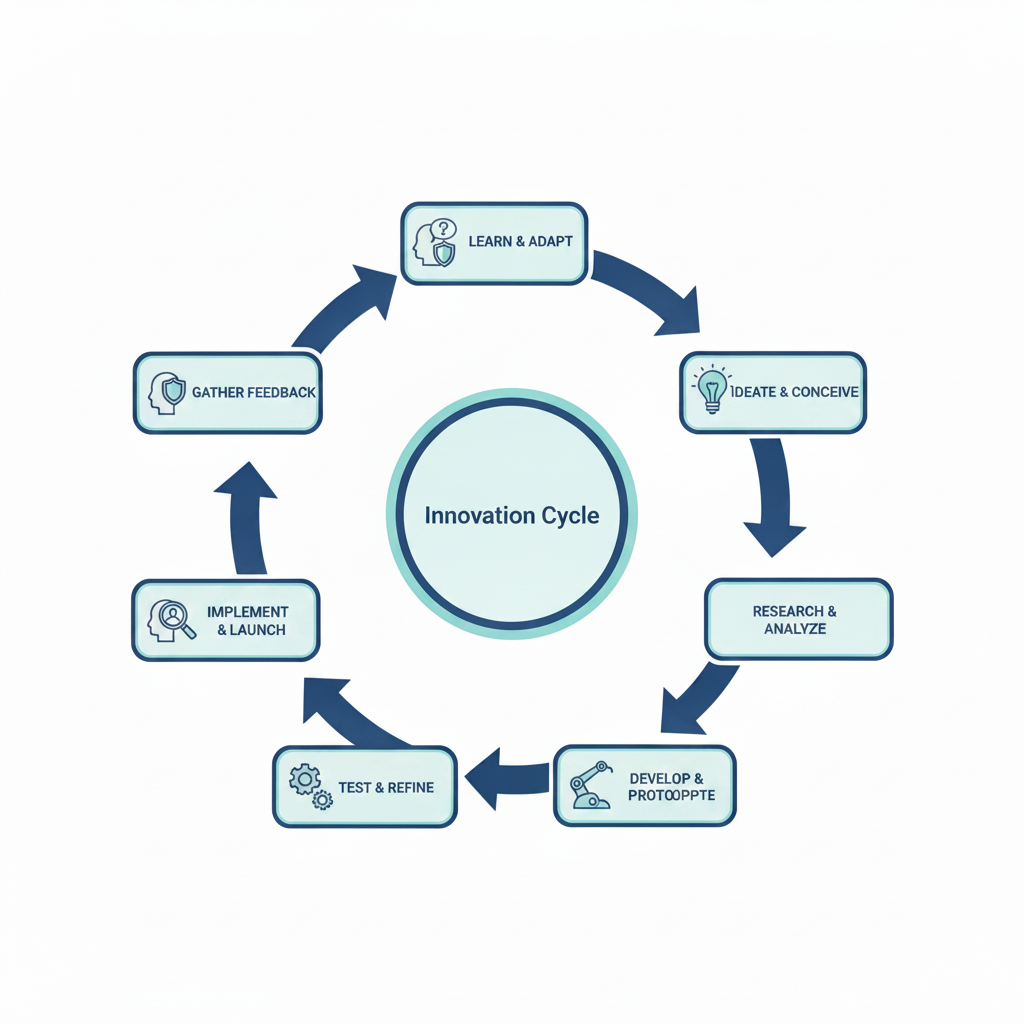
Marketing fundamentals are the core principles that help you attract, engage, and retain customers. They include understanding your audience, creating a clear value proposition, choosing the right channels, publishing useful content, and measuring what works.
For solopreneurs and indie hackers, these basics matter before you add automation or paid ads. Without a solid foundation, you can waste time and money on campaigns that do not resonate.
Think of marketing as a system. Your audience tells you who to reach. Your value proposition explains why they should care. Your channels determine where to find them. Your metrics show what to improve.
AI can make this system faster. It cannot replace the fundamentals. Use it to research, draft, organize, and analyze while you keep control of the strategy and final message.
Key takeaways
- Start with audience problems, not product features.
- Write a value proposition that names the customer, problem, and outcome.
- Choose one or two channels where your buyers already ask questions.
- Use AI to speed up research and content production, not to replace judgment.
- Track conversations, conversions, and customer acquisition cost instead of vanity metrics.
Know Your Audience: The Foundation of All Marketing
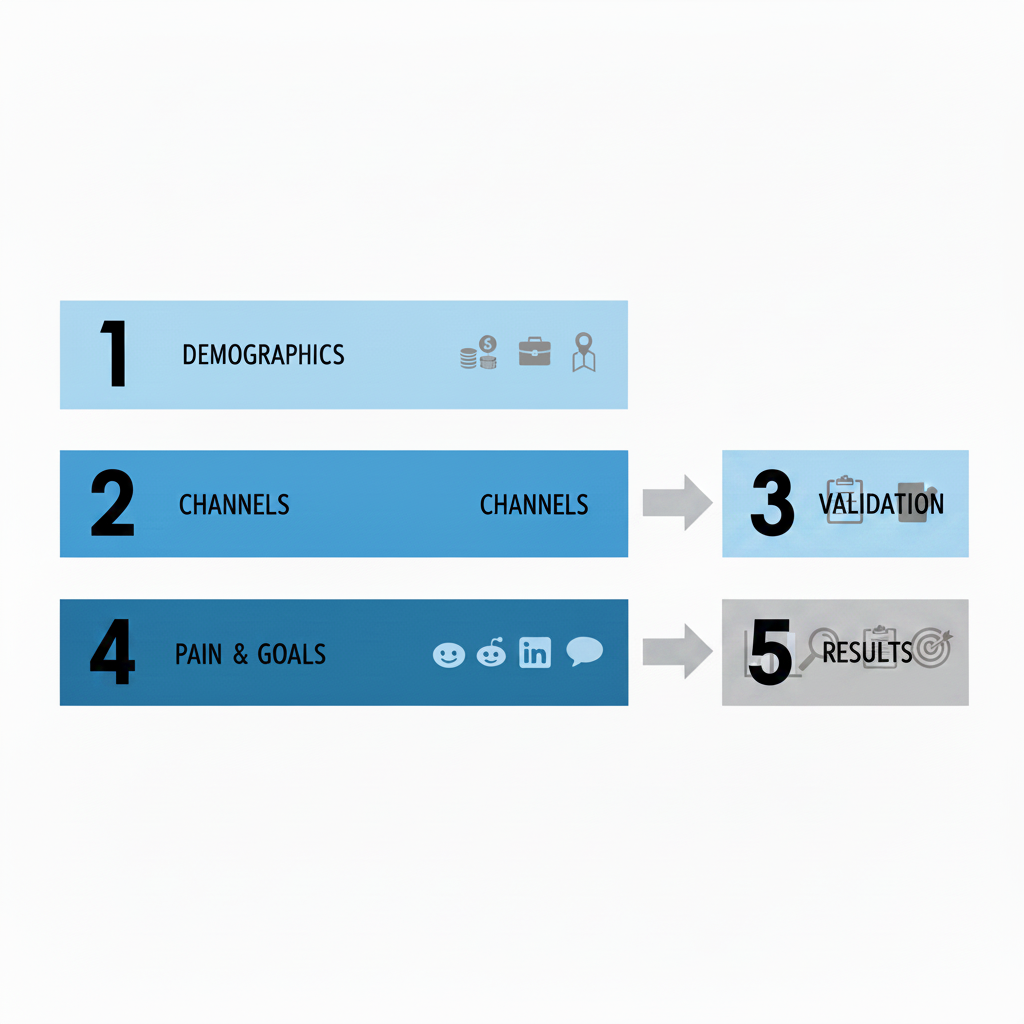
To market effectively, you need to know exactly who you are marketing to. Go beyond age, location, and job title. Learn what your audience is trying to do, what keeps slowing them down, and how they describe the problem in their own words.
Build a practical buyer persona
A buyer persona is a working profile of your ideal customer. It should be based on real conversations and observed behavior, not guesses.
- Role: Are they a solo founder, developer, marketer, agency owner, or small-team operator?
- Situation: What are they building? What tools do they already use?
- Pain points: What costs them time, money, or momentum?
- Goals: What result do they want in the next 30, 90, or 365 days?
- Buying triggers: What event makes them search for a solution now?
- Objections: What might stop them from trying or buying your product?
- Preferred channels: Where do they ask questions, compare products, and seek recommendations?
For an indie hacker audience, the persona might be a technical founder who has a working SaaS product but lacks a repeatable way to find high-intent prospects. A solopreneur persona might care more about reducing manual work and getting qualified conversations without hiring a team.
Use direct research before AI research
Start with the raw material. Read customer reviews, support tickets, sales calls, public questions, and competitor discussions. Save the exact phrases people use to describe their problems.
- Surveys: Ask five to ten focused questions through your email list or customer base.
- Direct conversations: Interview potential customers and ask what they tried before.
- Social listening: Review discussions on Reddit, LinkedIn, Hacker News, and niche forums.
- Competitor analysis: Study competitor reviews and comment sections to find unmet needs.
- Search research: Look for recurring questions and the language used in search results.
For indie hackers, Reddit is especially useful for audience research. Subreddits such as r/SaaS, r/Entrepreneur, and r/Startups contain questions about growth, pricing, distribution, and product decisions. Read for a week before posting. Note repeated problems, common objections, and the recommendations people trust.
Use AI tools to organize audience insight
AI tools can help you process research faster. Tools such as SparkToro can surface websites, podcasts, social accounts, and communities that an audience follows. Similarweb can help you compare traffic sources and audience interests for websites where available.
Use these tools to form hypotheses, then validate them with real conversations. For example, if research suggests your audience spends time in a particular subreddit, read recent threads and check whether people discuss the problem you solve.
- Collect 20 to 50 real comments, reviews, or interview notes.
- Remove private information and group the material by problem, goal, objection, and desired outcome.
- Ask an AI tool to identify recurring themes and the words people use.
- Check the themes against the original conversations.
- Turn the strongest theme into a content topic, landing page message, or outreach angle.
Once you understand your audience, tailor your content, posts, and offers to one specific problem at a time. Generic marketing fails because it tries to speak to everyone. Specific marketing earns attention because it sounds familiar.
Craft a Value Proposition That Sticks
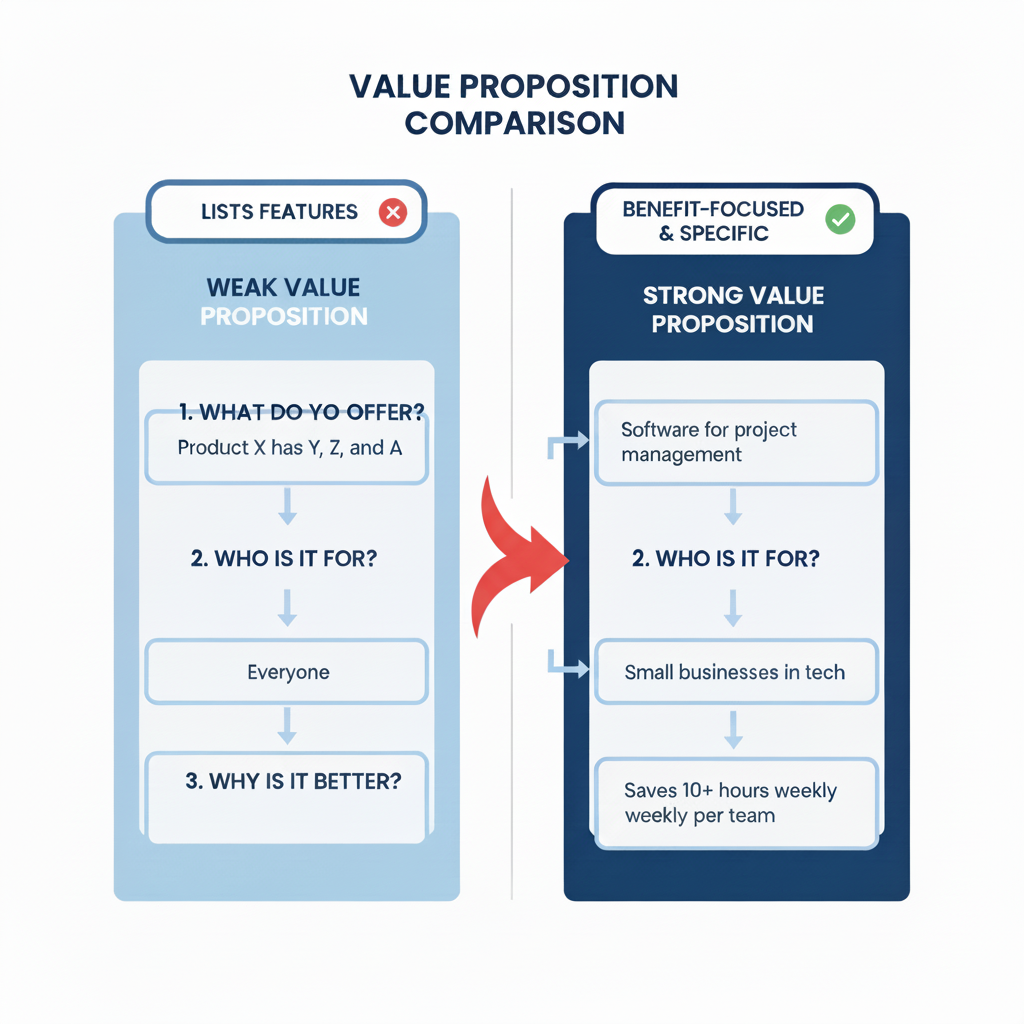
Your value proposition is a clear statement that explains how your product improves a situation for a specific customer. It answers three questions: What do you offer? Who is it for? Why should they choose it over the alternatives?
A strong value proposition is simple, benefit-focused, and specific. Avoid leading with a feature list. Lead with the result your customer wants.
- Weak: “We offer AI-powered marketing automation.”
- Stronger: “Find high-intent conversations and draft personalized outreach without spending your day searching for prospects.”
The second version gives the reader a customer, a problem, and an outcome. It also creates a clear reason to continue reading.
Write your value proposition in three steps
- List the main features of your product.
- Ask “so what?” after each feature to uncover the customer benefit.
- Combine the audience, problem, and outcome into one clear sentence.
Test your message in real conversations. You can post a helpful explanation in a relevant Reddit discussion, ask potential customers for feedback, or compare two versions on your landing page. Look for understanding and follow-up questions, not empty praise.
Place your value proposition on your homepage, social profiles, email signature, product directory profile, and the first section of your marketing content. Your reader should understand what you do within a few seconds.
Choose the Right Marketing Channels
Not all marketing channels are equal for solopreneurs. You have limited time, so choose channels where your audience already has a problem, asks for recommendations, or looks for solutions.
Map each persona to its behavior:
- Technical founders: Reddit, Hacker News, GitHub, technical newsletters, and product communities.
- B2B professionals: LinkedIn, niche industry groups, podcasts, and professional newsletters.
- Creative entrepreneurs: Instagram, TikTok, Pinterest, and creator communities.
- Local businesses: Google Business Profile, local groups, email, and referral networks.
For many indie hackers, Reddit and LinkedIn are useful starting points because they support direct conversations and educational content. Product directories can also help when buyers are actively comparing tools.
Score a channel before you commit
Evaluate each channel against four questions:
- Does your audience spend time there?
- Do people ask questions related to your product?
- Can you contribute something useful without a large budget?
- Can you measure visits, conversations, sign-ups, or sales?
Choose one primary channel and one supporting channel for the first 30 to 90 days. Master the workflow before expanding. Consistency on the right channel beats sporadic activity on five platforms.
AI tools for marketing channels
AI can help you discover where to focus and reduce the manual work of creating channel-specific content. Use audience research tools to identify communities, then use writing tools to adapt one useful idea for each platform.
- Audience discovery: Use SparkToro, Similarweb, search data, and competitor research to find the websites, communities, and creators your audience already follows.
- Reddit research: Use search and analysis tools to identify recurring questions, relevant subreddits, and discussions with clear buying intent.
- LinkedIn research: Review posts from your target buyers, note recurring themes, and identify the formats that generate thoughtful comments.
- Content drafting: Ask an AI writing tool to create a short Reddit answer, a LinkedIn post, or an email from the same source insight.
- Personalized outreach: Use AI to suggest a relevant opening based on a public problem or post. Review every message before sending it.
Do not copy the same post everywhere. A detailed Reddit answer should become a concise LinkedIn insight, not a duplicate. Keep the idea consistent while adapting the format, tone, and community expectations.
Marketing Channels for Indie Hackers and Solopreneurs in 2026
In 2026, the best channel is still the one where your target customer shows intent. Tools change quickly, but the behavior to watch remains consistent: people ask questions, compare options, and describe problems they want to solve.
Reddit: Find questions with buying intent
Start with communities such as r/SaaS, r/Entrepreneur, r/Startups, and subreddits specific to your customer's industry. Search for phrases related to the problem you solve, then read the full discussion before responding.
Lead with a useful answer. Explain what you would try, share a relevant lesson, or provide a checklist. Mention your product only when it directly fits the question and the community rules allow it.
- Track: relevant discussions found, helpful replies published, profile visits, referral visits, sign-ups, and customers.
- Review: which topics create meaningful replies and which produce qualified conversations.
- Improve: your opening, examples, and call to action based on the questions people ask next.
LinkedIn: Build trust in a professional niche
Follow the people you want to serve. Study their posts, comments, and recurring challenges. Publish practical lessons, short case studies, product-building notes, and clear opinions based on your experience.
AI can help you turn customer research into several post drafts. You should still add your own examples and review every claim. Genuine comments are often more valuable than posting more frequently, so spend time responding to relevant conversations.
- Track: profile visits, meaningful comments, direct conversations, qualified clicks, sign-ups, and customers.
- Review: which topics attract your target buyers rather than general engagement.
- Improve: your positioning, proof, and call to action as you learn what prompts useful conversations.
AI tool directories: Capture active discovery
Product directories and AI tool directories can help buyers discover solutions while they are comparing options. Create a clear listing with your audience, problem, use case, differentiator, and proof.
Send directory traffic to a focused landing page. Make the next action obvious, such as starting a trial, booking a call, or joining a waitlist.
- Track: listing views, referral visits, activation events, sign-ups, and customers.
- Review: which directory pages and descriptions bring qualified visitors.
- Improve: screenshots, categories, keywords, and your first sentence when the traffic is not converting.
A practical example
Imagine a solopreneur selling a tool that helps SaaS founders find warm prospects. They begin by reading r/SaaS and LinkedIn discussions about inconsistent lead flow. They collect the language founders use, publish helpful answers, and turn the strongest insight into a short LinkedIn post and a directory listing.
An AI assistant helps group the conversations, draft platform-specific versions, and suggest follow-up questions. The solopreneur approves each post and message, replies personally, and tracks which channel produces qualified conversations and customers. That is a repeatable workflow, not blind automation.
Do not compare channels using a universal engagement rate or conversion benchmark. Your audience, offer, price, and call to action affect the result. Establish a baseline during the first month, then compare each channel against its own previous performance.
Content Marketing: Educate and Engage
Content marketing means creating useful material that attracts and retains a clearly defined audience. For solopreneurs, it is one of the most effective ways to build trust without a large advertising budget.
Start with your audience's questions and pain points. For every piece of content, ask: “Does this help my ideal customer solve a problem or reach a goal?”
- Blog posts: Write in-depth guides, tutorials, comparisons, and case studies.
- Videos: Share product demos, behind-the-scenes lessons, and answers to common questions.
- Social posts: Publish tips, insights, experiments, and stories.
- Newsletters: Send regular lessons, product updates, and curated resources.
- Community replies: Answer questions on Reddit, LinkedIn, and niche forums.
Storytelling builds authenticity. Share the struggles, decisions, wins, and lessons from building your business. People connect with specific experiences more than polished sales language.
Repurpose one strong idea across channels. Turn a blog post into a Reddit answer, a LinkedIn post, a newsletter section, and a short video outline. Adapt each version to the audience instead of publishing identical text everywhere.
AI can speed up outlining, editing, summarizing, and repurposing. Keep your own examples, opinions, and customer evidence in the final version. Those details are what make the content useful and credible.
AI Tools for Marketing Fundamentals: Automate and Scale
AI tools can help solopreneurs complete research and content tasks that would otherwise take hours. The best use of AI is narrow and supervised: find patterns, prepare drafts, and surface opportunities while you make the final decision.
Useful tool categories
- Audience research: SparkToro and Similarweb can help you investigate audience interests, websites, traffic sources, and related channels.
- Conversation research: Reddit search, LinkedIn search, review sites, and community analytics reveal the language and problems of your market.
- Writing and repurposing: Generative AI tools can help turn notes into outlines, posts, email drafts, and content variations.
- Workflow automation: Automation platforms can move approved information between your research, content, CRM, and reporting tools.
- Marketing execution: OneUp Today helps SaaS founders, indie hackers, and small teams find high-intent Reddit leads, draft personalized DMs, emails, and replies in their voice, publish content across platforms, and support SEO and blog workflows.
OneUp Today keeps you in control of outreach. You approve every send, which helps you protect your voice and avoid sending messages that feel generic. Its strongest use case is turning active conversations into organized, reviewable opportunities.
How AI selects a channel
Channel selection should come from audience behavior data. If your research shows repeated problem questions in Reddit communities, prioritize helpful Reddit participation. If your buyers discuss the problem through professional posts and groups, prioritize LinkedIn. If they compare tools through directories, improve your listings and landing pages.
Use a simple decision rule: choose the channel with the strongest combination of audience presence, problem relevance, contribution opportunity, and measurable next steps.
Integrate AI into your marketing workflow
- Define the customer: Write down the audience, problem, desired outcome, buying trigger, and likely objections.
- Collect evidence: Save customer comments, reviews, interviews, support questions, and competitor feedback.
- Analyze patterns: Use AI to group the evidence, identify repeated language, and suggest audience segments.
- Validate the findings: Return to the original sources and check whether the patterns are real.
- Choose a channel: Select one primary channel based on where the audience asks questions or seeks recommendations.
- Create a content system: Turn one validated insight into a useful post, article, email, or reply.
- Personalize the draft: Add the person's context, relevant examples, and a helpful next step.
- Approve before publishing: Check accuracy, tone, privacy, community rules, and whether the message actually helps.
- Measure the outcome: Track qualified conversations, visits, sign-ups, activations, and customers.
- Improve the system: Keep what works, remove low-value steps, and test one change at a time.
Measure What Matters: Key Metrics for Beginners
Data is your compass. You do not need a complicated dashboard. You need a small set of metrics that connects marketing activity to business outcomes.
- Engagement rate: Comments, replies, shares, or other meaningful actions compared with reach or impressions. Use it to assess resonance.
- Conversion rate: The percentage of visitors or recipients who take a desired action, such as signing up or booking a call.
- Customer acquisition cost: Total marketing and sales spend divided by new customers. Include meaningful tool and contractor costs when comparing channels.
- Qualified conversations: The number of conversations with people who match your audience and have a relevant problem.
- Website traffic: Track not only visitor volume, but also source, engagement, activation, and conversion.
- Email open and click rates: Use these as directional indicators alongside replies, visits, and conversions.
- Activation and retention: Check whether new users reach the product's first meaningful outcome and continue using it.
Use Google Analytics or another analytics platform to track website behavior and conversions. Review platform analytics on Reddit, LinkedIn, and other channels. Use tagged links where possible so you can connect visits to their source.
Avoid treating follower counts, impressions, and likes as business results. They can provide context, but they do not prove that marketing is working.
Set a review cadence
- Weekly: Review recent posts, replies, qualified conversations, and traffic.
- Monthly: Compare channel conversion, activation, retention, and acquisition cost.
- Quarterly: Revisit your audience, value proposition, channel mix, and content strategy.
Look for trends rather than isolated results. If engagement falls, test a new topic or format. If qualified conversations rise but sign-ups do not, inspect your landing page, offer, and follow-up process.
Automate to Scale Without Losing Authenticity
Your time is your most limited resource. Automation can help you scale without sacrificing quality, but use it for repetitive tasks rather than human judgment.
Good candidates include scheduling content, organizing research, preparing drafts, summarizing analytics, and creating follow-up reminders. Community replies, sensitive conversations, and final outreach decisions deserve your attention.
OneUp Today is built for this workflow. It can identify high-intent Reddit opportunities, draft personalized outreach and replies, publish content across multiple platforms, and support SEO and blog automation. You approve each send, so automation remains controlled.
Start with one task, such as drafting weekly content from your research notes. Check quality for a month before adding another task. The goal is to create more time for strategy and genuine conversations.
Iterate and Improve: The Solopreneur's Edge
Marketing is not a set-it-and-forget-it activity. Review your efforts, make a small change, and observe the result. Solopreneurs can often move faster than larger companies because fewer approvals stand between insight and action.
A/B test one element at a time:
- Headlines: Which version earns more qualified clicks?
- Calls to action: Does “Start a free trial” outperform “Learn more” for your audience?
- Content formats: Do practical checklists create more conversations than opinion posts?
- Posting times: When is your audience most likely to respond?
- Offers: Does a demo, trial, guide, or consultation create better activation?
Document what works and what does not. Over time, you will build a marketing playbook for your specific audience and niche.
If a Reddit community responds well to a topic, create more useful content around that problem. If a LinkedIn approach produces no qualified conversations after a fair test, change the angle or move your time elsewhere.
Marketing fundamentals are not a one-time lesson. They are an ongoing discipline. Master the basics, add AI where it removes repetitive work, and keep improving from real customer behavior.
Frequently asked questions
What are marketing fundamentals?
Marketing fundamentals are the core principles that help businesses attract, engage, convert, and retain customers. They include audience research, value proposition, channel selection, useful content, measurement, and continuous improvement.
Why are marketing fundamentals important for solopreneurs and indie hackers?
They help you focus limited time and money on the right customers, message, and channels. A strong foundation also makes automation more effective because the system knows who to reach and what to say.
How can you reach indie hackers and solopreneurs with AI tools?
Research where they ask questions, such as Reddit, LinkedIn, Hacker News, niche communities, and product directories. Use AI to organize audience research, identify recurring problems, draft personalized content, and prioritize channels. Review every message before publishing or sending it.
What are the best marketing channels for solopreneurs in 2026?
The best channel depends on your audience and offer. Reddit can work well for problem-focused conversations, LinkedIn for professional trust and niche expertise, and AI tool directories for active product discovery. Choose based on audience behavior, not general popularity.
What is a value proposition?
A value proposition is a clear statement explaining what you offer, who it is for, and why it is valuable. A strong version focuses on the customer's problem and desired outcome instead of listing features.
How do you craft a strong value proposition?
List your main features, ask “so what?” to uncover the benefit of each one, and combine the audience, problem, and outcome into one specific sentence. Test it in real conversations and refine it based on the questions people ask.
Which AI tools help with audience research?
SparkToro and Similarweb can help you investigate audience interests, websites, traffic sources, and related channels. Combine those tools with direct interviews, customer reviews, and community research so your conclusions reflect real behavior.
How do you measure AI-driven marketing?
Track qualified conversations, referral traffic, sign-ups, activation, customers, retention, and customer acquisition cost. Also review engagement as a directional signal. The right metric is the one that helps you make a better channel, content, or offer decision.