
From GitHub Commit to Viral Post: Turning Your Changelog Into Content That Actually Gets Read
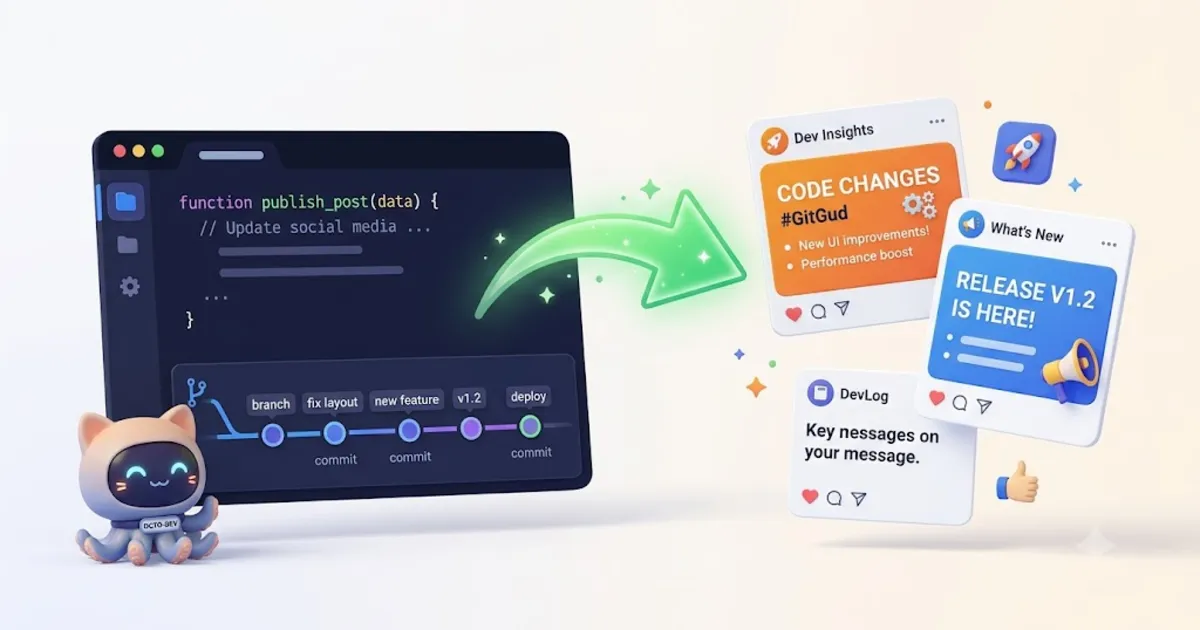
The Most Underused Content Asset in SaaS
Every technical founder ships code. Most of them treat their git history as a private artifact, occasionally writing a polished release note that no one reads. The founders who win on X, LinkedIn, and Reddit have realized something: their changelog is the highest-quality content engine they own. It just needs translation.
This guide is the practical version of that translation, the funnel we use to turn dry commit messages into platform-native posts that actually get engagement, customers, and sometimes hires.
Why Changelogs Make Such Good Content
Three reasons:
- They're proof. A commit message is undeniable evidence you built something. "Founder claims they shipped feature X" is marketing; "Here's the commit" is reality.
- They're frequent. Most active products ship multiple commits a day. Translated correctly, that's daily content forever.
- They tell a story by accident. The bug fix you shipped because a customer reported it is a story about caring. The refactor at 2am is a story about effort. The feature you killed is a story about discipline.
The job isn't to invent stories, it's to surface the ones already in your git log.
The Transformation Funnel, Commit to Post
Step 1, Strip the commit jargon (find the user-visible benefit)
Engineers write commit messages for engineers. To make them content, translate to user-visible benefit.
Commit: fix: race condition in bulk DM scheduler when scheduledAt < now()
User-visible benefit: "Bulk DMs you scheduled in the past now actually get sent immediately instead of getting stuck."
Engineer's story: "This bug had been quietly eating customer messages for weeks. We only found it when one customer's data showed half their scheduled DMs vanishing."
Step 2, Add the before/after frame
Posts about "we shipped feature X" perform poorly. Posts about "we replaced the broken thing with the working thing" perform well. Find the contrast.
- Before: scheduled DMs sometimes vanished without explanation.
- After: every scheduled DM is now logged and either sent immediately or queued.
- The lesson: every bug fix is a chance to be more transparent than the launch announcement was.
Step 3, Add stakes (what was hard, why it mattered)
Why did this matter enough to ship? What was hard about fixing it? What did you learn? Stakes are what make a post stop feeling like a release note and start feeling like a story.
Without stakes: "We fixed a scheduling bug."
With stakes: "For weeks we had a customer who said messages were vanishing. We assumed user error. They sent us a screen recording. They were right. Here's what we found, what we fixed, and the dashboard query we now run weekly to make sure it doesn't happen again."
Same fix. Different post. The second one earns trust.
Three Worked Examples
Example 1, A bug fix becomes an X thread
Source commit: fix: timezone handling in subreddit activity heatmap
X thread:
- Tweet 1: "A user emailed: 'your best-time-to-post is wrong for me, every time.' We checked. They were right. Here's what was actually happening."
- Tweet 2: Screenshot of the heatmap showing wrong peaks.
- Tweet 3: "We were storing timestamps in UTC and rendering in browser local, but the heatmap aggregator was bucketing in UTC. So a peak at 8pm Pacific looked like a peak at 4am for everyone."
- Tweet 4: Code diff showing the fix (3 lines).
- Tweet 5: "Lesson: 'use UTC everywhere' is not the same as 'aggregate in UTC.' Aggregations need to happen in user-local time."
- Tweet 6: "Shipping the fix now. Thanks @[user] for the email."
Example 2, A feature kill becomes a LinkedIn post
Source commit: revert: remove instagram bulk uploader (low usage, high support burden)
LinkedIn post:
We just deleted a feature 47 customers were using.
The Instagram bulk uploader had 12% adoption and accounted for 38% of our support tickets. The math wasn't even close.
The hard part: emailing those 47 customers individually. Not a templated "feature deprecation notice." Real emails explaining why and offering 3 months free as we shipped a better version.
34 of them replied. 6 churned. 28 told us specifically what they actually needed. We're building that instead.
Killing features feels like failure. It's not. It's the only way to keep the product honest.
Example 3, A refactor becomes a Reddit discussion post
Source commit: refactor: replace celery with custom job queue (~70% memory reduction)
Reddit post in r/SaaS:
Title: "Replaced Celery with a custom queue, cut memory 70%. Was it worth it?"
Body: 4 paragraphs of context. Why we considered it. What surprised us. What broke. Genuine question at the end: "Anyone else done this and regretted it?" No link to product. Mentions the product name once in passing.
This kind of post outperforms a launch announcement on Reddit by 5–10×, because it's a real engineering discussion, not marketing.
Cadence, Daily, Weekly, or Release-Driven?
Three cadences, three audiences:
- Daily commit posts on X: works for technical audiences and build-in-public founders. Low effort per post, high consistency. See build in public strategy.
- Weekly digest on LinkedIn: a roundup of "what we shipped this week." Higher polish, broader audience, fewer posts to maintain.
- Release-driven posts everywhere: a major feature → cross-platform announcement (X thread, LinkedIn post, Reddit discussion in relevant niche subs). See how to repurpose one piece of content into 8 native posts.
You don't have to pick one, daily commits on X for technical audience signal, weekly digests on LinkedIn for broader visibility, big-feature announcements when there's something to announce.
How to Automate the Boring 80%
The bottleneck isn't ideas, it's the manual work of translating commits to posts. The automatable parts:
- Reading your repo's recent commits and generating draft posts.
- Filtering noise (auto-dependency-bumps, version bumps, formatter runs) from real shipping.
- Adapting one source draft into platform-native versions.
- Scheduling across X, LinkedIn, and Reddit at platform-appropriate times.
OneUp Today's GitHub integration does exactly this, connect your repo, every meaningful commit becomes a draft post in your voice, you approve and publish. See how the GitHub-to-content pipeline works and why engineering output makes the best marketing input.
What Not to Post
- Sensitive bug fixes that haven't been deployed yet (gives attackers a window).
- Customer-specific data, ever, in any form.
- Internal team conflict or hiring drama.
- Roadmap details you don't want competitors to see.
- Anything that would embarrass an employee.
The default is openness, but the line between "transparent" and "reckless" is real. If a commit message contains a customer's name or a security-sensitive detail, do not post it.
The Bottom Line
Your git history is the most authentic, frequently-updated, easily-searchable content asset your company will ever have. The founders who realize this two years before everyone else have a structural advantage on social that's nearly impossible to fake, because the content can't be invented; it has to come from actually shipping.
Ship the work. Tell the story. Repeat daily for two years. That's the entire playbook.